Soviet Space Timeline
The complete chronological record of the Soviet space program, 1957 - 1991. 32 milestone events organized into 5 eras, with 22 verified Soviet firsts.
Early Achievements
The dawn of the Space Age. From Sputnik to Yuri Gagarin, the USSR set the pace and shocked the world.
- October 4, 1957First
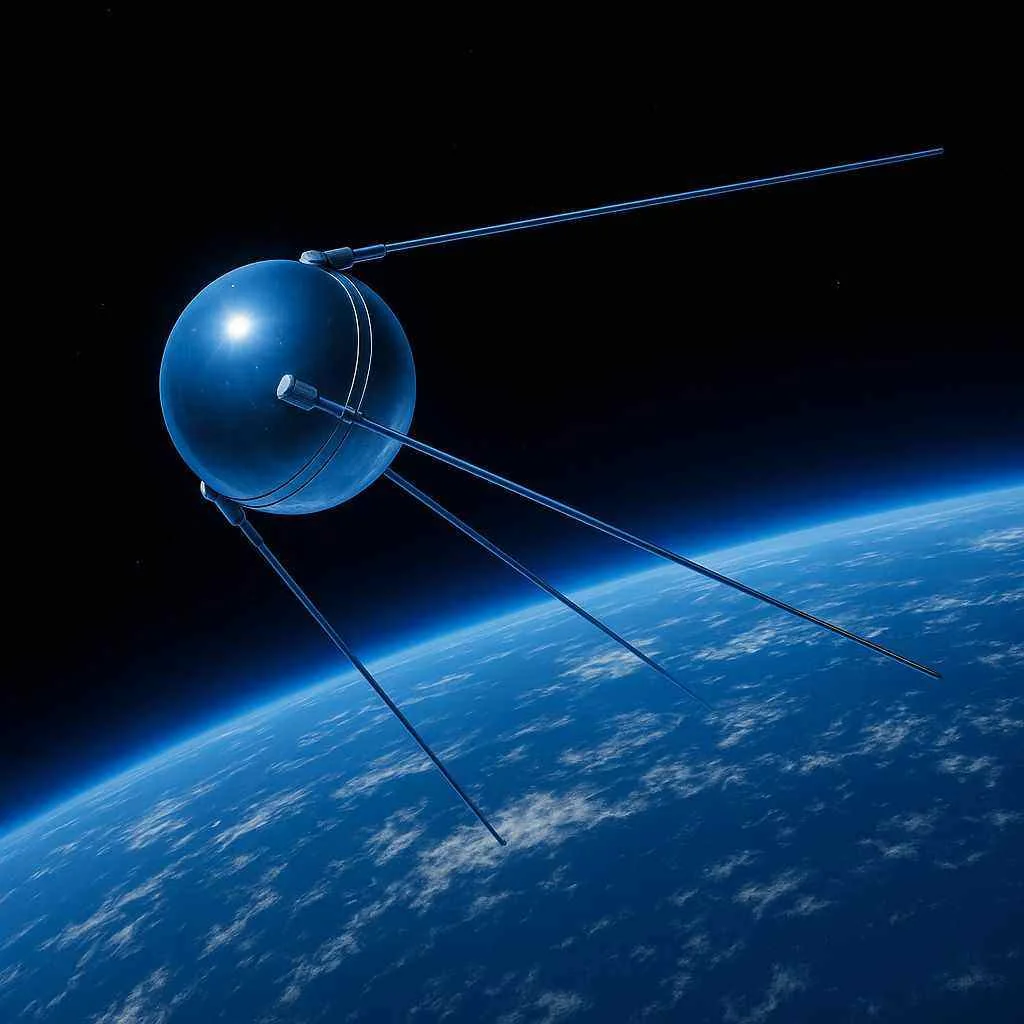
Sputnik 1 launch
The world's first artificial satellite is launched aboard an R-7 rocket from Baikonur, opening the Space Age and triggering the Space Race.
Satellite - November 3, 1957First
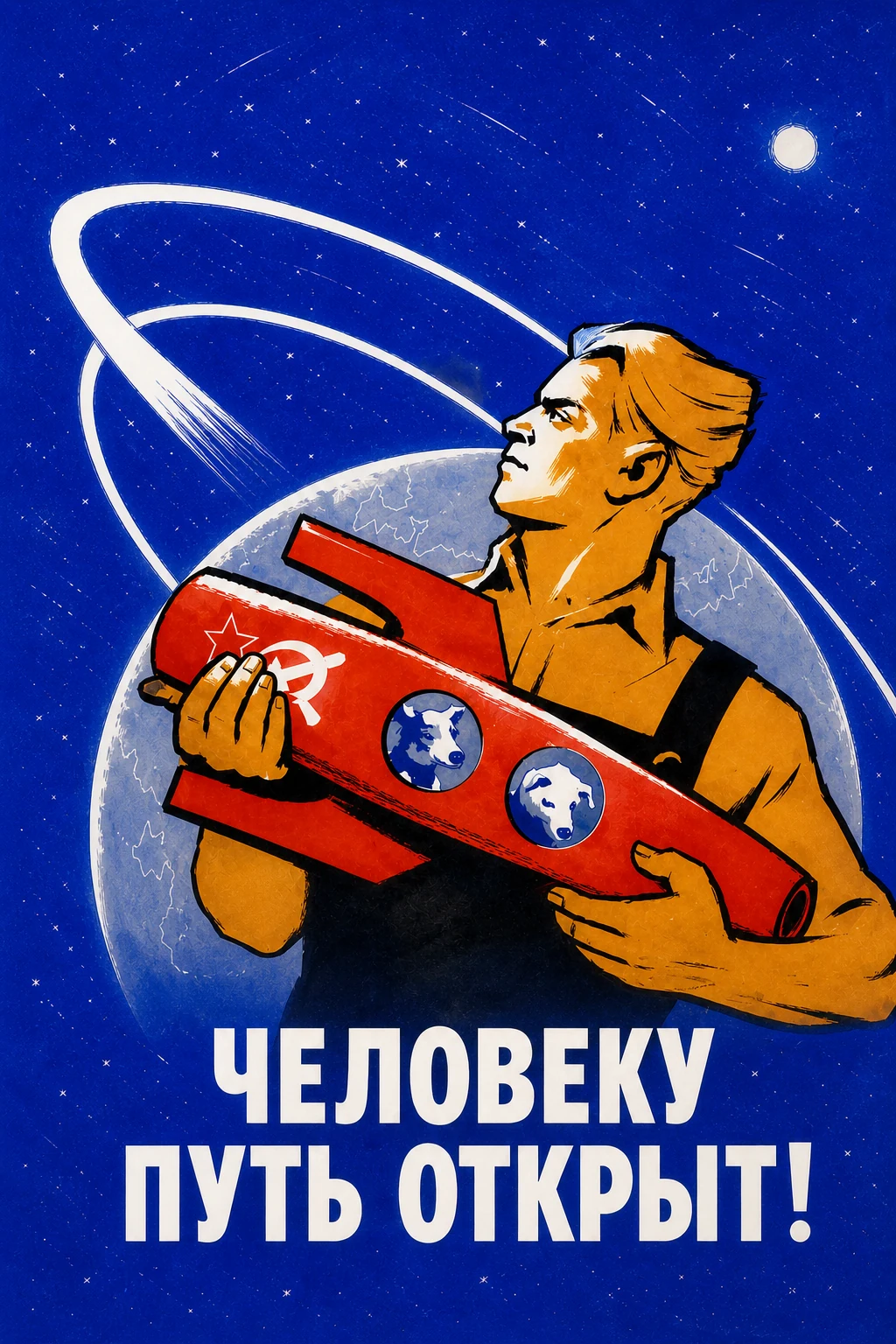
Sputnik 2 carries Laika to orbit
Sputnik 2 puts the first living animal into orbit - a Moscow stray dog named Laika - though she did not survive the mission.
Satellite - January 2, 1959First
Luna 1 - first to reach the Moon's vicinity
Luna 1 becomes the first human-made object to escape Earth's gravity and pass close to the Moon, missing the surface by about 6,000 km.
Lunar mission - September 13, 1959First
Luna 2 - first impact on the Moon
Luna 2 deliberately crashes into the lunar surface near Mare Imbrium, becoming the first human-made object to reach another world.
Lunar mission - October 7, 1959First
Luna 3 photographs the Moon's far side
Luna 3 returns the first images of the far side of the Moon, revealing terrain no human had ever seen.
Lunar mission - August 19, 1960First
Belka and Strelka return alive from orbit
Korabl-Sputnik 2 returns two dogs - Belka and Strelka - safely from orbit, the first living beings to make the trip and survive.
Satellite - April 12, 1961First
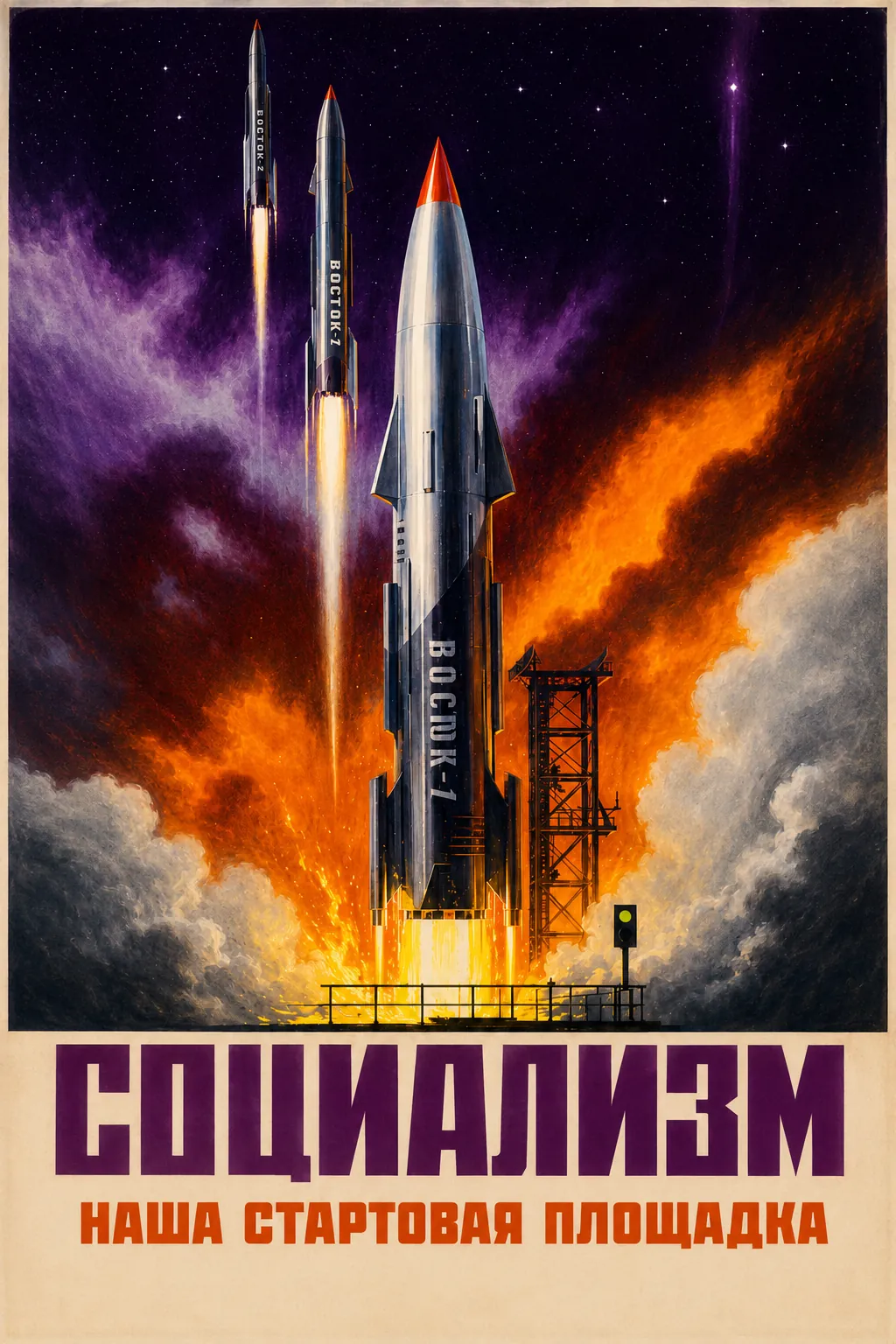
Yuri Gagarin becomes the first human in space
Vostok 1 completes one orbit of Earth in 108 minutes, with cosmonaut Yuri Gagarin aboard. The single most-recognized achievement of the program.
Crewed flight
Race Heats Up
Spacewalks, the first woman in orbit, the first soft landing on the Moon, and the death of the Chief Designer. The Soviet lead at its apex.
- August 11, 1962First
Vostok 3 and Vostok 4 fly together
The first dual-spacecraft mission. Andriyan Nikolayev and Pavel Popovich come within five kilometers of each other in orbit.
Crewed flight - June 16, 1963First
Valentina Tereshkova - first woman in space
Vostok 6 carries Valentina Tereshkova, a former textile worker and amateur parachutist, on a three-day, 48-orbit solo mission.
Crewed flight - October 12, 1964First
Voskhod 1 - first multi-crew spacecraft
Three cosmonauts share a single Voskhod capsule for one day, the first crewed mission with more than one person.
Crewed flight - March 18, 1965First
Alexei Leonov performs the first spacewalk
Tethered to Voskhod 2, Leonov spends about 12 minutes outside the spacecraft - nearly trapped when his pressurized suit ballooned.
Spacewalk - January 14, 1966
Sergei Korolev dies
The Chief Designer dies during routine surgery. His identity, kept secret his whole career, is finally revealed in his obituary.
Loss - February 3, 1966First
Luna 9 - first soft landing on the Moon
Luna 9 touches down in Oceanus Procellarum and transmits the first photographs taken from the lunar surface.
Lunar mission - March 1, 1966First
Venera 3 reaches Venus
Venera 3 becomes the first spacecraft to impact another planet, though it failed before returning useful surface data.
Planetary mission
Moon Race Era
The U.S. takes the lead. The Soviet N1 lunar rocket fails four times in a row. Apollo wins the Moon. The Soviet program pivots to space stations - and loses three cosmonauts in the process.
- April 24, 1967
Vladimir Komarov killed on Soyuz 1
Soyuz 1's parachute fails to deploy on reentry. Komarov becomes the first human to die during a spaceflight.
Loss - October 30, 1967First
First automated docking in orbit
The uncrewed Cosmos 186 and Cosmos 188 rendezvous and dock automatically - a capability the U.S. won't match until the 21st century.
Program milestone - January 16, 1969First
Soyuz 4 and Soyuz 5 - first crew transfer
Two cosmonauts spacewalk from Soyuz 5 to Soyuz 4 - the first time humans transferred between spacecraft in orbit.
Spacewalk - February 21, 1969
N1 maiden flight - failure
The first N1 super-heavy launcher fails 69 seconds after liftoff. Three more attempts will follow over the next three years, all unsuccessful.
Launch vehicle - July 3, 1969
Second N1 explodes on the pad
Just two weeks before Apollo 11, the second N1 falls back onto its launch pad in one of the largest non-nuclear explosions in history. The lunar program is effectively over.
Loss - November 17, 1970First
Lunokhod 1 - first robotic lunar rover
The remote-controlled Lunokhod 1 lands on the Moon and operates for 11 months, driving 10 kilometers across the surface.
Lunar mission - April 19, 1971First
Salyut 1 - first space station
The first space station of any nation reaches orbit. It hosts a single three-cosmonaut crew before being deorbited later that year.
Space station - June 30, 1971
Soyuz 11 crew killed on reentry
After 23 days aboard Salyut 1, a valve opens during separation and the cabin depressurizes. Dobrovolsky, Volkov, and Patsayev die before reentry. No fatalities in Soviet/Russian spaceflight since.
Loss
Space Station Era
After ceding the Moon, the USSR pivots to long-duration missions and orbital stations. Salyut becomes a series, Venera lands on Venus, and the program quietly outpaces the U.S. on time-in-orbit records.
- October 22, 1975First
Venera 9 - first photos from Venus surface
Venera 9 transmits the first black-and-white panoramas from another planet's surface, lasting 53 minutes in the 470°C heat.
Planetary mission - 1976
N1 program officially cancelled
Four years after the last attempted launch, the Soviet super-heavy lunar rocket is formally shelved. The remaining hardware is dismantled or repurposed.
Launch vehicle - September 1977
Salyut 6 - the long-duration station
Salyut 6 introduces two docking ports, allowing visiting Soyuz crews and Progress resupply freighters. It hosts long-duration crews for 4 years.
Space station - March 1, 1982First
Venera 13 lands on Venus
Venera 13 transmits the first color images from Venus's surface and analyzes soil chemistry before succumbing to the heat.
Planetary mission - July 25, 1984First
Svetlana Savitskaya - first woman to spacewalk
Aboard Salyut 7, Savitskaya performs a 3-hour, 35-minute EVA, becoming the first woman to walk in space.
Spacewalk
Final Years
Mir, Buran, glasnost, and the dissolution of the Soviet Union. The program transitions, opens to international cooperation, and finally becomes Roscosmos.
- February 20, 1986First
Mir core module launched
The first modular space station begins assembly in orbit. Mir will operate continuously for 15 years and host astronauts from 12 countries.
Space station - December 21, 1987First
Vladimir Titov begins his year in space
Titov and Manarov launch on Soyuz TM-4 for what becomes the first crewed mission to last a full year - 365 days, 22 hours, 39 minutes in orbit.
Crewed flight - November 15, 1988
Buran shuttle's first and only flight
The Soviet space shuttle completes two orbits and an automated landing - then never flies again as Soviet finances collapse.
Launch vehicle - May 30, 1989
Gorbachev publicly discloses the space budget
For the first time, the USSR publishes its real space spending: 6.9 billion rubles per year, about 1.5% of GDP, more than half going to military programs.
Program milestone - December 26, 1991
USSR dissolves - Roscosmos inherits the program
The Soviet Union formally ceases to exist. Russia inherits most of the space program; Kazakhstan keeps Baikonur on a long-term lease. The 34-year era ends.
Program milestone
Who Ran the Program
Political leaders set the budgets and the agenda. Chief designers and theorists ran the engineering. Both groups shaped what the program could attempt and what it could deliver.
Early Space Program (1946 - 1966)
Space Station Era (1964 - 1985)
Final Years (1985 - 1991)
Frequently Asked Questions
When did the Soviet space program start and end?
The program is conventionally dated from the launch of Sputnik 1 on October 4, 1957 to the dissolution of the USSR on December 26, 1991 - a span of 34 years. Earlier rocket research at the Reactive Scientific Research Institute (RNII) and later at OKB-1 ran for roughly a decade before Sputnik.
How many Soviet firsts are there?
This timeline counts 22 recognized firsts, from the first satellite to the first robotic lunar rover to the first woman to walk in space. Each is marked with a "First" badge on its event card.
How many cosmonauts died during missions?
Four: Vladimir Komarov on Soyuz 1 (April 24, 1967), and the three-person Soyuz 11 crew - Georgy Dobrovolsky, Vladislav Volkov, and Viktor Patsayev - during reentry on June 30, 1971. No Soviet or Russian cosmonaut has died in spaceflight since.
Why didn't the Soviets land on the Moon?
The N1 super-heavy rocket failed on all four flight attempts between 1969 and 1972. Funding came late after Korolev's death in 1966, the 30-engine first stage was never fully static-fired, and internal rivalries between Korolev's, Glushko's, and Chelomei's design bureaus split engineering effort. The program was suspended in 1974 and cancelled in 1976.