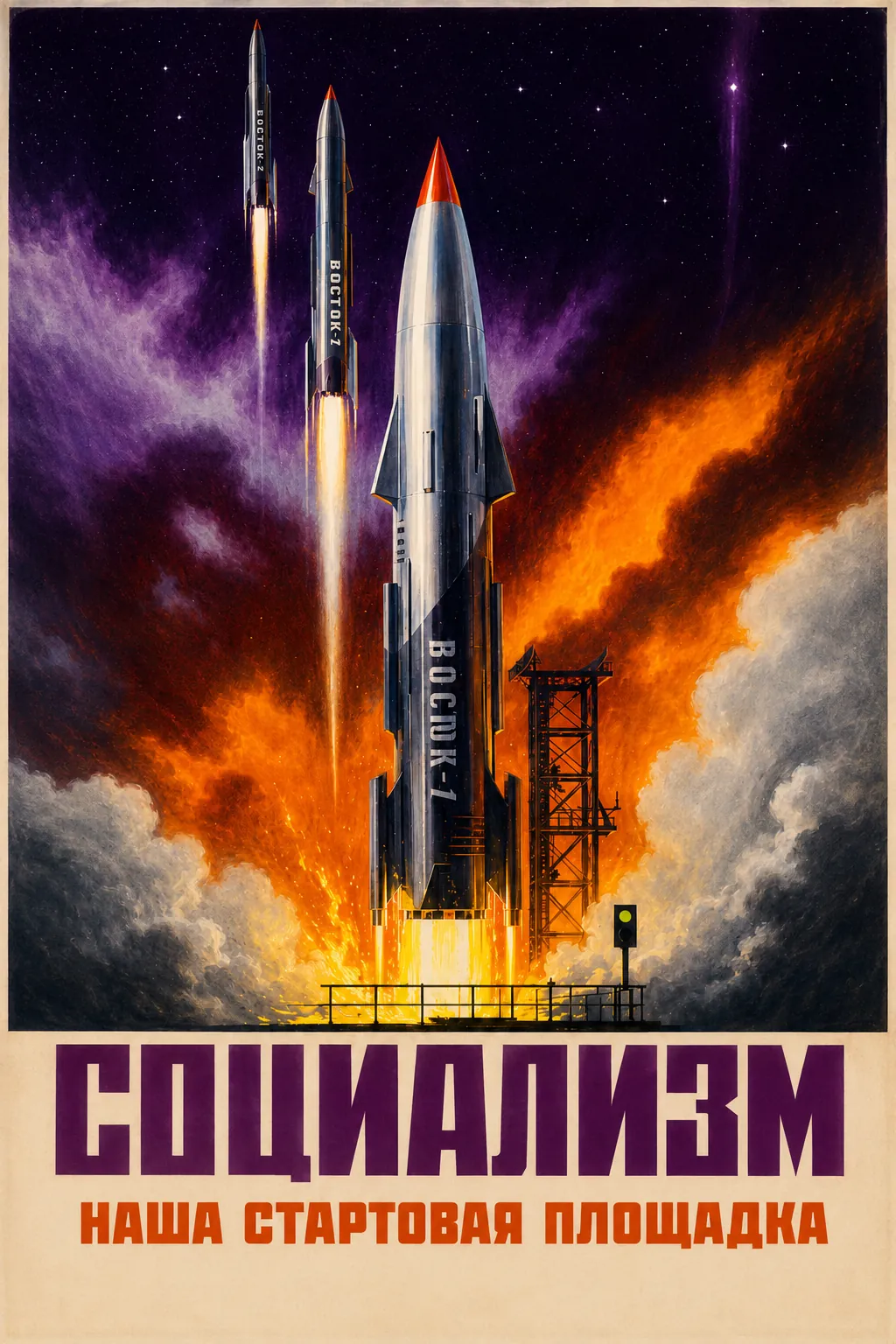
Sputnik 1 was the first artificial satellite to orbit Earth. The Soviet Union launched it on October 4, 1957, using an R-7 rocket from Baikonur. Its radio pulses could be received on the ground, giving observers a way to follow the satellite as it circled the planet. NASA's history of the launch places it at the start of the Space Age.
Size and specifications | Radio signals | Orbit and reentry | Satellite comparison | FAQ. Reviewed September 4, 2026. Images are AI-generated illustrations, not photographs taken in orbit.
How Big Was Sputnik 1?
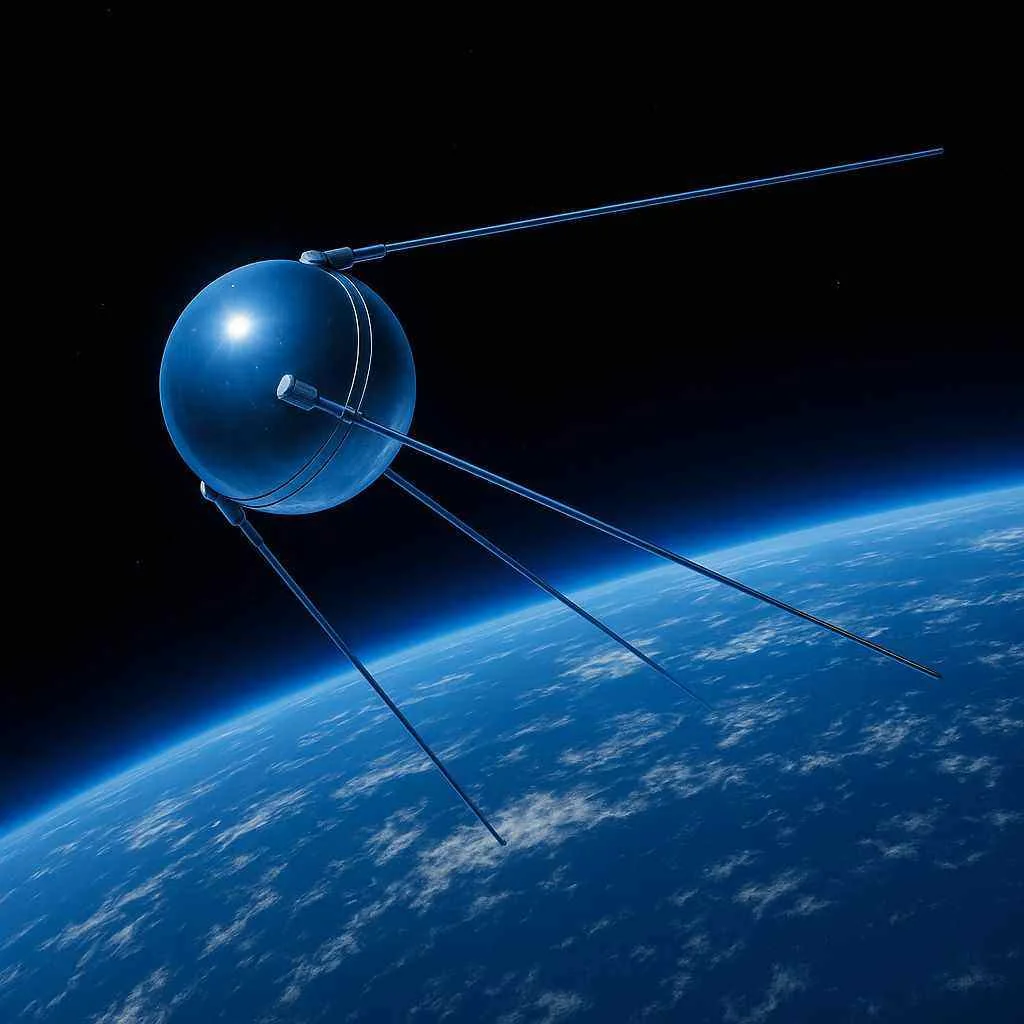
Sputnik 1's polished sphere was 58 centimeters, or about 23 inches, in diameter. That measurement excludes the four antennas. The complete satellite weighed 83.6 kilograms, about 184 pounds. These figures appeared in the original Soviet launch announcement, preserved by NASA. Its body could fit through a normal doorway; the deployed antenna span could not.
| Specification | Sputnik 1 |
|---|---|
| Body diameter | 58 cm / about 23 in |
| Total mass | 83.6 kg / about 184 lb |
| Body material | Aluminum alloy |
| Antennas | Four: two 2.4 m long and two 2.9 m long |
| Electrical power | Three silver-zinc batteries |
| Radio frequencies | 20.005 MHz and 40.002 MHz |
| Launch date | October 4, 1957 |
| End of flight | Atmospheric reentry, January 4, 1958 |
Who Built Sputnik 1?
Sergei Korolev's OKB-1 organization developed the spacecraft. Historian Asif Siddiqi identifies Mikhail Khomyakov as the satellite's lead designer and Oleg Ivanovskiy as his deputy. His archival account dates work on the simplified satellite to January 1957 and approval of the final configuration to June 24. The claim that Sputnik 1 was built in under a month confuses its development with the rush to launch Sputnik 2.
The team initially planned a heavier scientific satellite known as Object D. Delays made a simpler payload attractive: a small sphere with radio equipment could reach orbit sooner. Sputnik 1's internal designation, PS-1, referred to this simplest-satellite approach. The R-7 supplied the lifting capacity; its missile origin explains why the flight also attracted military attention. The R-7 family comparison shows how this launcher led to later Vostok and Soyuz rockets.
What Was Sputnik 1's Purpose?
The immediate task was to demonstrate orbital launch and radio tracking. Sputnik also offered scientific measurements. Changes in its orbit could reveal atmospheric drag, while reception of its radio signals helped researchers study propagation through the atmosphere. Monitoring conditions inside the sphere tested whether the pressurized spacecraft remained intact. NASA lists five mission objectives, covering launch, atmospheric density, tracking, radio propagation and pressurization.
This was a modest instrument package compared with later scientific satellites. Sputnik 1 had no camera, no crew cabin and no system for returning samples. Its success was being placed in orbit and remaining detectable. The later Soviet robotic missions carried increasingly specialized instruments to the Moon, Venus and Mars.
Sputnik's Radio Signals: What Did the Beeps Mean?
Sputnik 1 transmitted on 20.005 and 40.002 megahertz. The contemporary announcement described alternating pulses lasting about 0.3 seconds. The signal's timing could convey changes in the satellite's internal condition. Radio observations also supplied evidence of its motion. The familiar beeps were not recorded speech or pictures.
The radios depended on batteries, with no solar panels to recharge them. NASA's mission account places battery exhaustion on October 26, 1957, about three weeks after launch. Radio silence did not mean the satellite immediately fell out of orbit: it continued circling Earth without transmitting.
Is Sputnik 1 Still in Orbit?
No. Sputnik 1 reentered and burned up on January 4, 1958, about three months after launch, according to NASA's chronology. It was not recovered. A museum display can be a replica or another example of the hardware, but cannot be the original satellite retrieved after this flight.
NASA historian Roger Launius describes an orbit taking about 96 minutes. Its height and period changed as atmospheric drag removed energy from the orbit. The satellite could keep moving after its batteries failed because an orbit does not require continuous engine thrust. Its eventual reentry came from orbital decay, not simply from losing electrical power.
Sputnik 1, Sputnik 2 and Explorer 1 Compared
| Satellite | Launch date | Distinction |
|---|---|---|
| Sputnik 1 (USSR) | October 4, 1957 | First artificial Earth satellite; radio transmitters, no animals or crew. |
| Sputnik 2 (USSR) | November 3, 1957 | Carried Laika, the first animal in Earth orbit. |
| Explorer 1 (United States) | January 31, 1958 (US local time) | First US satellite; measurements helped identify Earth's radiation belts. |
Laika is often associated with the word Sputnik, but she was not inside Sputnik 1's small sphere. The second mission carried separate life-support equipment and was not designed to bring her home. The history of Soviet space dogs follows those flights and the later missions that returned animals safely.
Why Sputnik Changed the Space Race
Sputnik put Soviet rocket capability on public display. An object passing overhead made a distant missile program tangible, and American officials faced questions about scientific leadership and defense. The US State Department's historical account explains the political response and the acceleration of the space race.
The United States already had satellite plans before October 1957. NASA's history of Sputnik's origins traces that earlier work and the decisions that followed the launch. Sputnik helped create pressure for a coordinated civilian space agency, but it did not start American space research from nothing. NASA began operations in 1958.
The Soviet program moved from this uncrewed satellite to Yuri Gagarin's first human spaceflight in April 1961. Both missions used descendants of the same R-7 rocket. Their place among later achievements is shown in the Soviet space program timeline.
Sources and Further Reading
- NASA: The original Soviet satellite announcement, contemporary dimensions and radio frequencies.
- Asif Siddiqi: Sputnik's development, design decisions, personnel and the 1957 development schedule.
- NASA: Sputnik ushers in the Space Age, launch, radio lifetime, reentry and Sputnik 2.
- NASA: Sputnik 1 objectives, the mission's engineering and scientific tasks.
- US State Department: Sputnik and the Space Race, the political context.
Sputnik 1 FAQ
What was Sputnik 1?
Sputnik 1 was the first artificial satellite to orbit Earth. The Soviet Union launched it on October 4, 1957. It was an uncrewed metal sphere carrying batteries, radio transmitters and equipment to monitor its internal condition.
How big was Sputnik 1?
Sputnik 1's spherical body was 58 centimeters (23 inches) across and its total mass was 83.6 kilograms (about 184 pounds). The four antennas extended well beyond the sphere: two were 2.4 meters long and two were 2.9 meters long.
Who built Sputnik 1?
Sergei Korolev's OKB-1 organization developed Sputnik 1. Mikhail Khomyakov led the satellite design, with Oleg Ivanovskiy as his deputy. Work on the simplified satellite began in January 1957; it was not built from scratch in one month.
Where was Sputnik 1 launched?
Sputnik 1 launched from the Baikonur Cosmodrome in the Kazakh Soviet Socialist Republic, now Kazakhstan. Its launcher was an R-7 adapted from the Soviet intercontinental ballistic missile.
Is Sputnik 1 still in orbit?
No. Sputnik 1 reentered Earth's atmosphere and burned up on January 4, 1958, about three months after launch. Its radio transmitters had stopped working after roughly three weeks. Objects displayed in museums are not the recovered original satellite.
What did Sputnik 1 transmit?
It transmitted short radio pulses on 20.005 and 40.002 MHz. The signal allowed ground observers to track the satellite and monitor its condition. Sputnik 1 did not send photographs and was not a television relay satellite.
Was Laika aboard Sputnik 1?
No. Sputnik 1 carried no animals or people. Laika flew aboard the separate Sputnik 2 mission, launched on November 3, 1957. She became the first animal to orbit Earth.
Why was Sputnik 1 important?
Sputnik 1 demonstrated that a human-made object could be placed in Earth orbit and tracked by radio. Its launch intensified the US-Soviet space race and accelerated American debates about missiles, science education and the organization of space research.