Sputnik 1: 58 Centimeters of Aluminum
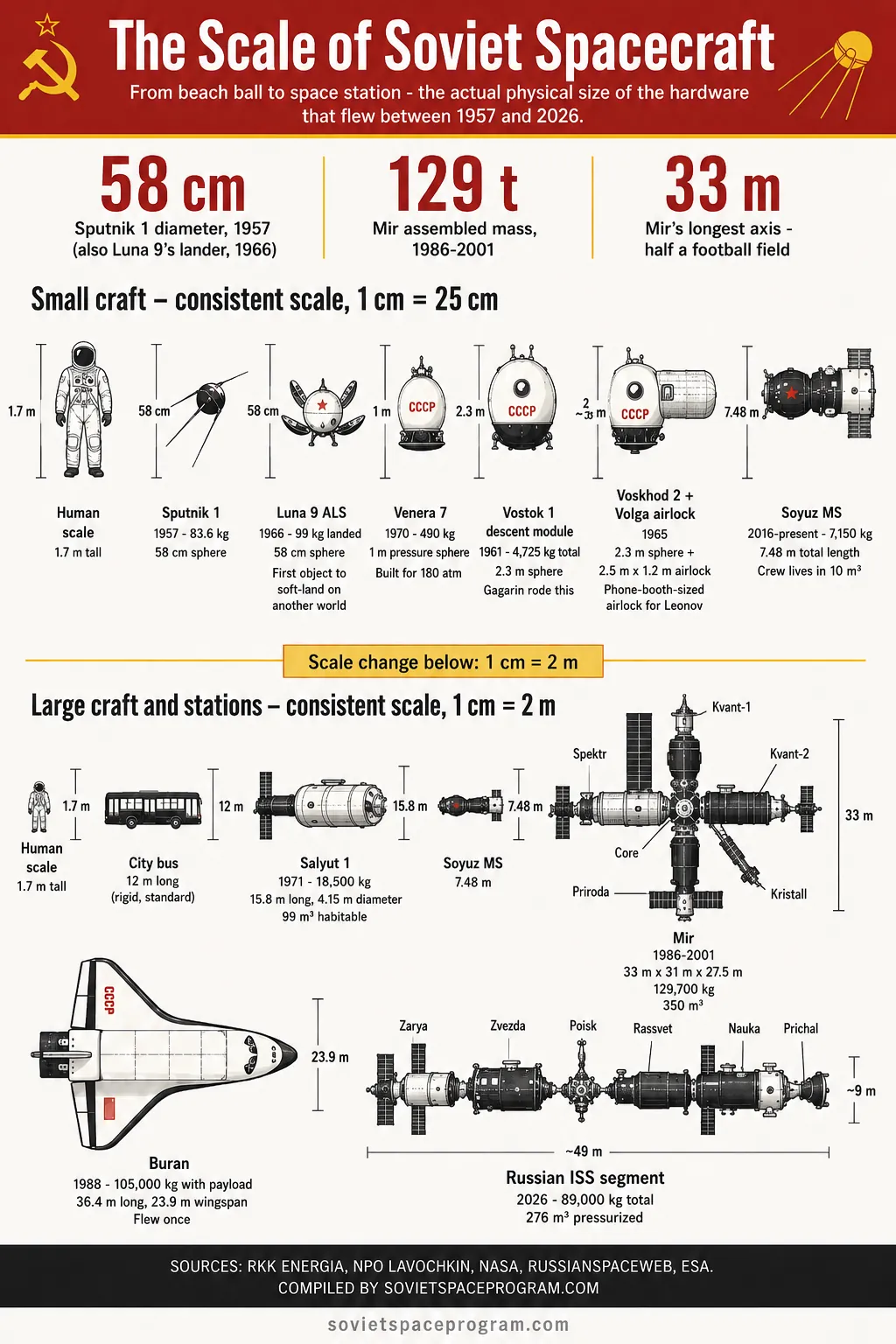
The satellite that started the space age was a polished aluminum sphere 58 centimeters in diameter. Without its antennas it would fit comfortably in your arms. With them, four trailing whips (two at 2.4 m, two at 2.9 m, angled 35 degrees from the base), it stretched about six meters end to end while tumbling.
The total mass was 83.6 kg. The interior held two radio transmitters, three silver-zinc batteries, a thermal control fan, and pressurized nitrogen to maintain internal temperature. There were no instruments on board to measure anything. Sputnik 1's job was to broadcast a beep and prove the Soviet Union could put something in orbit. It transmitted for 21 days, then the batteries died on October 26, 1957. It reentered and burned up on January 4, 1958.
The smallness was the reason for the global response. American intelligence had assumed the first Soviet satellite would be a heavier scientific payload taking another year or two to develop. When Sputnik turned out to be a simple polished sphere anyone could pick up with two hands, the implication was clear: a rocket powerful enough to orbit even this much was a rocket powerful enough to deliver a warhead. The historical context page covers the political aftermath in detail.
The Crewed Era: Spheres With People Inside
Korolev's solution for crewed reentry was a sphere. Spheres are aerodynamically forgiving from any angle, which mattered because the early descent modules had no active attitude control. The first Soviet crewed capsule, the Vostok sharik, was 2.30 m in diameter and 2,460 kg empty.
Sharik means "little ball" in Russian. Inside it, Yuri Gagarin sat in a metal ejection seat for 108 minutes on April 12, 1961. The total Vostok spacecraft, including its service module, was 4.4 meters long and weighed 4,725 kg at launch. By comparison, a 2026 Toyota Camry is 4.9 m long and weighs about 1,600 kg. Gagarin's spacecraft was shorter than a sedan and three times as heavy.
The descent module had no parachute or retro-rockets soft enough for a crewed landing. Gagarin ejected from the capsule at 7 km altitude over Saratov Oblast and parachuted down separately. The capsule landed nearby with a hard thump. The official Soviet line for years was that Gagarin had landed inside the capsule, because the Federation Aeronautique Internationale rules at the time required the pilot to be in the vehicle on landing to set a record.
Voskhod 1 (October 1964) used the same 2.30 m sphere but crammed three cosmonauts into it. There were no spacesuits and no ejection seats - the volume budget did not allow for them. Voskhod 2 (March 1965) added the Volga, an inflatable airlock that packed into a 70 cm by 77 cm cylinder for launch and deployed to a 2.5 m by 1.2 m cylinder in orbit. Alexei Leonov used it to perform the first spacewalk. The Volga had an internal volume of 2.5 cubic meters, roughly the size of a phone booth.
Soyuz: The Compromise That Still Flies
Soyuz, introduced in 1967, was the first Soviet crewed spacecraft designed for more than a single flight profile. Korolev's original concept had to ferry crews to lunar orbit. After the N1 program failed, Soyuz inherited the role of ferrying crews to space stations. It has been doing exactly that for 59 years.
The modern Soyuz MS is 7.48 m long and 2.72 m in diameter at the service module base. Across the deployed solar arrays the spacecraft spans about 10.7 m. Launch mass is roughly 7,150 kg. Three modules stacked end to end:
- Orbital module (BO): 2.98 m long, 2.25 m diameter, 1,300 kg, 6 m³ habitable volume. The crew uses it during transit and as a docking adapter when berthed.
- Descent module (SA): 2.20 m long, 2.20 m diameter, 2,900 kg, 4 m³ total interior with about 2.5 m³ of usable space for three crew. This is the only module that returns to Earth.
- Service module (PAO): 2.26 m long, 2.72 m diameter at the base, 2,900 kg. Contains the main engines, propellant, solar arrays, and life support consumables.
Total habitable volume across all three modules: about 10 cubic meters. Three crew live in it for the two-day transit to the ISS. That is roughly the volume of a walk-in closet. The descent module they ride home in is even tighter, with seats packed against the inner pressure hull.
The Robotic Landers: Built Like Submarines
Two Soviet robotic spacecraft achieved firsts that look impossibly small. The first object to soft-land on the Moon was 58 centimeters in diameter, exactly the same as Sputnik 1. The first object to land on Venus was a one-meter pressure sphere built to withstand the surface of a deep-sea trench.
Luna 9 (January 1966) carried an Automatic Lunar Station, designated ALS, on its descent stage. The ALS was an egg-shaped pressure capsule with four spring-loaded petals that unfolded after landing to right the craft and expose its instruments. Total mass on the lunar surface was 99 kg. The cruise stage that delivered it to the Moon was about 2.7 m tall. The lander capsule itself was the same size as Sputnik 1 a decade earlier.
Venera 7 (December 1970) was harder. The Soviet team had to design a vehicle that could survive entry into a 460 degree Celsius atmosphere and a surface pressure of 90 Earth atmospheres. The lander was a 1 m titanium pressure sphere rated to 180 atmospheres - twice the design load, because Venusian surface conditions in 1970 were poorly characterized. The lander mass was 490 kg, dense as a refrigerator full of lead.
Venera 7 transmitted from the surface of Venus for about 23 minutes before its electronics failed. The signal was so weak it took weeks to recognize that the spacecraft had survived landing at all. It was the first object built by humans to land on another planet.
Salyut 1: The First Space Station
Soviet engineers built the first space station in 14 months on a crash schedule that started after the N1 cancellation freed up the necessary lift capacity. Salyut 1 launched on a Proton on April 19, 1971. Its body was 15.8 meters long and 4.15 meters in diameter at the widest section - the length of a rigid city bus and the diameter of a small grain silo. Launch mass was about 18,500 kg.
The habitable interior was 99 cubic meters. For comparison, a typical American studio apartment is around 95 cubic meters. Three cosmonauts could move freely. Salyut 1 had a control panel, a centralized galley, an exercise treadmill, scientific instruments, and a small biological greenhouse.
The station operated for 175 days. Only one crew, Soyuz 11, ever reached and lived on it. All three of them died on reentry when a valve failed during separation and depressurized the descent module. Salyut 1 was deorbited in October 1971. The space stations page covers the Salyut program in detail.
Mir: A Six-Story Building in Orbit
Mir was the first space station assembled in orbit from multiple modules. Construction began with the Core Module launch in February 1986. Six more modules followed over the next decade. By April 1996 the complete assembly massed 129,700 kg, with on-orbit mass excursions up to 140,000 kg when Soyuz and Progress vehicles were docked.
Mir's longest axis, running from a docked Progress through Kvant-1, the Core, and a docked Soyuz, measured 33 meters. The Priroda-Kristall-Docking axis measured 31 meters. The Kvant-2 to Spektr axis was 27.5 meters. The habitable interior across all modules was about 350 cubic meters, roughly the size of a typical three-bedroom American house.
Mir operated continuously inhabited from September 5, 1989 to August 28, 1999, a span of 3,644 days. Across its full 15-year operational life it hosted 125 cosmonauts and astronauts from 12 countries and ran an estimated 23,000 scientific experiments (Roscosmos figure - no independent audit). The full Mir story is on the Legacy page.
Buran: Bigger Than You Remember
The Soviet space shuttle Buran was 36.37 m long, with a wingspan of 23.92 m and a height on its landing gear of 16.5 m. Empty mass was about 62,000 kg. With a full 30-tonne payload it weighed 105,000 kg.
By comparison, NASA's Space Shuttle Orbiter was 37.24 m long with a 23.79 m wingspan and could carry 24.4 tonnes to low Earth orbit. The two vehicles were almost identical in size, but Buran could carry about 4 tonnes more cargo. They look so similar that aerospace historians have argued for decades about how much of Buran's design was independent and how much came from Soviet intelligence-gathering on the American program. The most likely answer: the lifting-body aerodynamics were similar because the physics constrained them to similar solutions.
Buran flew exactly once, on November 15, 1988, fully uncrewed. It completed two orbits and performed the first autonomous runway landing by a winged spacecraft. NASA's Shuttle was never designed to land without a pilot. The Soviet Union dissolved before a second Buran flight could fly. The only flight-tested airframe was crushed in 2002 when its hangar roof at Baikonur collapsed under snow. A second, never-flown airframe sits in a museum at the cosmodrome today.
The Scale Side by Side
The Russian Segment of the ISS in 2026
Russia's current contribution to the ISS, as it stands in 2026, masses about 89,000 kg and contains more than 276 cubic meters of pressurized volume. That is more pressurized volume than a three-bedroom house. Six modules make up the segment:
Pirs, a docking compartment launched in 2001, was deorbited on July 26, 2021 to free up Zvezda's nadir port for Nauka. It was the first ISS module ever decommissioned.
Frequently Asked Questions
Was Sputnik 1 really only 58 centimeters across?
Yes. The polished aluminum sphere was 58.0 centimeters in diameter, about the size of a large beach ball. Total mass was 83.6 kg. The four whip antennas trailing behind extended much further (2.4 m and 2.9 m each), but the spacecraft body itself was tiny. Source: NASA NSSDCA Sputnik 1 datasheet.
How big was Yuri Gagarin's spacecraft?
Vostok 1's total length was about 4.4 m and total launch mass was 4,725 kg. The descent module he rode in (the sharik) was a 2.30 m sphere with no ejection-seat space inside, no parachute system, and no way to survive a hard landing. Gagarin ejected at 7 km altitude and parachuted to the ground separately.
How did Mir compare in size to the ISS?
Mir had a habitable volume of about 350 cubic meters and a peak assembled mass of 129,700 kg. The full ISS in 2026 has about 916 cubic meters of habitable volume and a total mass of approximately 420,000 kg - more than three times the mass and roughly 2.6 times the habitable volume. Mir was a six-story building in orbit; the ISS is a small office park.
Was Buran really bigger than the U.S. Space Shuttle?
Buran and the U.S. Orbiter were almost identical in external size (Buran 36.4 m × 23.9 m wingspan vs. Orbiter 37.2 m × 23.8 m), but Buran could carry 30 tonnes to LEO compared to the Orbiter's 24.4 tonnes. The propulsion architecture explains the gap: Buran rode atop Energia and contributed no main engines to launch, so all 105 tonnes of orbiter weight could be cargo and structure. The Shuttle's three Space Shuttle Main Engines were on the orbiter, eating into its payload budget.
How small was the Soyuz return capsule, really?
Soyuz MS's descent module is 2.20 m wide and 2.20 m long, with 4 m³ total interior volume and about 2.5 m³ of usable habitable space. Three cosmonauts strapped into custom-fitted seats occupy nearly all of that. The capsule is smaller than a backyard storage shed and is the only part of Soyuz that returns to Earth, the other modules burn up.
Why are early Soviet spacecraft so much smaller than modern ones?
Two reasons. First, early launchers had limited lift capacity, so spacecraft had to be miniaturized to fit. Sputnik 1 weighed 84 kg because that was what the R-7 ICBM could throw into orbit in 1957. Second, mission requirements grew. A satellite that beeps needs less hardware than a satellite that runs experiments, takes images, downlinks data, and survives years on orbit. By the time Mir was assembled in the 1980s, Proton-class rockets could lift 20 tonnes at a time, and each module came pre-equipped to function as a piece of a permanent habitat.