The Robots That Went First
The Soviet space program's deepest strength was automation. While the U.S. built its identity around astronauts, the Soviet side built an unmatched record of robotic firsts, sending machines where no human could yet go.
Those machines reached the Moon, Venus, and Mars years ahead of any other nation, and they did it with onboard automation and remote control that drew on the same engineering culture described on the technology page.
Across three flagship programs (Luna at the Moon, Venera at Venus, and Mars), the Soviet Union collected planetary firsts that have never been repeated because they can only happen once.
The Luna Program: Reaching the Moon
The Luna program opened the door to the Moon. Luna 1 swept past it in January 1959, becoming the first spacecraft to escape Earth's gravity. Eight months later, Luna 2 struck the lunar surface, the first human-made object ever to reach another celestial body.
Then came the result that stunned the world. In October 1959, Luna 3 flew around the Moon and photographed its far side, the hemisphere no human had ever seen. The grainy images were a sensation, and the Soviet Union earned the right to name the features it had revealed.
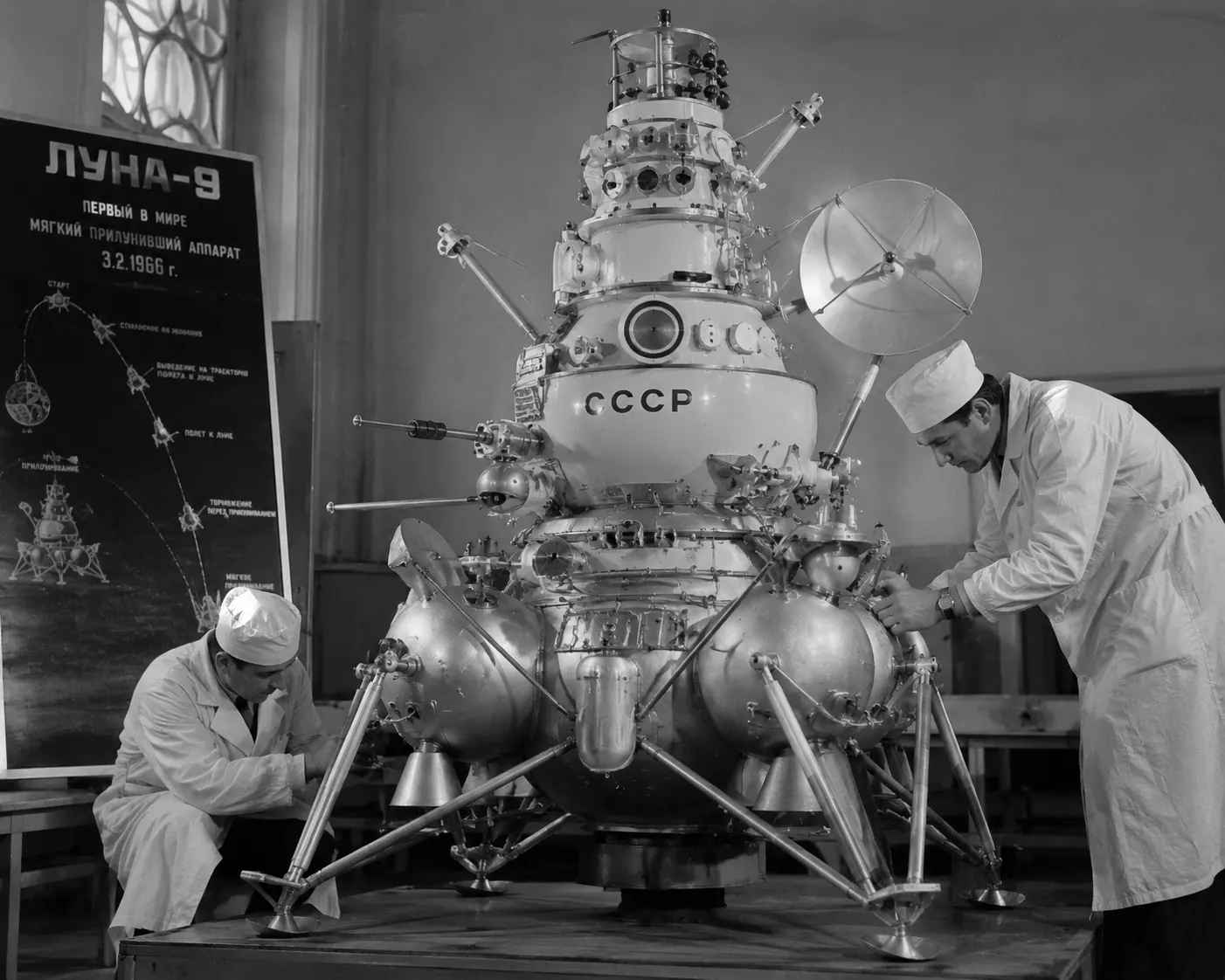
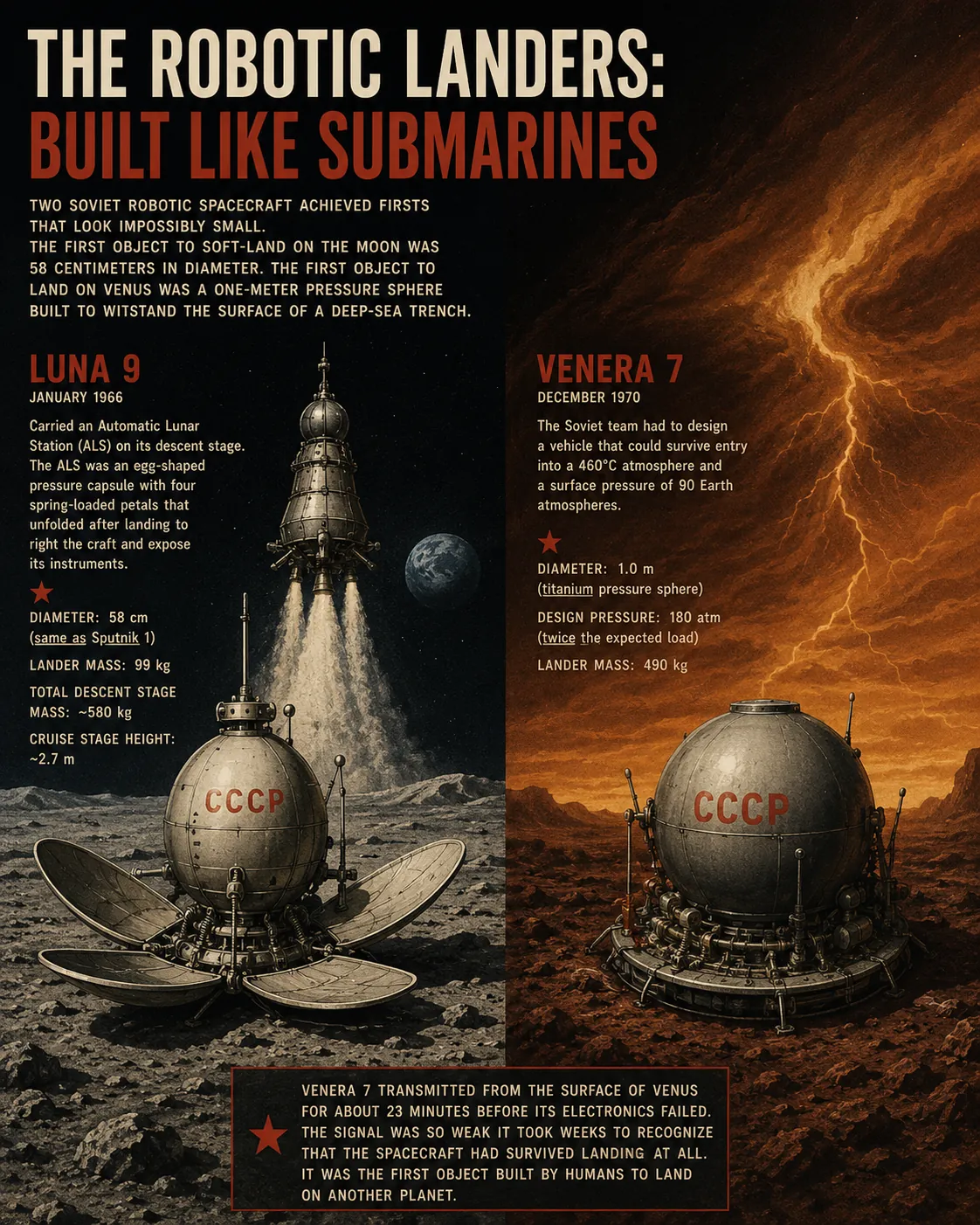
The Moon resisted landing for years. The surface dust was an unknown; some scientists feared a lander would simply sink into it. On February 3, 1966, Luna 9 settled onto the surface intact and transmitted the first photographs ever taken from the surface of another world, proving the ground was solid enough to stand on. This early run of firsts is plotted on the Soviet space timeline.
The program's most sophisticated achievements came at the end. Luna 16 (1970) drilled a core sample, sealed it in a return capsule, and flew it back to Earth, the first fully automated sample return from another body. The same year, Luna 17 delivered a rover.
Venera: Surviving Hell on Venus
Venus is the most hostile surface in the solar system that a spacecraft has ever reached. The temperature holds around 465°C, hot enough to melt lead. The pressure is about 92 Earth atmospheres, equivalent to a depth of nearly a kilometer underwater. The clouds are sulfuric acid.
The Soviet Venera program conquered it anyway, and did so repeatedly. The landers were built as titanium and steel pressure vessels, over-engineered like submarines to buy a few precious minutes on the surface before the heat killed the electronics.
Venera 7, in December 1970, became the first spacecraft to soft-land on another planet and transmit data back from its surface. Its signal was so faint that engineers only realized weeks later, on reviewing the tapes, that it had survived the landing and sent roughly 23 minutes of data.
Venera 9 (1975) returned the first photograph ever taken from the surface of another planet, a stark black-and-white panorama of flat, broken rock. Venera 13 (1982) went further still: the first color images of the Venusian surface, the first recording of sound on another planet, and an on-the-spot chemical analysis of the soil, all in the 127 minutes it survived before succumbing.
The Mars Curse
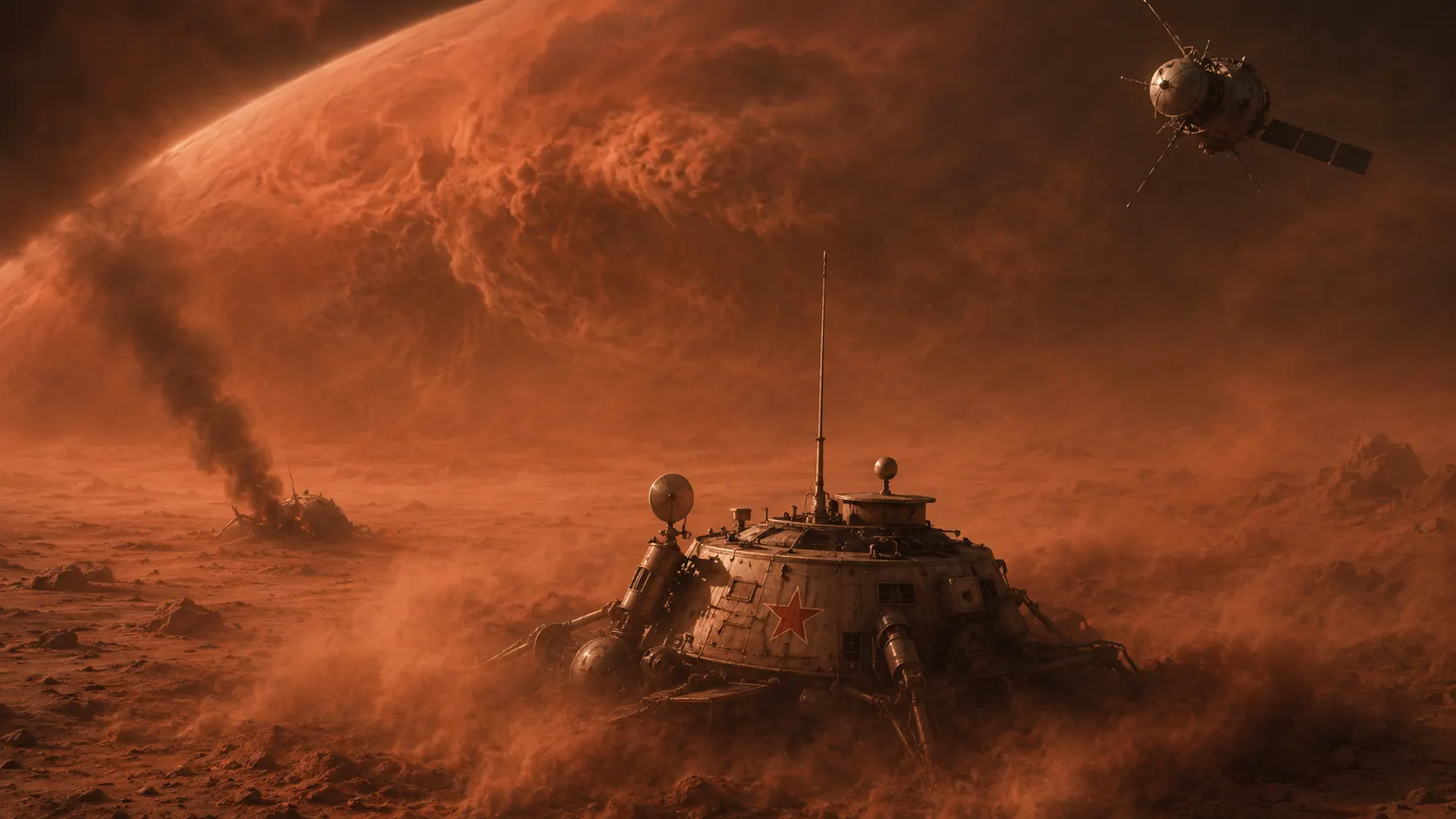
If the Moon and Venus were Soviet triumphs, Mars was the program's heartbreak. The Mars campaign was plagued by failures at every stage: launch, cruise, orbit insertion, and landing.
Mars 2, in November 1971, became the first human-made object to reach the Martian surface, but only as a crash; its landing system failed. Days later, Mars 3 achieved the first genuine soft landing on Mars.
Then Mars 3 went silent after about 20 seconds, having returned only a fragment of a featureless gray image. The leading explanation is that it landed in the middle of the largest global dust storm ever recorded on Mars, which may have toppled or buried it.
Later attempts fared no better. The ambitious Phobos 1 and Phobos 2 probes of 1988, aimed at Mars and its moon Phobos, were both lost, Phobos 2 just before its rendezvous with the moon. The Soviet Union never got the sustained Mars success that the United States achieved with Mariner 9 and the Viking landers.
Vega: Venus and a Comet in One Mission
The Venera lineage produced one last spectacular act. The twin Vega probes, launched in late 1984, each dropped a lander and an instrumented balloon into the atmosphere of Venus in June 1985, the first balloons ever deployed in the atmosphere of another planet.
Then, their Venus work done, both spacecraft flew on to a second target. In March 1986 they made close flybys of Halley's Comet, returning the first detailed images of a comet nucleus and helping guide the European Giotto probe to its even closer encounter. The hardware lineage of these deep-space probes is shown on the scale of Soviet spacecraft page.
Why the Soviets Led in Robotic Exploration
The robotic firsts were not luck. They came from a deliberate engineering culture that treated full automation and remote operation as the default rather than the exception.
That culture, traced in detail on the technology page, gave Soviet engineers a head start in autonomous landing systems, deep-space communication, and the heat- and pressure-resistant hardware that Venus demanded. The theoretical groundwork for the interplanetary trajectories was laid by mathematicians including Mstislav Keldysh.
The probes also rode the program's heavy launchers. Most of the planetary missions were lofted by the Molniya and Proton rockets covered on the rocket development page, the same vehicles that flew the program's crewed and station hardware.
Robotic Firsts by the Numbers
Key Robotic Firsts
| Year | Mission | First |
|---|---|---|
| 1959 | Luna 2 | First object to reach another celestial body (the Moon) |
| 1959 | Luna 3 | First images of the Moon's far side |
| 1966 | Luna 9 | First soft landing on the Moon; first images from its surface |
| 1966 | Luna 10 | First spacecraft to orbit the Moon |
| 1970 | Venera 7 | First soft landing and first surface data from another planet (Venus) |
| 1970 | Luna 16 | First fully automated sample return from another body |
| 1970 | Lunokhod 1 | First remote-controlled rover on another world |
| 1971 | Mars 3 | First soft landing on Mars (transmitted ~20 seconds) |
| 1975 | Venera 9 | First photograph from the surface of another planet |
| 1982 | Venera 13 | First color images and first sound recorded on another planet |
| 1985 | Vega 1 & 2 | First balloons deployed in another planet's atmosphere |
Frequently Asked Questions
What was the first spacecraft to reach the Moon?
Luna 2, which impacted the lunar surface on September 14, 1959, becoming the first human-made object ever to reach another celestial body. Earlier that year, Luna 1 had become the first spacecraft to escape Earth's gravity and fly past the Moon. In October 1959, Luna 3 took the first photographs of the Moon's far side.
How did Soviet probes survive landing on Venus?
They were built like deep-sea submarines. Venus has a surface temperature around 465°C and a pressure of about 92 Earth atmospheres. The Venera landers were heavy titanium and steel pressure spheres, over-engineered to roughly twice the expected load, with the instruments packed inside and pre-chilled before descent. Even so, none survived more than about two hours. Venera 7 (1970) lasted about 23 minutes; Venera 13 (1982) set the record at 127 minutes. No nation has soft-landed on Venus since.
What was Lunokhod?
Lunokhod was a pair of Soviet robotic Moon rovers. Lunokhod 1, delivered by Luna 17 in November 1970, was the first remote-controlled rover to operate on another world. A five-person team in Crimea drove it in real time using slow-scan television, working against a 2.5-second signal round-trip. It covered about 10.5 km over roughly ten months. Lunokhod 2 followed in 1973 and drove even farther. They predated the first U.S. Mars rover, Sojourner, by 27 years.
Why did the Soviet Mars program fail so often?
Mars proved far harder than the Moon or Venus for the Soviet program. Many missions failed at launch, in cruise, or at orbit insertion. The closest success, Mars 3, achieved the first soft landing on Mars in 1971 but transmitted for only about 20 seconds before going silent, probably because it landed during the largest global dust storm ever recorded on Mars. The later Phobos 1 and 2 probes (1988) were also lost. The Soviet Union led decisively at the Moon and Venus but never matched the sustained U.S. success at Mars from Mariner 9 and the Viking landers.
Did Soviet probes really visit a comet?
Yes. The twin Vega probes dropped landers and instrumented balloons into the atmosphere of Venus in June 1985, then flew on to make close flybys of Halley's Comet in March 1986. They returned the first detailed images of a comet's nucleus and provided trajectory data that helped the European Space Agency's Giotto probe make its even closer approach to the comet.
Sources
- NASA NSSDCA: planetary spacecraft catalog - mission parameters and dates
- RussianSpaceWeb: planetary missions - Anatoly Zak's detailed mission histories
- NASA: Venus fact sheet - surface conditions
- Wikipedia: Luna programme - the Soviet lunar robotic program
- Wikipedia: Venera - the Soviet Venus program
- Wikipedia: Vega program - the Venus-Halley dual mission