Propulsion: The Staged Combustion Inheritance
The single most exported Soviet engineering idea of the late twentieth century was not a vehicle. It was a thermodynamic cycle.
Oxidizer-rich staged combustion was invented in the Soviet Union in 1960 and first flown on the Molniya upper stage that same year. It became the architecture behind every Soviet heavy-lift engine that followed, and eventually behind the American RD-180s that flew Atlas V missions from 2000 to 2022.
In a conventional gas-generator cycle, a small fraction of the propellant burns in a separate preburner to drive the turbopumps and exhausts overboard. In staged combustion, all of the propellant cycles through the preburner first.
Soviet engineers chose to run the preburner fuel-lean, so the hot gas downstream is oxygen-rich. U.S. propulsion engineers had long believed this was impossible because the oxidizer-rich gas, at about 600 K, was thought to dissolve any turbine material.
Soviet metallurgists at NPO Energomash developed nickel-chrome alloys with chromium content above 50% that withstood the environment for the full burn duration. Western teams did not duplicate the result for another four decades.
When Pratt and Whitney engineers first inspected disassembled RD-180s in 1996, they confirmed the chamber pressure at 257 bar, the highest of any operational LOX/kerosene engine ever flown. The Space Shuttle Main Engine ran at 206 bar; the F-1 that flew Apollo at about 70 bar.
NPO Energomash had been operating at this pressure since 1976, when the RD-170 for the Energia first stage entered ground testing. The Soviet rocket engineering tree, including the N1 program, is covered in detail on the Rocket Development page.
The cycle traveled. United Launch Alliance flew 122 RD-180s on Atlas V missions between 2000 and 2022, when sanctions ended the import program. The Antares 230 used a single-chamber RD-181 derivative from 2014 to 2023.
SpaceX and Blue Origin both designed their flagship engines, Raptor and BE-4, around the staged combustion principle the Soviets pioneered six decades earlier. The RD-180's internal geometry is in the engine cross-section on Rocket Development.
| Engine | Cycle | Chamber pressure | First flight |
|---|---|---|---|
| F-1 | Gas generator | 70 bar | 1967 (Saturn V, USA) |
| SSME (RS-25) | Fuel-rich staged combustion | 206 bar | 1981 (Space Shuttle, USA) |
| RD-170 | Oxidizer-rich staged combustion | 245 bar | 1985 (Energia, USSR) |
| RD-180 | Oxidizer-rich staged combustion | 257 bar | 2000 (Atlas III, USA) |
| Raptor 2 | Full-flow staged combustion | 300 bar | 2019 (Starship, USA) |
| BE-4 | Oxidizer-rich staged combustion | 134 bar | 2024 (Vulcan, USA) |
Plasma Propulsion: The Quiet Revolution
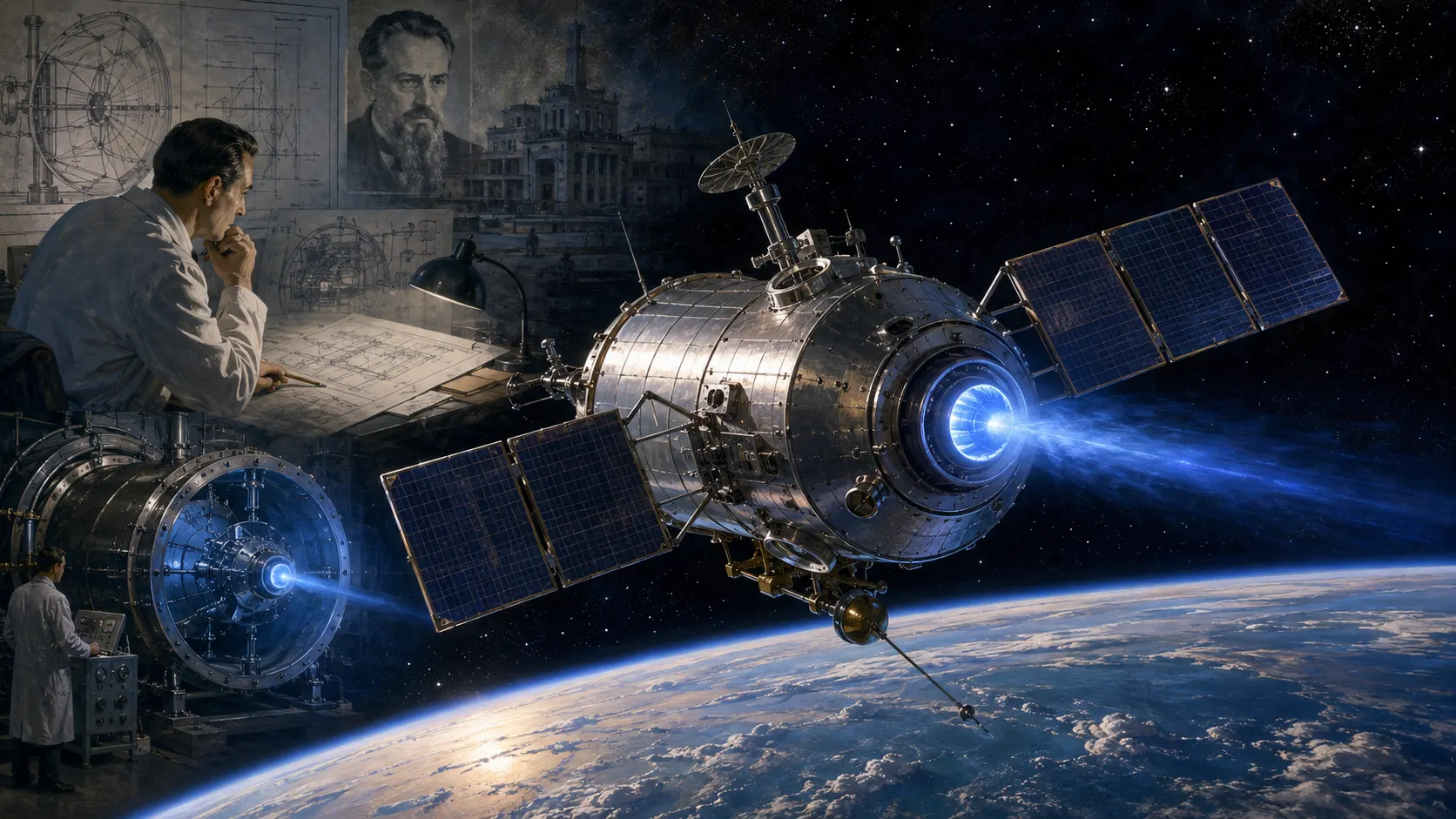
Stationary plasma thrusters, also called Hall-effect thrusters, were developed by Aleksey Morozov's team at the Kurchatov Institute of Atomic Energy beginning in 1962.
The first orbital test, an SPT-50 mounted on the Meteor-1-10 weather satellite, fired successfully on December 29, 1971. Over the next four months it demonstrated 0.02 newtons of thrust at a specific impulse of about 1,000 seconds.
The performance was unimpressive by chemical-rocket standards. An SPT-50's thrust would not lift a paperclip on Earth.
The efficiency, however, was revolutionary. A Hall thruster delivers roughly three times the specific impulse of the best storable chemical rocket and runs on inert xenon rather than corrosive hypergols.
For station-keeping, where a satellite needs to fight orbital drift over a 15-year design life, that efficiency translates directly into less propellant mass and more payload.
Soviet operational deployments were extensive. The SPT-70, derived from the SPT-50, flew on more than 100 Meteor, Kosmos, and military satellites between 1982 and 1990.
After the Soviet collapse, the design migrated through Loral and Aerojet to commercial American satellite buses. As of 2026, the SPT family has powered more orbital operations than any other electric propulsion system, totaling tens of thousands of operational hours.
| Model | Power | Thrust | Specific impulse | First flight |
|---|---|---|---|---|
| SPT-50 | 350 W | 0.02 N | ~1,000 s | 1971 (Meteor-1-10) |
| SPT-70 | 700 W | 0.04 N | ~1,500 s | 1982 (Meteor-Priroda) |
| SPT-100 | 1.35 kW | 0.083 N | 1,600 s | 1994 (Gals-1) |
| SPT-140 | 4.5 kW | 0.28 N | 1,800 s | 2014 (commercial GEO) |
Automated Spacecraft Operations
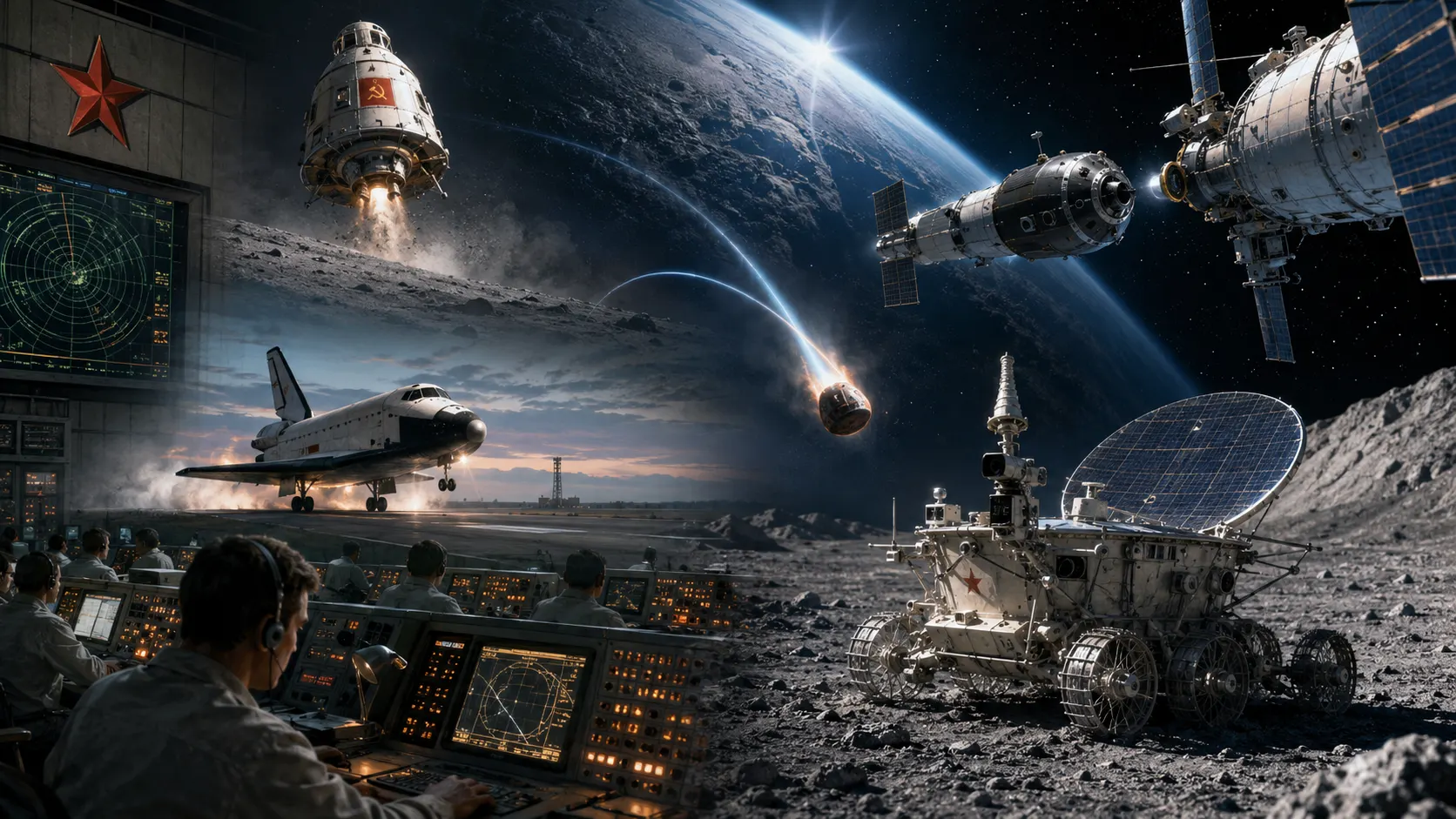
Soviet engineering culture treated remote and automated operation as the default. Where NASA in the 1960s built its crewed program around continuous astronaut input, the Soviet program built its uncrewed program around full autonomy.
The result was a series of firsts in remote planetary exploration, automated docking, and unattended ground operations that the U.S. only began to match in the 1990s.
Luna 16, launched September 12, 1970, became the first uncrewed mission to land on another body, collect a soil sample, and return it to Earth. Luna 17 deposited Lunokhod 1 on the Moon in November 1970, the first remotely operated planetary rover.
Across five Luna sample-return missions (1970-1976) and two Lunokhod rovers (1970, 1973), Soviet teams ran lunar surface operations entirely from control rooms at Yevpatoria. The unmanned missions page covers individual mission outcomes.
Closer to home, automated docking became the operational backbone of Soviet station crew rotation. The Igla rendezvous system, introduced on Soyuz in 1967, used radar-cooperative target acquisition to bring spacecraft into docking range without crew piloting.
Its successor Kurs, introduced in 1986 and still in use in 2026, replaced Igla's gimbaled antennas with electronically scanned arrays. It added the capability to abort and re-attempt without ground-station support.
Kurs has docked Progress freighters to Mir and the International Space Station's Russian segment more than 200 times. No other automated docking system comes close.
The most ambitious automation demonstration was Buran's first and only flight, on November 15, 1988. The Soviet shuttle launched on top of the Energia, completed two orbits, and landed itself at Baikonur with no crew on board.
The crosswind on final approach exceeded the manual control budget for the U.S. Space Shuttle. Buran handled it. The flight remains the only autonomous orbital re-entry and runway landing in history.
Life Support and Closed Ecology
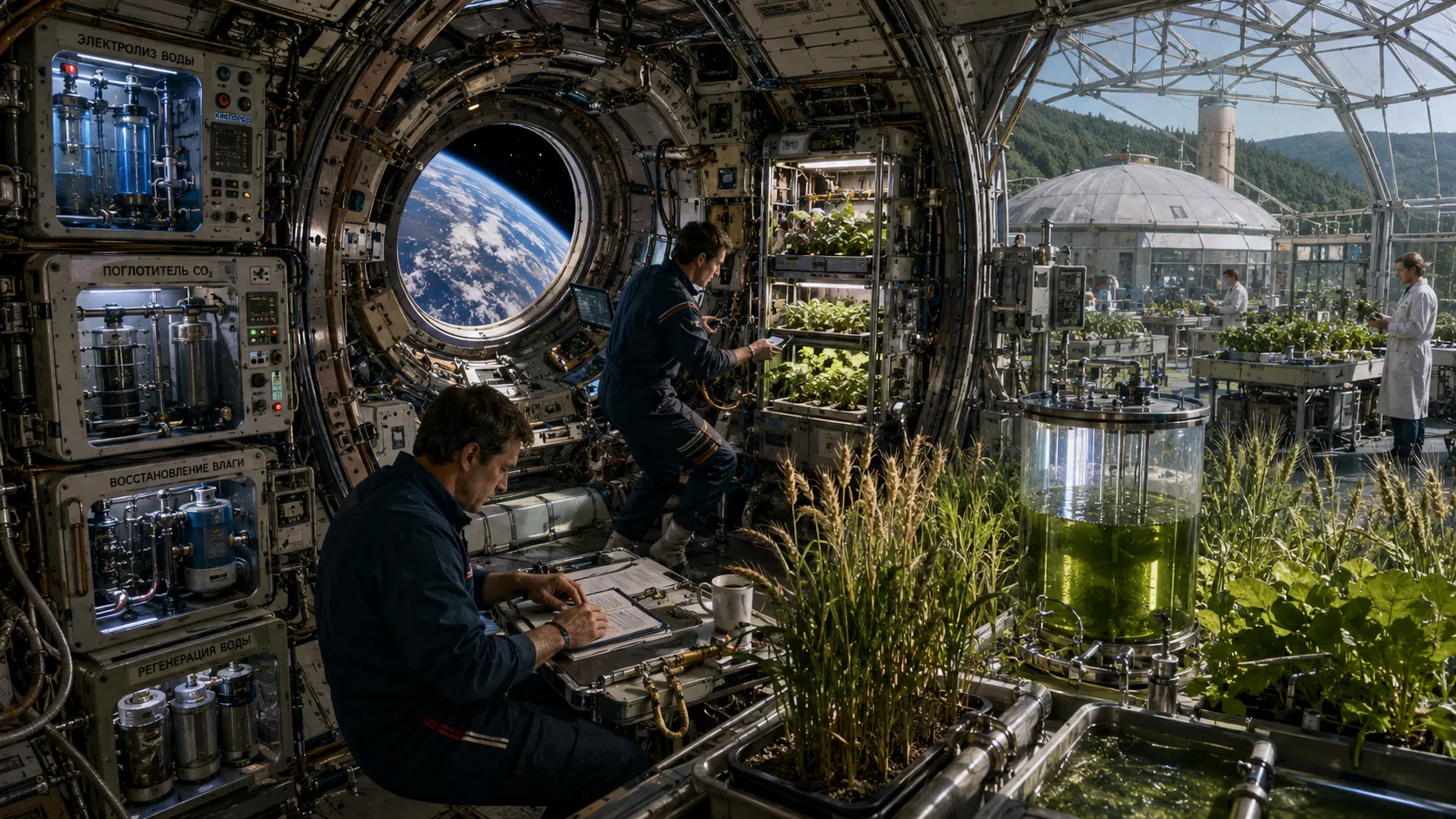
The Soviet long-duration human spaceflight program required life-support systems no Western program had built. The Salyut and Mir orbital stations were designed for stays measured in months, then years.
By the time Mir was de-orbited in 2001, Soviet and Russian regenerative life-support hardware had logged about 4,500 person-days of continuous operation. The U.S. Skylab record for the longest single mission stood at 171 days.
The core hardware suite was developed at the Institute of Biomedical Problems in Moscow during the 1970s and refined across the Salyut and Mir generations.
The Elektron unit, in service from Salyut 6 forward, generates breathable oxygen by electrolyzing wastewater. The Vozdukh assembly removes carbon dioxide from cabin air using a regenerable solid-amine sorbent that vents the captured CO2 overboard during a regular cycle.
SRV-K recovers humidity from the cabin atmosphere as drinkable water. SRV-U processes urine for the same purpose. All four systems are still operating, in upgraded form, on the Russian segment of the ISS.
The longer-term research happened on the ground. BIOS-3, a closed-ecology facility built outside Krasnoyarsk in 1972 by the Institute of Biophysics, ran experimental closures of up to 180 days with three-person crews.
Chlorella algae, wheat, and other higher plants supplied oxygen regeneration and a substantial fraction of food calories.
Among other findings, BIOS-3 established that closing the food loop is fundamentally harder than closing the gas loop. Higher plants require many times more illumination volume per crew member than algae.
Modern ISS regenerative architecture descends from BIOS-3 research, though no operational spaceflight has yet attempted full food-loop closure.
| System | Function | First flown | Status (2026) |
|---|---|---|---|
| Elektron | O₂ generation by water electrolysis | Salyut 6, 1977 | Operating on ISS Zvezda |
| Vozdukh | CO₂ removal (regenerable amine sorbent) | Salyut 6, 1977 | Operating on ISS Zvezda |
| SRV-K | Cabin humidity recovery to drinking water | Mir, 1986 | Operating on ISS Zvezda |
| SRV-U | Urine processing to drinking water | Mir, 1986 | Operating on ISS Zvezda |
| BMP | Micro-impurity adsorber | Salyut 6, 1977 | Operating on ISS Zvezda |
Onboard Computing and Flight Software
Soviet onboard computing followed a different evolutionary path from American spaceflight computing.
Where the Apollo Guidance Computer and Shuttle GPCs were custom designs around the mission's specific guidance equations, Soviet onboard computers came from a parallel-developed line of space-rated digital machines.
The Argon series was manufactured at NIIVK in Moscow from 1962 onward and served both military and civilian space programs.
The first BTsVM (Bortovaya Tsifrovaya Vychislitelnaya Mashina, onboard digital computing machine) flew on the OKB-52 Polyot tactical satellite in 1963, two years before the Apollo Guidance Computer's first flight.
Mir's central computer, the Salyut-5B, was a 32-bit machine running at 500 kHz with 8 megabytes of magnetic-core memory. Modest by the standards of 1986.
It managed station attitude, life-support telemetry, and crew interface across 15 years of continuous service. No full-system failure was ever attributed to the computer itself.
Flight software in the Soviet tradition emphasized recoverable degraded operations rather than the deterministic guarantee model favored in U.S. avionics.
When Mir's primary computer failed in 1997 following a fire and depressurization sequence, the spacecraft's secondary processor maintained pointing and life support while the crew rebooted the primary.
The architecture drew directly on the parallel-redundancy patterns developed for the Buran flight control system a decade earlier.
| Computer | Year | Clock speed | Memory | Spacecraft |
|---|---|---|---|---|
| Apollo Guidance Computer | 1966 | 2.048 MHz | 4 kwords ROM, 2 kwords RAM | Apollo (USA) |
| Argon-11S | 1968 | ~1 MHz | 4 kwords | Zond / Vostok (USSR) |
| Argon-11D | 1969 | ~1 MHz | 5 kwords | Soyuz (USSR) |
| Space Shuttle GPC (AP-101) | 1981 | 1.4 MHz | 32 kwords core | Space Shuttle (USA) |
| Salyut-5B | 1986 | 500 kHz | 8 MB magnetic core | Mir (USSR) |
Long-Distance Communications
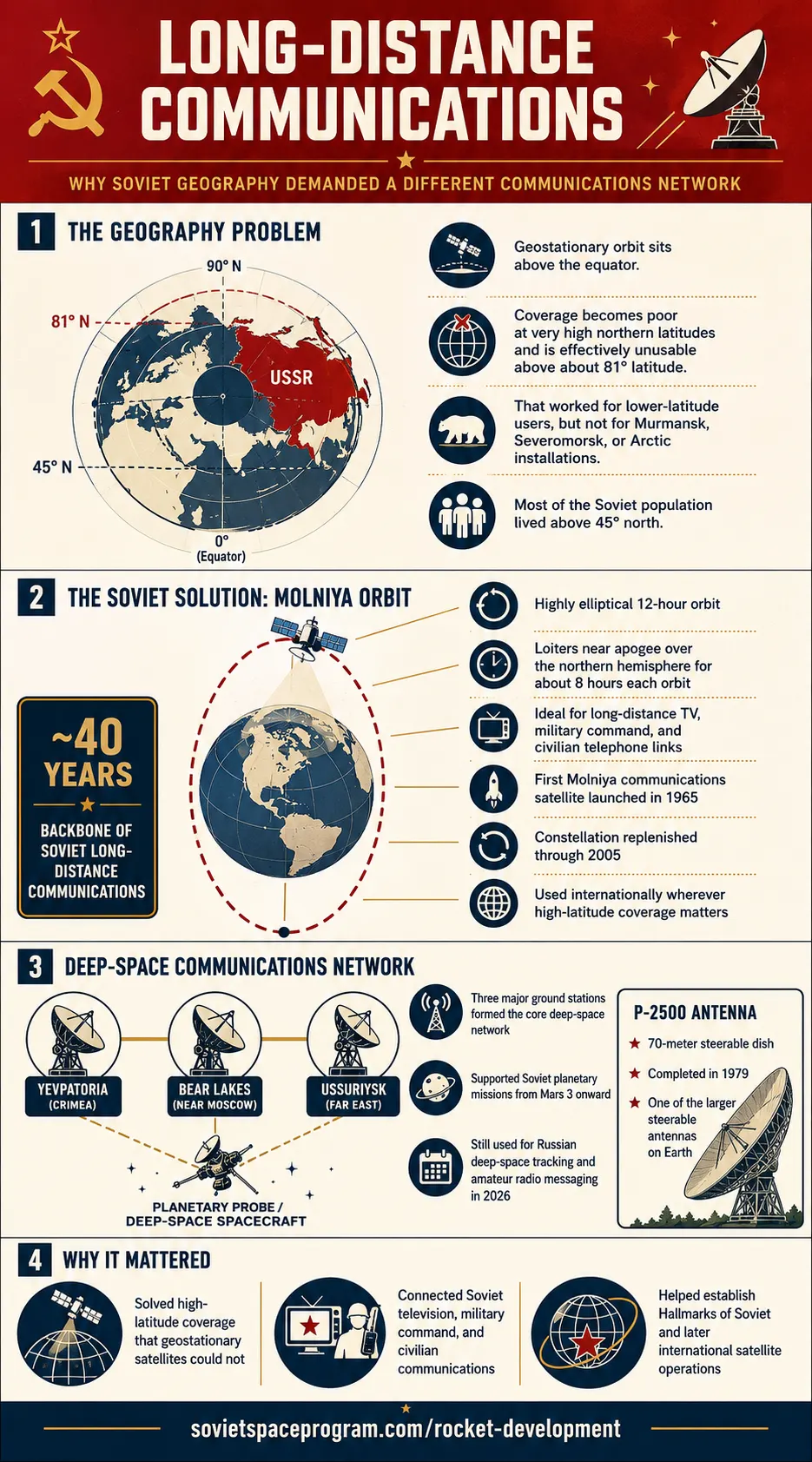
Soviet geography forced an unusual communications architecture on the program.
Geostationary orbit, the preferred satellite location for U.S. communications, sits over the equator and is invisible from latitudes above about 81 degrees.
Most of the Soviet population lived above 45 degrees, and Soviet military installations stretched to the Arctic. Geostationary satellites would have worked for Moscow but not for Murmansk or Severomorsk.
The Soviet solution was the Molniya orbit, a highly elliptical 12-hour ground-track that loiters at apogee over the northern hemisphere for about 8 hours per orbit.
The first Molniya communications satellite launched in 1965. The constellation, replenished through 2005, became the operational backbone of Soviet long-distance television, military command, and civilian telephone for forty years.
The Molniya orbit is now used by international operators wherever high-latitude coverage matters.
Deep-space communications were built around three ground stations: Yevpatoria (Crimea), Ussuriysk (far east), and Bear Lakes (near Moscow).
The Yevpatoria P-2500 antenna, 70 meters in diameter, was completed in 1979 and remains one of the larger steerable dishes on Earth.
It supported every Soviet planetary mission from Mars 3 onward and continues to be used for Russian deep-space tracking and amateur radio messaging into 2026.
Soviet Tech by the Numbers
Frequently Asked Questions
Did Soviet engineers really invent staged combustion?
Yes. The first flight of a staged-combustion engine, the Soviet S1.5400 on the Molniya upper stage, occurred in 1960. The cycle had been theoretically studied in both countries during the 1950s, but the Soviet program was the first to demonstrate it operationally. The first large staged-combustion engine, Glushko's RD-253 powering the Proton first stage, flew in 1965. The U.S. did not fly a staged-combustion engine until the Space Shuttle Main Engine in 1981, and even then on the fuel-rich side. Oxidizer-rich staged combustion, the Soviet specialty, did not fly on a U.S. engine until the Be-4 in 2024.
How did the Buran landing actually work without a crew?
The Buran flight control system was developed by NPO Molniya and used a dual-redundant onboard computer architecture with full pre-loaded ballistic trajectory data. The vehicle's main flight software, written in PROL2 (a derivative of PL/1), executed the de-orbit burn, hypersonic glide, and final approach autonomously, with ground stations at Yevpatoria, Ussuriysk, and Crimea providing radio-navigation aids during the descent. The November 1988 flight encountered an 18 m/s crosswind on final approach. A crewed U.S. Space Shuttle would have aborted the landing. Buran's software adjusted the glide path and touched down within 8 meters of the runway centerline. The vehicle never flew again because the Soviet Union dissolved before the next planned mission, and Russia could not afford to continue the program.
Why were Soviet space computers behind U.S. ones in raw performance?
They were not, on the metric the program cared about. The Apollo Guidance Computer ran at 2.048 MHz with 4 kilowords of read-only memory. The contemporary Argon-11S, flown on the Zond and Vostok programs in the same period, ran at about 1 MHz with 4 kilowords of memory. The Soviet machines were physically larger but used Soviet-manufacturable bipolar logic instead of the integrated circuits the U.S. program imported from Fairchild and Texas Instruments. By the Mir era in 1986, Soviet onboard computers had caught up on most metrics that mattered for orbital operations. The cultural gap was bigger than the technical gap.
Is Kurs still being used in 2026?
Yes. Kurs-NA, the digital flight-control variant introduced in 2007, is the standard docking system for Russian Progress freighters and Soyuz crew vehicles arriving at the International Space Station. It is also used by the Chinese Tianzhou cargo vehicles to dock with Tiangong, under license. The Russian-built docking ports on the ISS Zvezda and Nauka modules will continue to operate Kurs through the station's currently planned 2030 retirement.
What happened to BIOS-3?
BIOS-3 ran its last closed experiment in 1984 and the facility was mothballed during the post-Soviet funding collapse. The building still exists outside Krasnoyarsk and was partially restored in the 2010s as a heritage and research site by the Institute of Biophysics. The scientific lineage of BIOS-3 continued in three parallel programs: the European MELiSSA closed-loop life-support project, NASA's Controlled Ecological Life Support System (CELSS) work at Kennedy Space Center, and Chinese facilities at Beihang University. The 2016-2017 Lunar Palace 1 closure experiment in Beijing ran for 370 days, breaking the BIOS-3 record using a similar architecture.
Sources
- NPO Energomash engine catalog - official manufacturer specs for the RD-170 family
- RussianSpaceWeb (Anatoly Zak) - detailed Soviet/Russian mission histories
- Wikipedia: Hall-effect thruster - history and operational deployment of SPT-derived electric propulsion
- Wikipedia: Kurs (docking system)) - automated docking system operational history
- Wikipedia: BIOS-3 - closed-ecology life support facility at Krasnoyarsk
- Wikipedia: Buran (spacecraft)) - autonomous flight system and the November 1988 flight
- Wikipedia: Molniya (satellite)) - Soviet high-latitude communications constellation