The Soviet space stations were the seven publicly named Salyuts and the later Mir complex. Salyut 1 became the world's first space station on April 19, 1971. Over the next fifteen years, engineers developed stations that could receive supplies, exchange crews and stay occupied for longer missions. Mir took that work into a larger, modular laboratory.
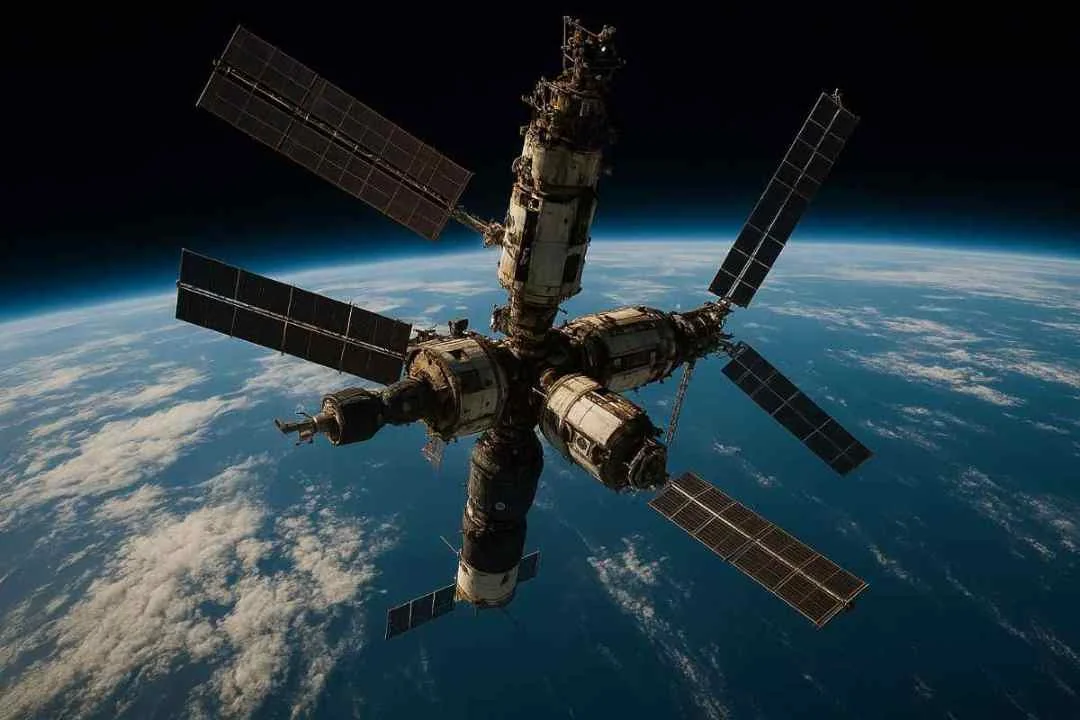
By Soviet Space Program. Updated September 4, 2026. Sources include NASA's station histories and mission reports, linked below. The header artwork and Shuttle-Mir image are AI-generated illustrations, not archival photographs.
Jump to the station list, Salyut and Mir comparison, military Almaz program, Mir modules, 1997 accidents or questions and answers.
List of Soviet Space Stations and Their Fate
| Station | Program | In orbit | Mission and fate |
|---|---|---|---|
| Salyut 1 | Civilian DOS | 1971 | First space station. Hosted Soyuz 11; reentered in October 1971. |
| Salyut 2 | Military Almaz | 1973 | Failed in orbit before a crew arrived; reentered in 1973. |
| Salyut 3 | Military Almaz | 1974-1975 | Reconnaissance station. Hosted Soyuz 14; reentered in January 1975. |
| Salyut 4 | Civilian DOS | 1974-1977 | Scientific station with two resident crews; reentered in February 1977. |
| Salyut 5 | Military Almaz | 1976-1977 | Last crewed Almaz station; reentered in August 1977. |
| Salyut 6 | Civilian DOS | 1977-1982 | Two docking ports and Progress resupply; reentered in July 1982. |
| Salyut 7 | Civilian DOS | 1982-1991 | Repaired by Soyuz T-13 in 1985. Last occupied in 1986; reentered in February 1991. |
| Mir | Modular civilian station | 1986-2001 | Operated by the USSR, then Russia; deliberately deorbited in March 2001. |
The count changes if failed development flights are included. DOS-2 was lost in a launch failure in 1972. DOS-3 reached orbit as Kosmos 557 in 1973 but failed before receiving a Salyut designation. These two flights bring the Salyut development total to nine vehicles, although only seven received public Salyut names. NASA's Salyut history explains the failures.
Salyut vs. Mir: What Changed?
| Feature | Salyut 1-5 | Salyut 6 and 7 | Mir |
|---|---|---|---|
| Main structure | Single station launched whole | Single main station; tests with attached TKS vehicles | Core plus five research modules and a docking module |
| Docking layout | One docking port | Two docking ports | Core with six ports; modules changed the available visiting-vehicle ports |
| Supply deliveries | Limited by single-port layout | Progress could dock with a crew Soyuz still attached | Progress resupply plus Shuttle visits in 1995-1998 |
| Crew operations | Separate expeditions | Long stays and visiting crews | Successive resident crews and international research visits |
The practical change was the ability to keep a station supplied without removing the crew's route home. A Soyuz remained docked as a return vehicle while another port received cargo or a replacement crew. The Soviet spacecraft size comparison places Salyut and Mir alongside the vehicles that served them.
Salyut and Almaz: Two Programs Under One Name
Salyut means 'salute' or 'firework'. The civilian DOS stations were developed by the organization descended from Sergei Korolev's design bureau. They supported science, Earth observation and research into long-duration spaceflight. The military Almaz stations came from Vladimir Chelomei's bureau and carried reconnaissance cameras.
The two programs shared the public Salyut name, but their missions differed. NASA's program history identifies Salyut 2, 3 and 5 as Almaz stations. All seven Salyuts launched on the Proton rocket.
Salyut 6 and 7: Resupply, Crew Visits and Repairs
Salyut 6 launched in 1977 with a second docking port. Progress freighters delivered propellant, water, food and equipment while the resident crew's Soyuz stayed attached. Visiting cosmonauts could arrive in a fresh Soyuz and leave in the older vehicle, extending the resident crew's stay without exceeding the return craft's orbital lifetime.
Salyut 7 continued this pattern after its 1982 launch. Its crews completed missions as long as 237 days. Experiments with the larger TKS spacecraft also tested attaching additional hardware to a station, a step toward the modular approach used on Mir. NASA's station history traces the transition.
Mir: The First Modular Space Station
Mir's core launched on February 19, 1986 UTC (February 20 in Moscow). It provided living quarters and a docking hub for later modules. NASA's account of the core launch describes a station designed to expand as new laboratories became available.
Five research modules followed between 1987 and 1996. Those modules launched on Proton rockets. The docking module took a different route: Atlantis delivered it on STS-74 in November 1995. Its extra clearance made Shuttle visits possible without repeatedly moving the Kristall module.
| Module | Launch year | Launch vehicle | Purpose |
|---|---|---|---|
| Core (DOS-7) | 1986 | Proton | Living quarters, control systems and docking hub |
| Kvant-1 | 1987 | Proton | Astrophysics instruments |
| Kvant-2 | 1989 | Proton | Airlock and life-support equipment |
| Kristall | 1990 | Proton | Materials research and Shuttle-compatible docking ports |
| Spektr | 1995 | Proton | Research equipment and additional solar arrays |
| Docking Module | 1995 | Atlantis, STS-74 | Clearance for Shuttle dockings |
| Priroda | 1996 | Proton | Earth-observation instruments |
Living Aboard Mir
Mir's longest continuous occupation lasted from September 1989 to August 1999. Valeri Polyakov's 1994-1995 mission lasted 437 days and 18 hours, providing medical observations across a much longer stay than a typical expedition. Daily life included exercise, maintenance and scientific experiments, supported by the station's water-recovery and oxygen-generation equipment.
The life-support technology and human spaceflight pages explain the equipment and medical work. Mir began as a Soviet station, then continued under Russia after the USSR dissolved in December 1991.
Shuttle-Mir: Cooperation Before the ISS
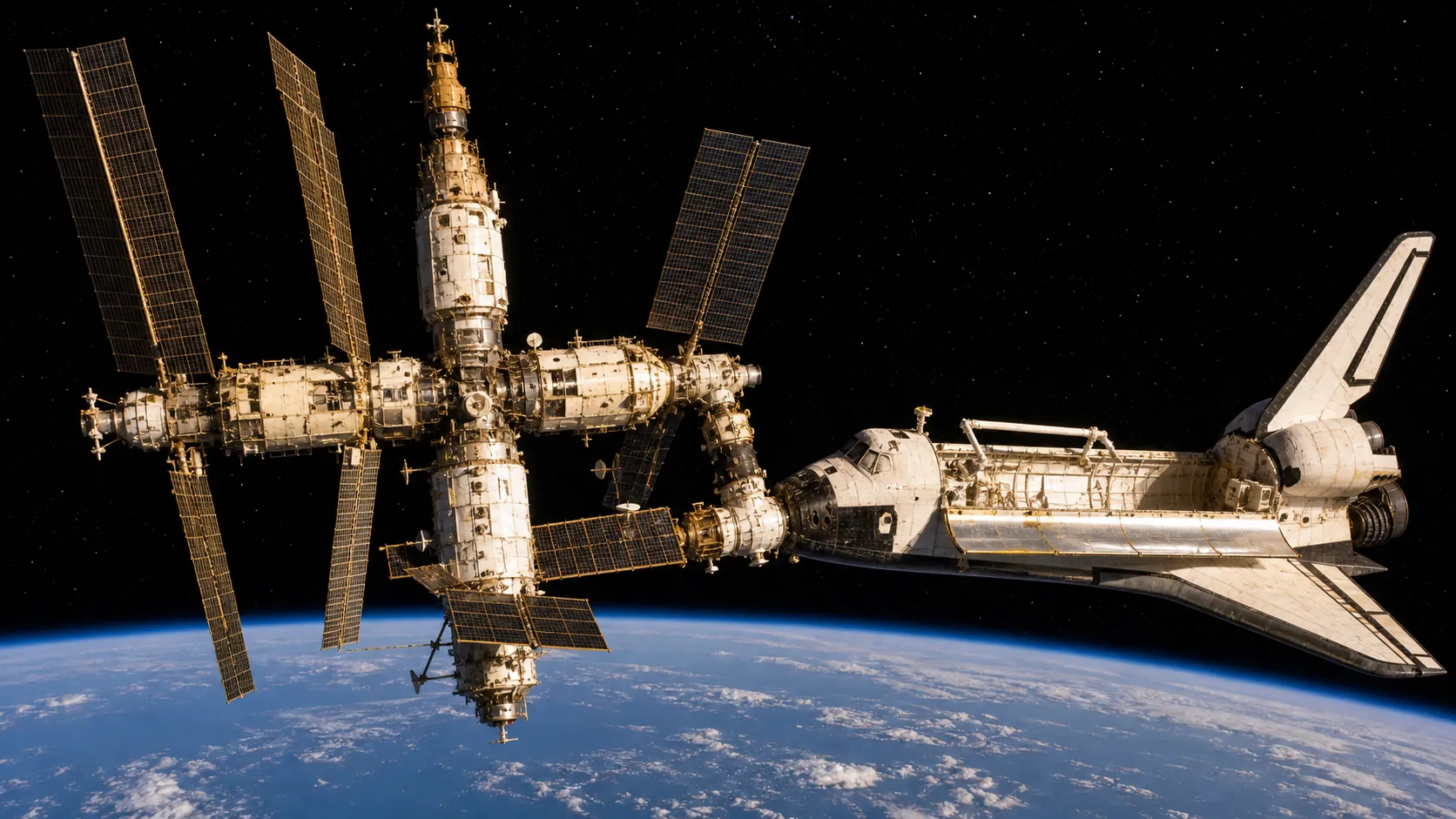
Shuttles docked with Mir nine times between 1995 and 1998. Seven American astronauts served long-duration stays. The Shuttle-Mir history records how crews and ground teams worked together before International Space Station assembly. This was not the first U.S.-Soviet docking: Apollo-Soyuz had brought the two countries' spacecraft together in 1975.
What Happened to Mir in 1997?
On February 23, 1997, an oxygen-generating canister caught fire. The crew fought the fire and cleared the smoke. ESA astronaut Reinhold Ewald, who was aboard, describes the incident in ESA's account of fire prevention in space.
On June 25, a Progress cargo spacecraft struck Spektr during a manual rendezvous test. The crew isolated the leaking module, which remained uninhabitable. Its electrical contribution was not lost permanently: later repair work recovered access to its solar arrays, as NASA's September 1997 reports document.
What Remains of Salyut and Mir?
None of these stations is still in orbit. Salyut 7 reentered in February 1991. Mir was deliberately deorbited over the South Pacific on March 23, 2001. Their engineering outlasted them: the ISS Zvezda service module developed from the planned Mir-2 station, continuing the DOS line.
For the wider sequence, see the Soviet space program timeline. The Soviet space program legacy page follows the later use of its spacecraft and technology.
Soviet Space Stations by the Numbers
Frequently Asked Questions
How many Soviet space stations were there?
Seven stations received the public names Salyut 1 through Salyut 7. Mir followed in 1986. That makes eight named stations in this series, but six of the seven Salyuts actually hosted crews. The wider development program also included the failed DOS-2 launch in 1972 and Kosmos 557 in 1973, neither of which received a Salyut number.
What was the first space station?
Salyut 1 was the world's first space station. The Soviet Union launched it on April 19, 1971. Its only resident crew arrived aboard Soyuz 11 and died during the return to Earth when their spacecraft lost cabin pressure.
Is Salyut 1 still in space?
No. Salyut 1 reentered Earth's atmosphere on October 11, 1971. None of the Salyut stations remains in orbit. Salyut 7 was the last to reenter, in February 1991; Mir followed in March 2001.
What does Salyut mean, and which stations were military?
Salyut means 'salute' or 'firework' in Russian. Salyut 2, 3 and 5 were military Almaz stations. Salyut 1, 4, 6 and 7 belonged to the civilian DOS program. The shared public name concealed the distinction between scientific stations and crewed reconnaissance platforms.
How was Mir different from the Salyut stations?
Mir was designed to expand into a modular complex, with a core, five research modules and a docking module. The earlier Salyuts launched as single main stations. Salyut 6 and 7 introduced two docking ports for resupply and visiting crews, and experiments with attached TKS spacecraft helped prepare the way for Mir.
Was Mir a Soviet or Russian space station?
Both. The Soviet Union launched Mir's core in February 1986. Russia continued operating and expanding the station after the USSR dissolved in December 1991. Mir was deliberately deorbited on March 23, 2001.
How long did people live aboard Mir?
Mir's longest stretch of continuous occupation ran from September 1989 to August 1999, about ten years. Valeri Polyakov spent 437 days and 18 hours in space during his 1994-1995 mission to Mir, studying the effects of a prolonged stay in weightlessness.
What happened to Mir in 1997?
An oxygen-generating canister caught fire in February. In June, a Progress cargo spacecraft collided with Spektr and depressurized that module. The crews survived both incidents. Spektr remained uninhabitable, but later repairs recovered electrical power from its solar arrays.
Sources and Further Reading
- NASA: History's Highest Stage, the Salyut generations and the transition to long-duration operations.
- NASA: Launch of Salyut, Salyut 1 and the early failed station launches.
- NASA: Mir Space Station, individual modules and Shuttle-Mir operations.
- NASA: STS-74 mission record, delivery of Mir's docking module aboard Atlantis.
- NASA: Mir-24 weekly reports, recovery of power after the Spektr collision.
- RussianSpaceWeb: Salyut 3, the Almaz reconnaissance mission and gun tests.