The Race to Build the First Station
By 1969 the Soviet space program had lost the Moon race. Sergei Korolev was dead. The N1 rocket was failing on every flight test. Apollo 11 had landed in July of that year.
Soviet leadership needed a recoverable narrative. An orbital station, kept in space for months at a time, would not match the symbolism of a Moon landing but would create a new category of human spaceflight that the U.S. did not yet operate in.
Two parallel station programs already existed. Vladimir Chelomei's OKB-52 was developing Almaz, a military reconnaissance station. The civilian DOS series (Dolgovremennaya Orbitalnaya Stantsiya, Long-Duration Orbital Station) was under the new OKB-1 leadership of Vasily Mishin.
In February 1970, Brezhnev personally approved a fast-track plan: take the Almaz hull, fit it with civilian Soyuz-compatible docking and crew systems, launch it before the Americans could fly their planned Skylab in 1973. The combined civilian-military hardware would be designated Salyut.
Construction took fourteen months. The first hull, designated DOS-1, was ready by early April 1971. It launched on April 19 from Baikonur on a Proton-K, the same heavy-lift workhorse described in detail on the Rocket Development page.
Inside the DOS-1 Architecture
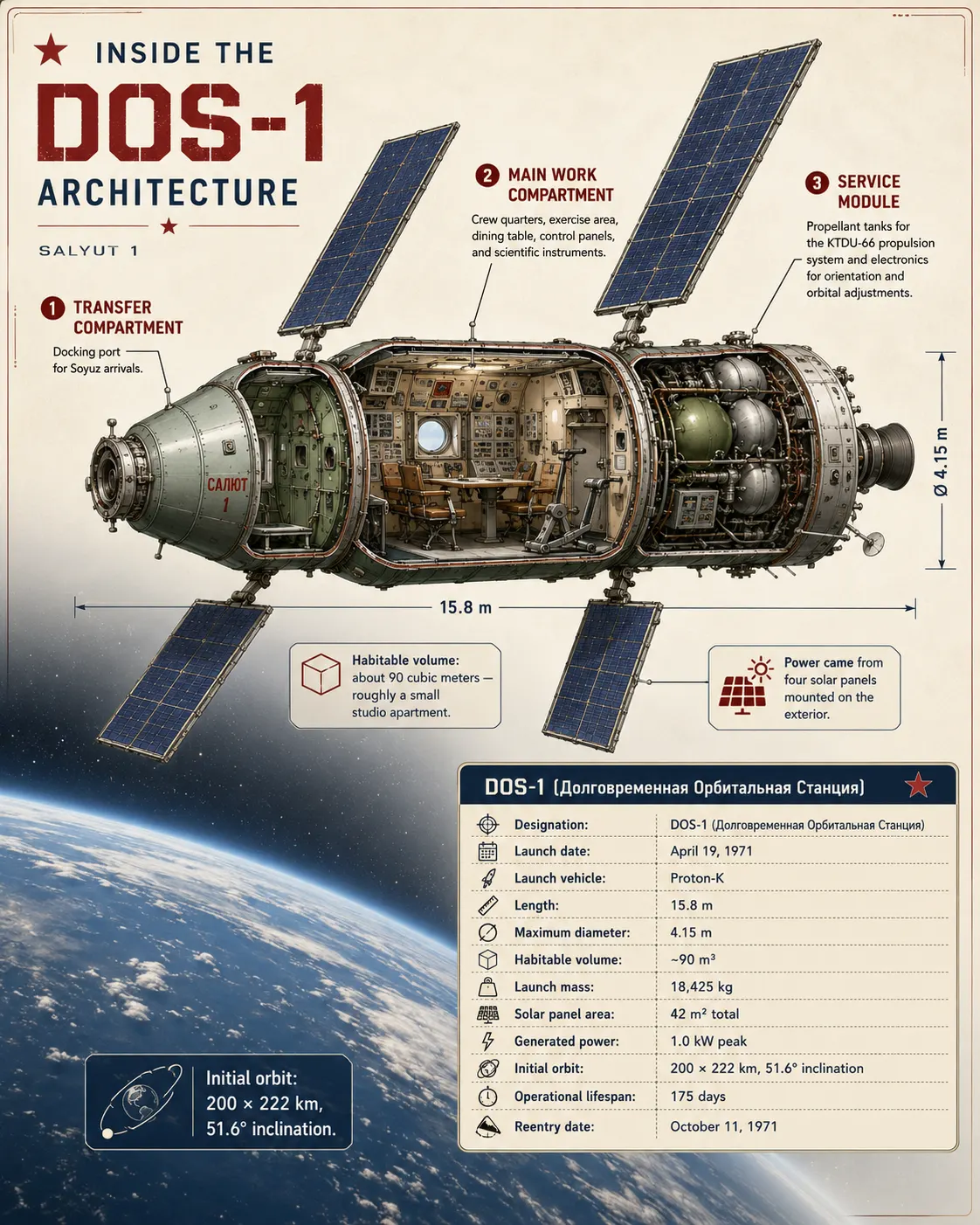
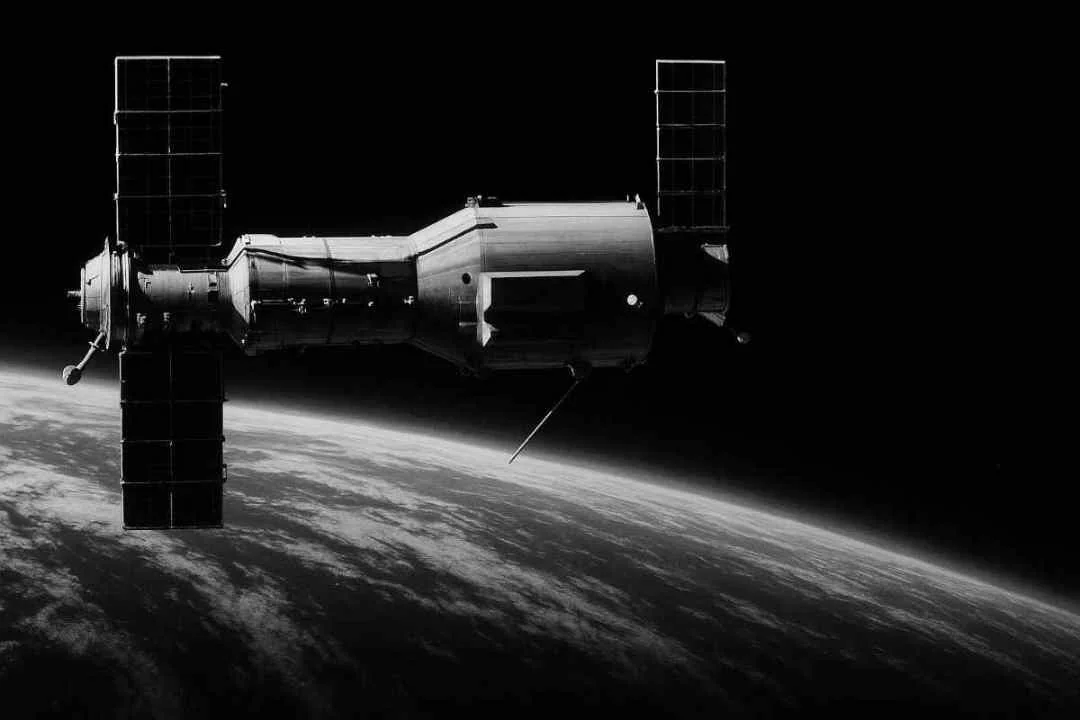
Salyut 1 was a 15.8-meter cylinder with a maximum diameter of 4.15 meters and three internal compartments: a small transfer compartment, the main work compartment, and a service module at the aft end.
The transfer compartment held the docking port for Soyuz arrivals. The main work compartment, about 4 meters in diameter, contained the crew quarters, exercise area, dining table, control panels, and most scientific instruments. The aft service module housed propellant tanks for the KTDU-66 propulsion system and electronics that controlled the station's orientation and orbital adjustments.
Total habitable volume was about 90 cubic meters, roughly the size of a small studio apartment. Power came from four solar panels mounted on the exterior, generating up to 1 kW when fully illuminated. Initial orbit was 200 by 222 km at 51.6° inclination, the same inclination later used by Mir and the ISS.
| Parameter | Value |
|---|---|
| Designation | DOS-1 (Долговременная Орбитальная Станция) |
| Launch date | April 19, 1971 (Baikonur, Site 81/24) |
| Launch vehicle | Proton-K |
| Length | 15.8 m |
| Maximum diameter | 4.15 m |
| Habitable volume | ~90 m³ |
| Launch mass | 18,425 kg |
| Solar panel area | 42 m² total |
| Generated power | 1.0 kW peak |
| Initial orbit | 200 × 222 km, 51.6° inclination |
| Operational lifespan | 175 days |
| Reentry date | October 11, 1971 |
Soyuz 10: The Failed Docking
Four days after Salyut 1 reached orbit, Soyuz 10 launched with the first crew: Vladimir Shatalov, Aleksei Yeliseyev, and Nikolai Rukavishnikov. The plan was a 22-day mission aboard the station.
Rendezvous and soft docking on April 24 went normally. When Shatalov attempted hard docking, the probe-and-drogue mechanism would not retract fully. After roughly five and a half hours of station-keeping at soft-dock, with the docking collar unable to lock, mission control ordered an abort.
Soyuz 10 returned to Earth on April 25 having never opened the hatch. Post-flight analysis traced the problem to a damaged docking probe on the Soyuz vehicle, not a Salyut 1 fault. The station was still healthy.
Soviet engineering teams spent six weeks redesigning the docking probe assembly and qualifying it for the next mission. By early June 1971 the redesigned hardware was on the pad.
Soyuz 11: Twenty-Three Days That Changed Spaceflight
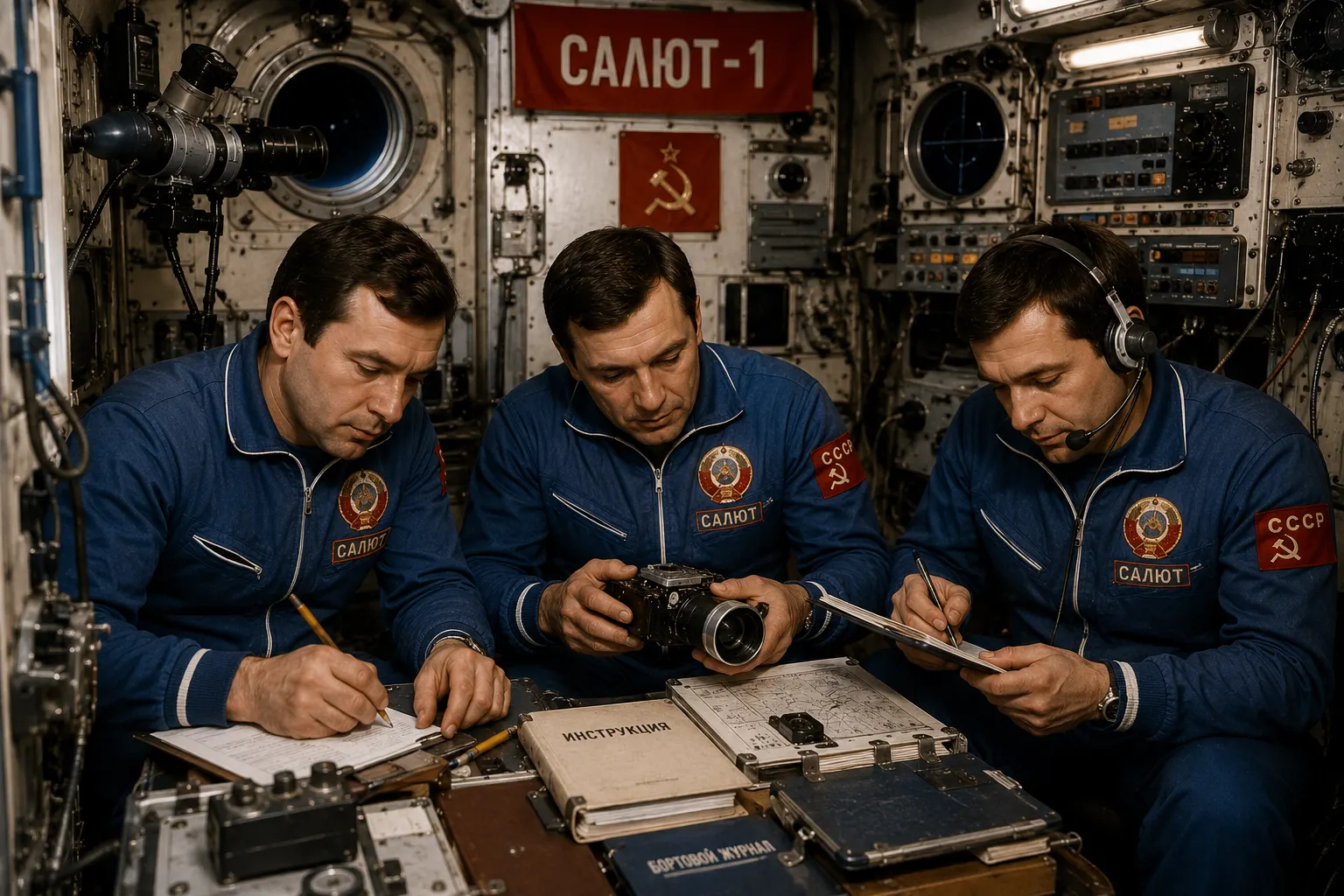
Soyuz 11 launched June 6, 1971 carrying Georgy Dobrovolsky (commander, age 43), Vladislav Volkov (flight engineer, 35), and Viktor Patsayev (research engineer, 38). All three were originally on the backup crew. They had been promoted three days before launch when the prime crew commander Alexei Leonov was grounded due to a medical concern about Valeri Kubasov.
Hard docking succeeded on June 7. The crew transferred into Salyut 1 and began the longest crewed spaceflight in history to that point.
The 23-day science program covered Earth observation through high-resolution cameras, stellar ultraviolet spectroscopy with the Orion 1 telescope built by Czech engineers, plant growth experiments with the Oasis biological chamber, and constant biomedical telemetry to monitor the cardiovascular effects of long-duration microgravity.
The Orion 1 results were the first telescope-based UV stellar observations from orbit. They gave Soviet astronomers spectra of Vega and Beta Centauri with wavelengths below 200 nanometers, which the atmosphere blocks entirely from ground observation.
Public coverage in the Soviet Union was unprecedented. Vremya, the state evening news, carried live updates from the station nearly every night. By the time undocking was scheduled on June 29, the three crew members were national figures.
The Tragedy of Soyuz 11
Soyuz 11 undocked from Salyut 1 at 21:28 GMT on June 29, 1971. The deorbit burn went normally. The descent module separated from the orbital and service modules at 23:47 GMT, at an altitude of 168 km.
Module separation in the Soyuz architecture fires twelve pyrotechnic charges sequentially to break the bolts connecting the three sections. On Soyuz 11, the charges fired simultaneously instead of sequentially. The shock opened a pressure-equalization valve that was only supposed to open below 4 km altitude.
The cabin depressurized to vacuum in approximately 30 to 40 seconds. The three crew members were not wearing pressure suits. The interior of the Soyuz descent module was too cramped for three crew members in suits, and the Soviet program had accepted the risk of unsuited operation since the original Voskhod 1 flight in 1964.
Telemetry showed heart rates spiking, then dropping to zero within about a minute of valve opening. The descent module continued its automatic re-entry on full ballistic-recovery autopilot. Parachutes deployed normally. The capsule landed in Kazakhstan at 02:16 GMT on June 30.
The Soviet recovery crews opened the capsule expecting to greet returning cosmonauts. They found Dobrovolsky, Volkov, and Patsayev dead in their seats. Resuscitation attempts continued for about an hour at the landing site. None succeeded.
Aftermath: Pressure Suits and Salyut 2
Soviet human spaceflight was suspended for 27 months while the Soyuz descent architecture was redesigned. The pressure-equalization valve was relocated and its firing logic isolated from the module-separation pyrotechnics. More importantly, the requirement to wear pressure suits during launch and landing was permanently restored.
The new Sokol-K (and later Sokol-KV) pressure suits required removing one crew member from each Soyuz flight to make room. From Soyuz 12 in September 1973 until Soyuz T-3 in 1980, Soyuz flew with two crew members instead of three. Soyuz only returned to a three-person configuration in 1981 with the Soyuz T-4 mission, on the redesigned Soyuz-T spacecraft.
Salyut 1 itself was deliberately deorbited on October 11, 1971, 175 days after launch. The station's KTDU-66 engine was fired for a final retrograde burn that put the vehicle on a trajectory to break up over the Pacific. No crew ever flew to it again.
The next civilian station, DOS-2, was lost in a launch failure in July 1972 and received no Salyut number. Salyut 2, launched in April 1973, was the military Almaz OPS-1 station; it failed in orbit before a crew arrived. Another civilian station, DOS-3, reached orbit as Kosmos 557 in May 1973 but also failed. NASA's Salyut history separates these flights. The next successful civilian station was Salyut 4, launched in December 1974.
Legacy: From Salyut 1 to the ISS
Despite ending in catastrophe, Salyut 1 established the operational template for every space station that followed. The single-launch monolithic hull with internal compartments, the soft-then-hard docking sequence, the rotational crew architecture, and the integration of military and civilian payloads were all first proven on DOS-1.
Six more numbered Salyuts launched between 1973 and 1982. Salyut 4, 6 and 7 belonged to the civilian DOS line; Salyut 2, 3 and 5 were military Almaz stations. Salyut 6 introduced a second docking port for Progress resupply and visiting crews. Salyut 7 supported missions as long as 237 days. The Soviet space station comparison shows how their docking layouts and supply arrangements developed.
The architecture culminated in Mir, launched February 1986, which extended the modular concept to a full multi-module station. The 15-year operational record of Mir, and the Soviet/Russian life-support hardware that ran on it, is covered on the Space Stations page.
The Russian segment of the International Space Station (Zvezda, Zarya, Nauka, Prichal, Pirs/Poisk) descends directly from the Salyut 1 DOS hull design. Zvezda's central work compartment is essentially a derivative of the Salyut module that flew in 1971. The same docking-port architecture invented for Salyut 1 still receives Soyuz and Progress vehicles in 2026.
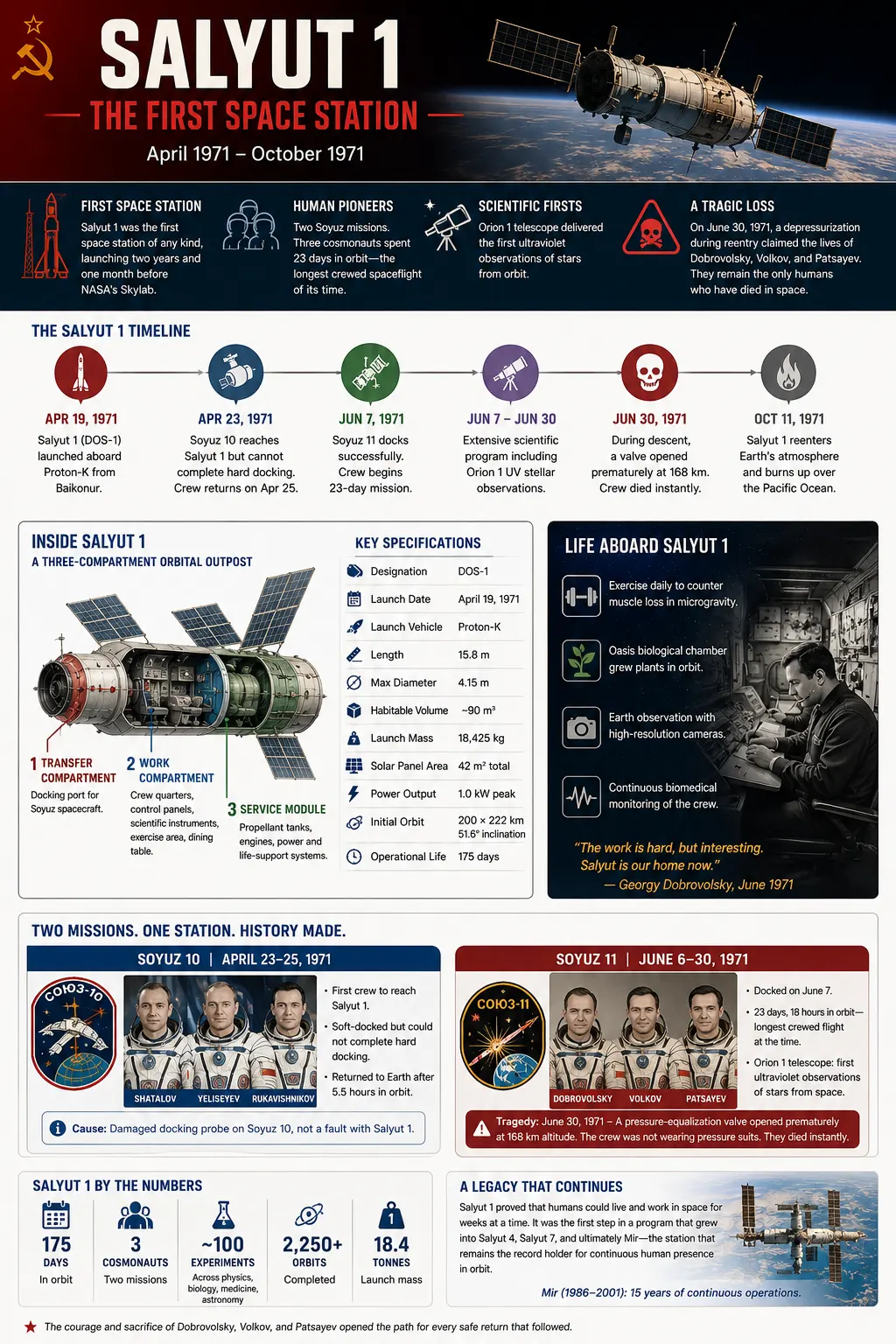
Salyut 1 by the Numbers
Salyut 1 Key Dates
| Date | Event |
|---|---|
| Feb 9, 1970 | Brezhnev authorizes the DOS-1 fast-track program. Combined civilian/military Almaz-derived design. |
| Apr 19, 1971 | Salyut 1 (DOS-1) launched from Baikonur Site 81/24 on a Proton-K rocket. |
| Apr 23, 1971 | Soyuz 10 launched. Soft-docks with Salyut 1 the next day but cannot achieve hard docking due to damaged probe. |
| Apr 25, 1971 | Soyuz 10 returns to Earth after about 31 orbits. |
| Jun 6, 1971 | Soyuz 11 launched with Dobrovolsky, Volkov, Patsayev. Backup crew, promoted three days before launch. |
| Jun 7, 1971 | Soyuz 11 docks with Salyut 1. Crew transfers aboard and begins the 23-day science program. |
| Jun 29, 1971 | Soyuz 11 undocks at 21:28 GMT. |
| Jun 30, 1971 | At 23:47 GMT June 29, descent module separation causes pressure-equalization valve to open at 168 km. Crew dies. Capsule lands automatically at 02:16 GMT in Kazakhstan. |
| Jul 1, 1971 | Soviet government announces the deaths. National day of mourning declared. Crew interred in Kremlin Wall Necropolis. |
| Jul 1971 – Oct 1971 | Salyut 1 continues to orbit unmanned. No further crews are sent. |
| Oct 11, 1971 | Salyut 1 deliberately deorbited over the Pacific Ocean. 175 days in space. |
| Sep 27, 1973 | Soyuz 12 launches as first crewed mission after the redesign. Two cosmonauts in new Sokol-K pressure suits. |
Frequently Asked Questions
Was Salyut 1 really the first space station?
Yes. Salyut 1 reached orbit on April 19, 1971. The U.S. Skylab launched on May 14, 1973 (two years and 25 days later). China's Tiangong-1 launched in 2011. Salyut 1 predated every other space station, including all of the subsequent Salyut series, Skylab, Mir, the ISS, and Tiangong. No definition of 'space station' (continuously crewed, occasionally crewed, military or civilian) puts anything in orbit ahead of it.
Why weren't the Soyuz 11 cosmonauts wearing pressure suits?
The Soyuz descent module interior is approximately 4 cubic meters. Fitting three crew members in seats already required minimal personal equipment. Pressure suits, which add about 25 kg per person and roughly double the volume each crew member needs, would not fit alongside three seated crew. Soviet planners had accepted the risk of unsuited operation since Voskhod 1 in October 1964, the first multi-crew spaceflight. The Soyuz 11 disaster ended that policy permanently. Sokol-K suits became mandatory for all Soyuz launches and landings from Soyuz 12 in 1973 onward, and the resulting volume penalty reduced Soyuz crew capacity from three to two for the next eight years.
What scientific work did the Soyuz 11 crew actually accomplish?
Twenty-three days of orbital science across four programs. The Orion 1 ultraviolet telescope, built by Czech researchers at the Astronomical Institute in Ondřejov, recorded UV spectra of Vega and Beta Centauri at wavelengths below 200 nm (impossible from ground observations). Earth observation cameras captured high-resolution imagery of the Soviet Union and the Pacific. The Oasis biological chamber tested plant growth in microgravity, the precursor to all later space agriculture experiments. Continuous biomedical telemetry tracked the cardiovascular effects of three weeks in microgravity, establishing the baseline data that all later long-duration crews were measured against.
Could the Soyuz 11 crew have been saved?
No. Telemetry indicates that the cabin depressurized to vacuum within about 30 seconds of the pressure-equalization valve opening at 168 km altitude. Unsuited crew at that altitude have less than 15 seconds of useful consciousness in vacuum. The valve was located behind the commander's seat and could in principle have been closed manually, but its location and the speed of decompression made that practically impossible. Post-incident analysis concluded that no recovery action by the crew could have saved them once the valve opened.
Why was Salyut 1 deorbited instead of refueled or reused?
Salyut 1 had no provision for refueling, no second docking port for resupply vehicles, and limited consumables for further crewed visits. By July 1971 the Soviet program had also concluded that the Soyuz architecture needed a complete redesign before another crewed flight, which would take at least two years. Keeping the station in orbit unmanned for that long offered no scientific return that warranted the orbital-debris risk of an uncontrolled reentry later. The decision to deorbit deliberately on October 11, 1971 was a routine end-of-mission action, not a response to a failure of the station itself. Salyut 1 was still healthy when it was destroyed.
Where are Dobrovolsky, Volkov, and Patsayev buried?
All three crew members are interred at the Kremlin Wall Necropolis in Red Square, Moscow, in urns following cremation. They lie alongside other major Soviet figures including Yuri Gagarin, Sergei Korolev, Vladimir Komarov (the first cosmonaut to die in a space mission, Soyuz 1, 1967), Valentin Glushko, and Mstislav Keldysh. Their portraits appear at the entrance to the Memorial Museum of Cosmonautics in Moscow alongside the other 19 cosmonauts and astronauts lost in spaceflight.
Sources
- RussianSpaceWeb: Salyut - Anatoly Zak's detailed history of the Salyut program
- RKK Energia: Salyut 1 spacecraft archive - the manufacturer's official Salyut 1 historical page
- Wikipedia: Salyut 1 - cross-referenced reference article on the station
- Wikipedia: Soyuz 11 - reference article on the mission and crew loss
- Wikipedia: Soyuz 10 - reference article on the failed docking mission
- NASA: Space Stations - NASA's reference on station history including Salyut 1
- Memorial Museum of Cosmonautics - official museum at the Monument to the Conquerors of Space in Moscow, with the Soyuz 11 archive