Origins of the Soviet Space Program
The Soviet space program grew out of the rocket race that followed World War II. Both superpowers had spent the final months of the war racing to capture German V-2 hardware and the engineers who built it.
The United States got Wernher von Braun and most of his Peenemünde team through Operation Paperclip. The Soviets pulled in V-2 parts, production tooling, and a smaller pool of German technicians who were relocated to Soviet design bureaus for the late 1940s.
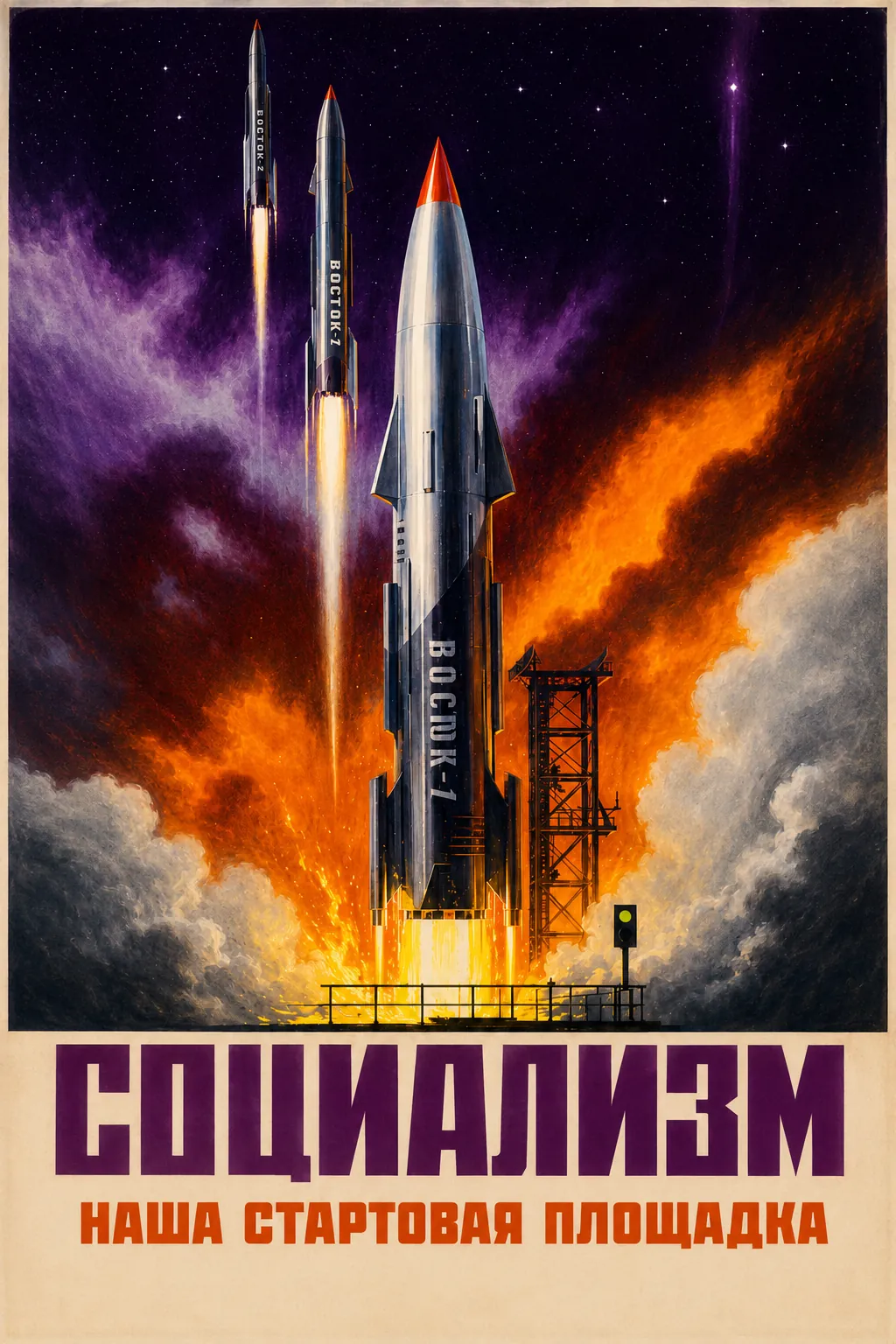
Stalin saw two uses for the new technology. Long-range rockets could carry nuclear warheads across continents, and orbital firsts could prove that communism produced better science than capitalism. Both motives shaped the program from the start.
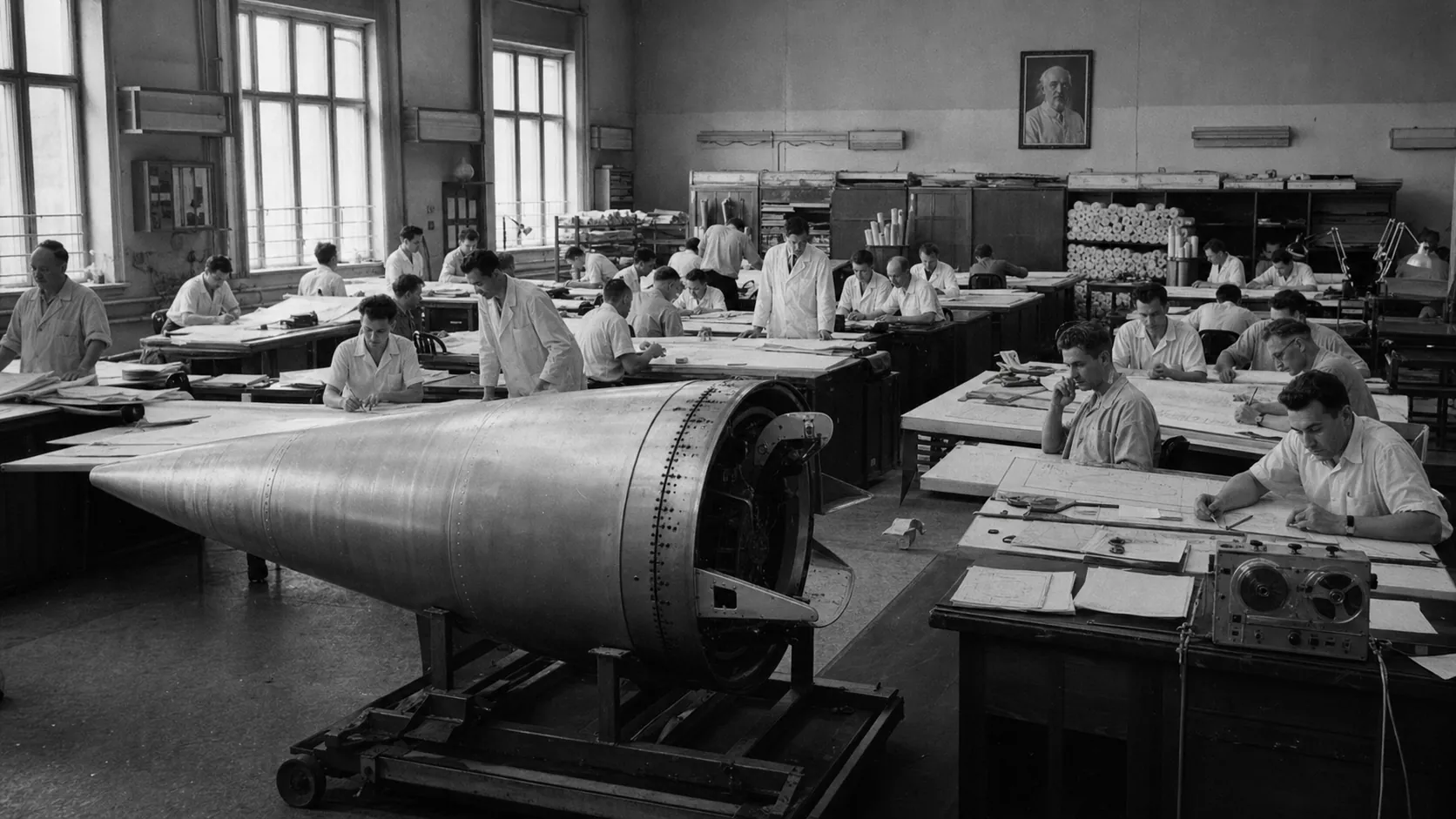
By the mid-1950s, Sergei Korolev had emerged as the visionary leader of the Soviet effort. He worked in secret under the cryptic designation "Chief Designer." His R-7 rocket, originally an ICBM, became the launcher that put Sputnik 1 into orbit in October 1957.
For the wider rocket story from R-7 to Energia, see Rocket Development.
The Cold War Space Race
Sputnik landed in American politics like a thrown brick. Within twelve months Congress had passed the National Defense Education Act, the Eisenhower administration had created NASA out of the old NACA, and federal R&D spending climbed sharply across science, mathematics, and engineering. The shock was less about the satellite itself and more about what the launcher implied - a rocket that could put 83 kg into orbit could put a warhead on Washington.
Soviet leadership read those reactions as a green light. Orbital firsts cost a fraction of what conventional military spending did and produced outsized propaganda dividends. So the two superpowers settled into a parallel competition: a public race to space, and a missile arms race underneath it, both feeding off the same R-7 family of rockets and the same engineers.
Political Motivations
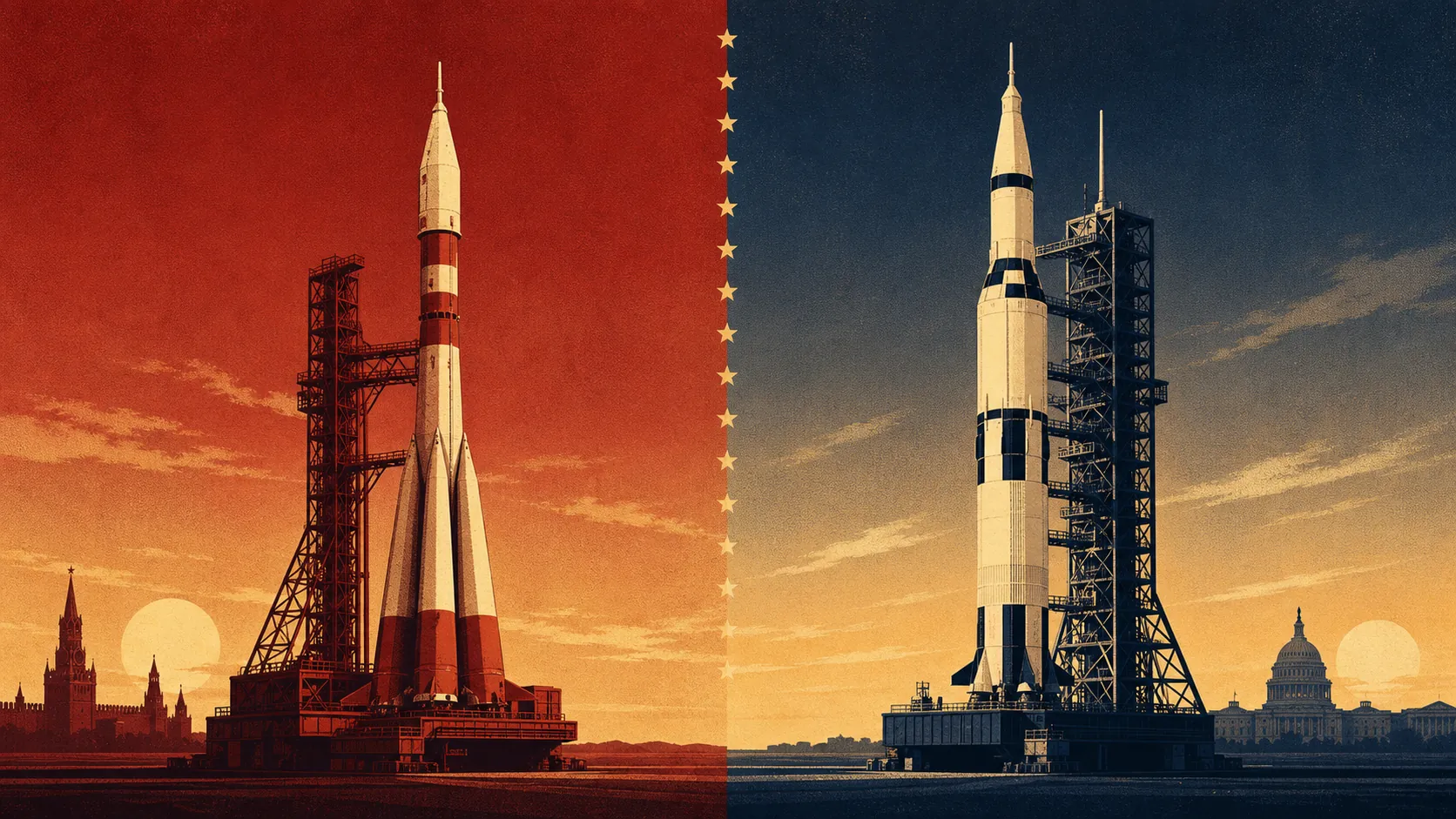
The space race was a battle for global influence. Every successful launch was framed as proof that one political system produced better engineers, better science, and better citizens than the other.
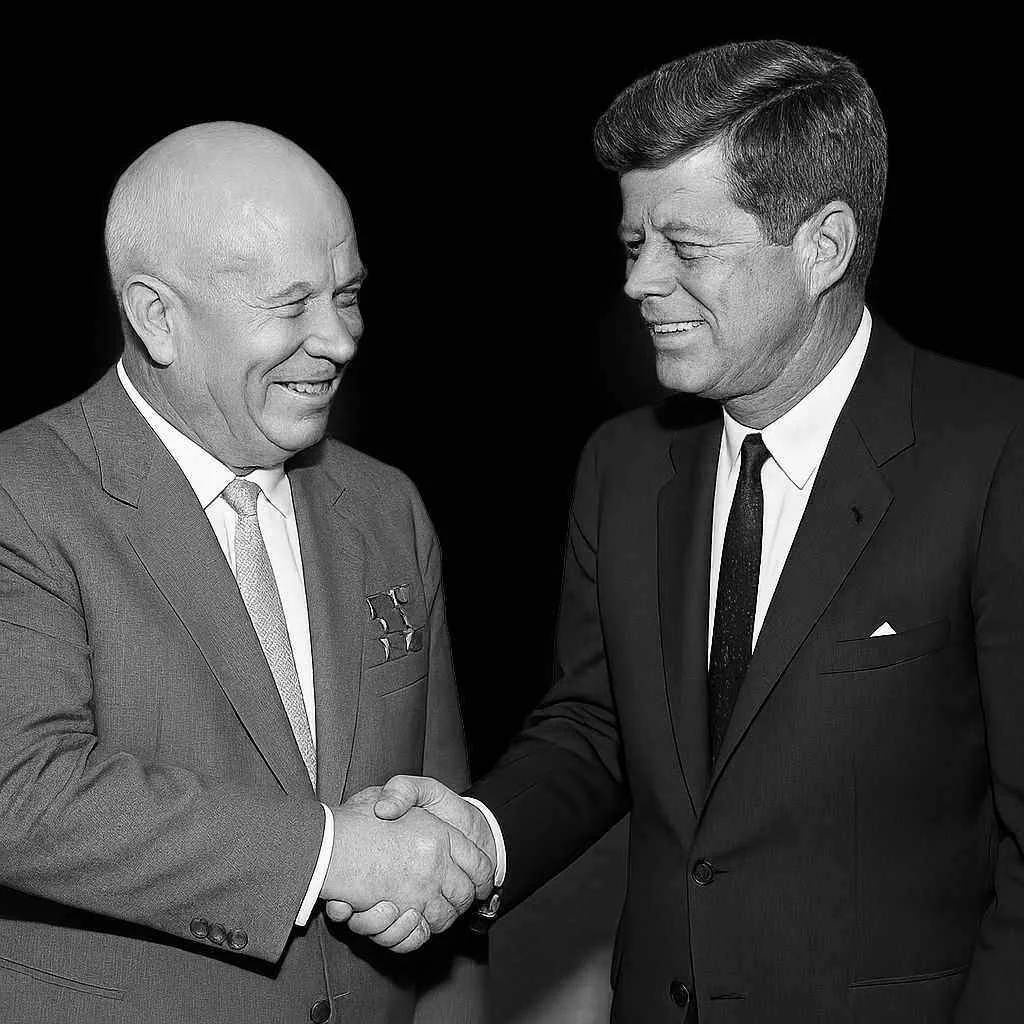
For Nikita Khrushchev, space firsts let the Soviet Union project technical superiority cheaply. A satellite the size of a beach ball traveled around the planet every 96 minutes and reminded the world that the same rockets could deliver thermonuclear weapons.
That propaganda dimension is covered in depth on the Cultural Impact page.
Military Implications
The civilian space program and the missile program were never really separate. Rockets that put satellites into orbit could also drop warheads on targets 6,000 miles away. Soviet leadership treated the two as one budget line.
Reconnaissance satellites, communications relays, and missile-launch warning systems all had military uses. So did the unmanned missions program, which doubled as a proving ground for ICBM guidance and re-entry.
Tensions peaked in the early 1960s after Yuri Gagarin's flight and President Kennedy's commitment to landing a man on the Moon before the decade ended. The Soviets logged early firsts, including the first human in space, the first spacewalk, and the first woman in space. The U.S. closed the gap with the Apollo program and reached the lunar surface first in July 1969.
The Cold War Space Race in Numbers
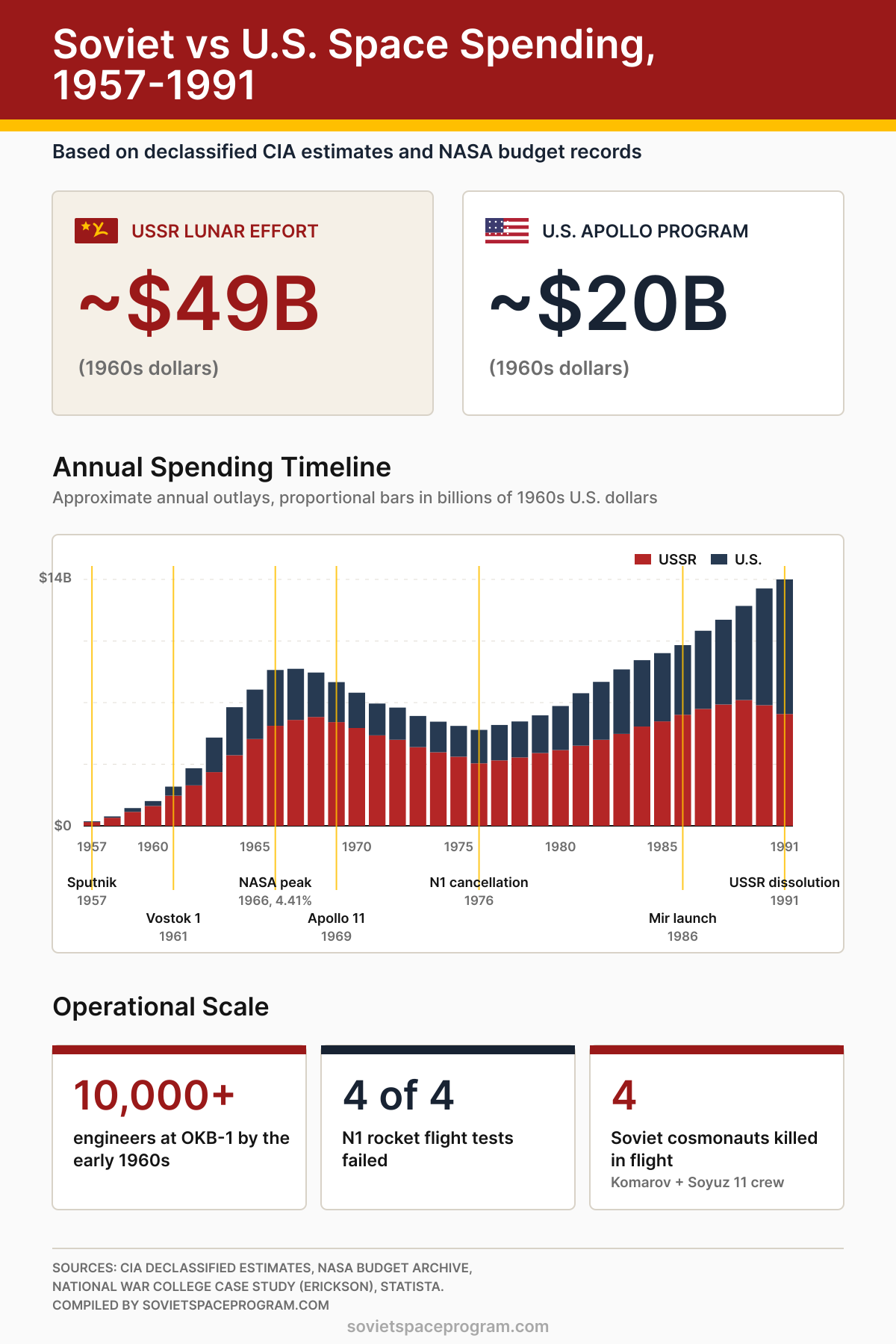
Comparing the two programs is harder than it looks. Soviet budgets were a state secret until Gorbachev publicly disclosed them in 1989. The figures below pull from declassified CIA estimates, the 1989 Soviet disclosure, NASA's budget archive, and academic reconstructions. Treat the Soviet numbers from before 1989 as informed estimates, not audited totals.
Key Political Figures
Nikita Khrushchev
Soviet Premier (1953 - 1964). Khrushchev was the program's loudest backer in the Politburo. He announced most of the early Soviet space firsts personally and used them as direct Cold War propaganda.
Leonid Brezhnev
Soviet Leader (1964 - 1982). After losing the Moon race, Brezhnev's administration pivoted Soviet space ambitions toward long-duration missions and space stations. The Salyut program began on his watch.
Mikhail Gorbachev
Soviet Leader (1985 - 1991). Gorbachev's glasnost and perestroika reforms opened the previously secretive program to international cooperation. That eventually led to the Mir-Shuttle docking program with the United States.
Scientific Leadership
Political leaders signed the checks. The real architects of the program were the chief designers and theorists who ran the closed design bureaus, identified only by number for security reasons.
Sergei Korolev - The Chief Designer
Led the R-7 rocket and the early Sputnik and Vostok programs. His identity was a Soviet state secret until his death in 1966.
Valentin Glushko - Rocket Engine Designer
Built the engines for most Soviet rockets and took over the merged design bureaus after Korolev died. Read his biography.
Vladimir Chelomei - Proton Rocket Designer
Designed the Proton rocket and proposed alternative crewed lunar architectures that competed with Korolev's. See his biography.
Mstislav Keldysh - The Chief Theorist
Mathematician who calculated orbital trajectories and coordinated the program's research direction. Read more about Keldysh.
Explore Related Topics
Rocket Development
From the R-7 to Energia and the Buran shuttle. Read more.
Human Spaceflight
The cosmonauts who flew Vostok, Voskhod, and Soyuz missions. Read more.
Cultural Impact
How the program shaped Soviet identity, art, and propaganda. Read more.
Timeline
Every major Soviet space milestone from 1957 to 1991. View timeline.
Legacy
What Soviet space engineering still influences today. Read more.
Space Race Tool
Compare Soviet and U.S. firsts side by side. Open tool.
Frequently Asked Questions
How much did the Soviet space program cost?
Soviet budgets were a state secret until Gorbachev's 1989 disclosure. Declassified CIA estimates put Soviet space spending at about $7 billion in then-year dollars at its 1969 peak (National Archives, CIA Oct 1970). The 1989 disclosure showed an annual budget of 6.9 billion rubles, equal to roughly 1.5% of Soviet GDP, with more than half going to military programs (Deseret News archive).
Did the Soviet Union spend more than the U.S. on the space race?
On headline dollars, the U.S. likely spent more. The U.S. funneled roughly $30 billion into space between Sputnik (1957) and the Moon landing (1969), with Apollo alone reaching $25.4 billion. As a share of GDP, Soviet spending was much heavier - the U.S. economy was nearly twice the size of the Soviet economy. Estimates for Soviet manned-program spending through 1969 range from $4.8 billion to $10.1 billion, less than half what NASA spent on manned programs over the same window (Source: CIA declassified comparison).
How many Soviet cosmonauts have died in space?
Four. Vladimir Komarov died on Soyuz 1 in April 1967 when his capsule's parachute failed during re-entry. Three more - Georgy Dobrovolsky, Vladislav Volkov, and Viktor Patsayev - died on Soyuz 11 in June 1971 when a valve opened during separation and depressurized the cabin. No Russian or Soviet crewed mission has had a fatality since.
Why did the Soviet Union lose the Moon race?
Multiple reasons stack up. The N1 super-heavy rocket failed on all four flight tests because its 30-engine first stage was never fully static-fired before launch. Funding came late after Korolev's death in 1966. Internal rivalries between Korolev, Glushko, and Chelomei split engineering talent across competing architectures. See N1 on Wikipedia) for the technical autopsy.
How big was the Soviet space program's workforce?
Korolev's OKB-1 bureau alone grew from a few hundred engineers in the early 1950s to more than 10,000 by the early 1960s. Total industry-wide employment across all design bureaus (OKB-1, Glushko's OKB-456, Chelomei's OKB-52, Yangel's OKB-586, Lavochkin, and others) plus production plants and launch sites ran into the hundreds of thousands (Source: Wikipedia: OKB).
When did the Soviet space program officially end?
The Soviet space program ended when the USSR dissolved on December 26, 1991. Its assets, personnel, and ongoing missions transferred to Roscosmos (Russia) and partner agencies in Ukraine and Kazakhstan. Most of the program's launch infrastructure - including the Baikonur Cosmodrome - sits in Kazakhstan and is still operated under a long-term lease.
Additional Resources
- National Archives: 1970 CIA document on Soviet space spending - the declassified estimate behind the $7B 1969 peak figure.
- Deseret News archive: 1989 Soviet space budget disclosure - contemporaneous reporting on Gorbachev's first public disclosure.
- CIA: Comparison of US and Estimated Soviet Spending - declassified side-by-side analysis.
- CIA: Estimated Costs of the Soviet Space Programs - cost breakdown by mission family.
- National Security Archive: NIE 11-1-73 Soviet Space Programs - the National Intelligence Estimate on Soviet space capability.
- GlobalSecurity.org: 1976-1980 Resource Burden of the Soviet Space Program - reconstruction of mid-program spending share of GNP.
- The Planetary Society: How much did Apollo cost? - inflation-adjusted breakdown of NASA's manned programs.
- NASA History: The Soviet Space Program - NASA's perspective on Sputnik and the Space Race.
- Russian Space Web - detailed mission chronology and technical archive.
- Encyclopedia Astronautica - reference encyclopedia for spaceflight, including most Soviet missions.