The Sputnik Shock
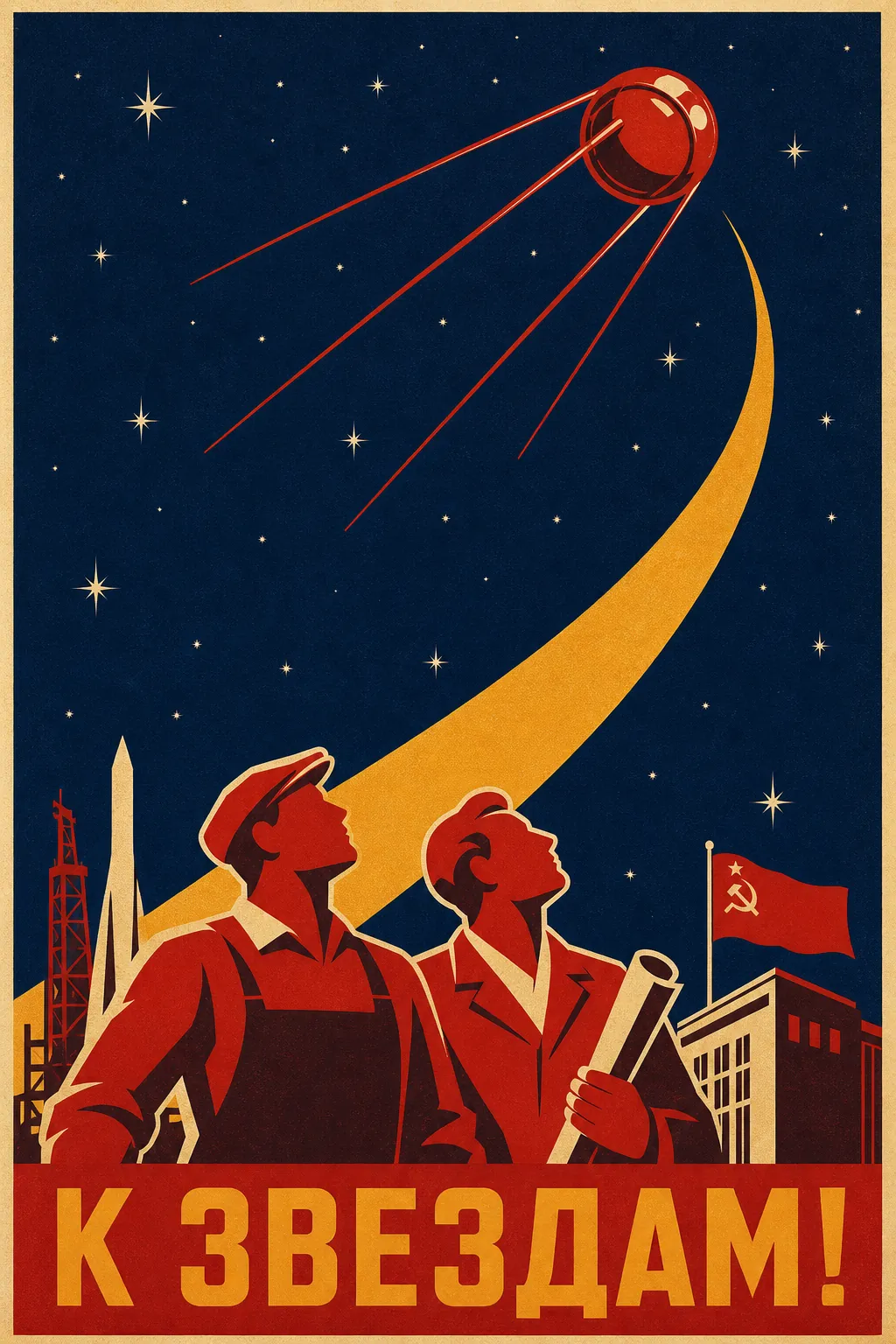
In October 1957 a 58-centimeter aluminum sphere - about the size of a beach ball, 83.6 kg with its four whip antennas trailing behind - began circling the Earth every 96 minutes. Inside the USSR the response was immediate national pride. Outside, it was something closer to panic. The shock was less about the satellite itself and more about what its rocket implied: a launcher capable of putting Sputnik into orbit was also capable of putting a thermonuclear warhead on Washington. American newspapers ran above-the-fold headlines for weeks, schools added physics and math hours, and within a year Congress had created NASA and passed the National Defense Education Act.
Soviet leadership noticed which lever they had just pulled. Space firsts produced outsized cultural returns at a fraction of the cost of conventional propaganda. By the time Gagarin flew in 1961, the program had become the showcase exhibit for Soviet modernity.
The economic and military side of that calculation is covered in detail on the Historical Context page. This page is about what the program did to Soviet culture and identity.
The Cult of the Cosmonaut
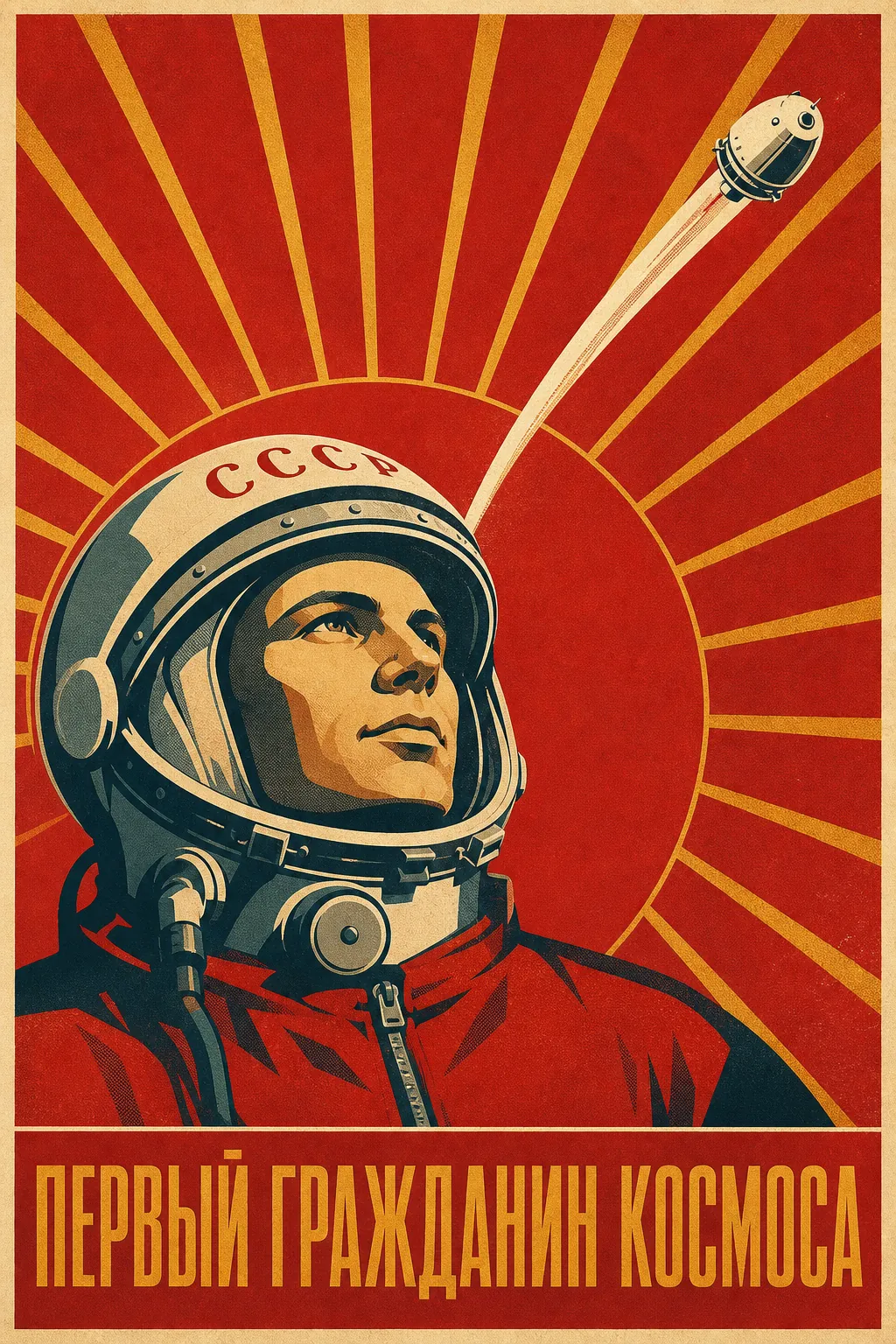
Stalin died in 1953. By 1956 Khrushchev had publicly denounced his predecessor's personality cult in the Secret Speech. The vacuum that left was filled by a different kind of state hero: the cosmonaut.
Cosmonauts were photogenic, technically credentialed, working-class in origin, and politically safe. They could be paraded through every Soviet republic, sent on foreign tours, and printed on stamps without the awkwardness that came with deifying a living politician.
Gagarin in particular was custom-built for the role. He was a former metalworker, came from a peasant village, was telegenic, and had a famously easy smile. His exclamation "Poyekhali!" - "Let's go!" - at the moment of launch became one of the most-quoted phrases in the Russian language. By the 1980s it was used to open the nightly TV news.
When Gagarin died in a 1968 jet crash, the Soviet state declared a day of national mourning. His hometown of Gzhatsk was renamed Gagarin that same year, and his ashes were interred in the Kremlin Wall Necropolis. A 2004 survey of Russians ranked his 108-minute flight as the second most significant event in modern Russian history, second only to the defeat of Nazi Germany.
Cultural Impact in Numbers
Selected stats from the academic and museum literature on Soviet space culture. Sources are linked on each card.
Posters, Film, and Architecture
The poster golden age, 1958 - 1963
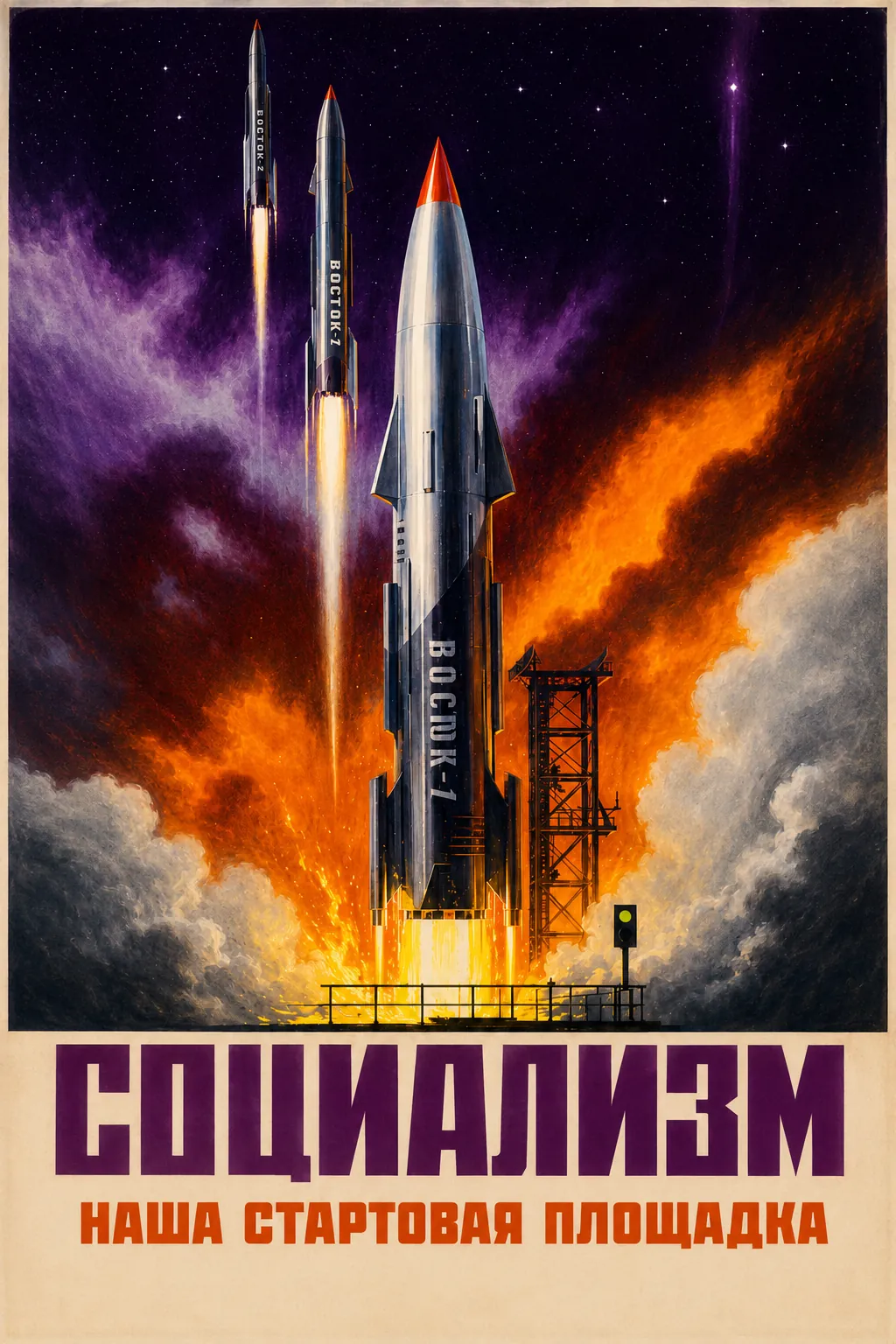
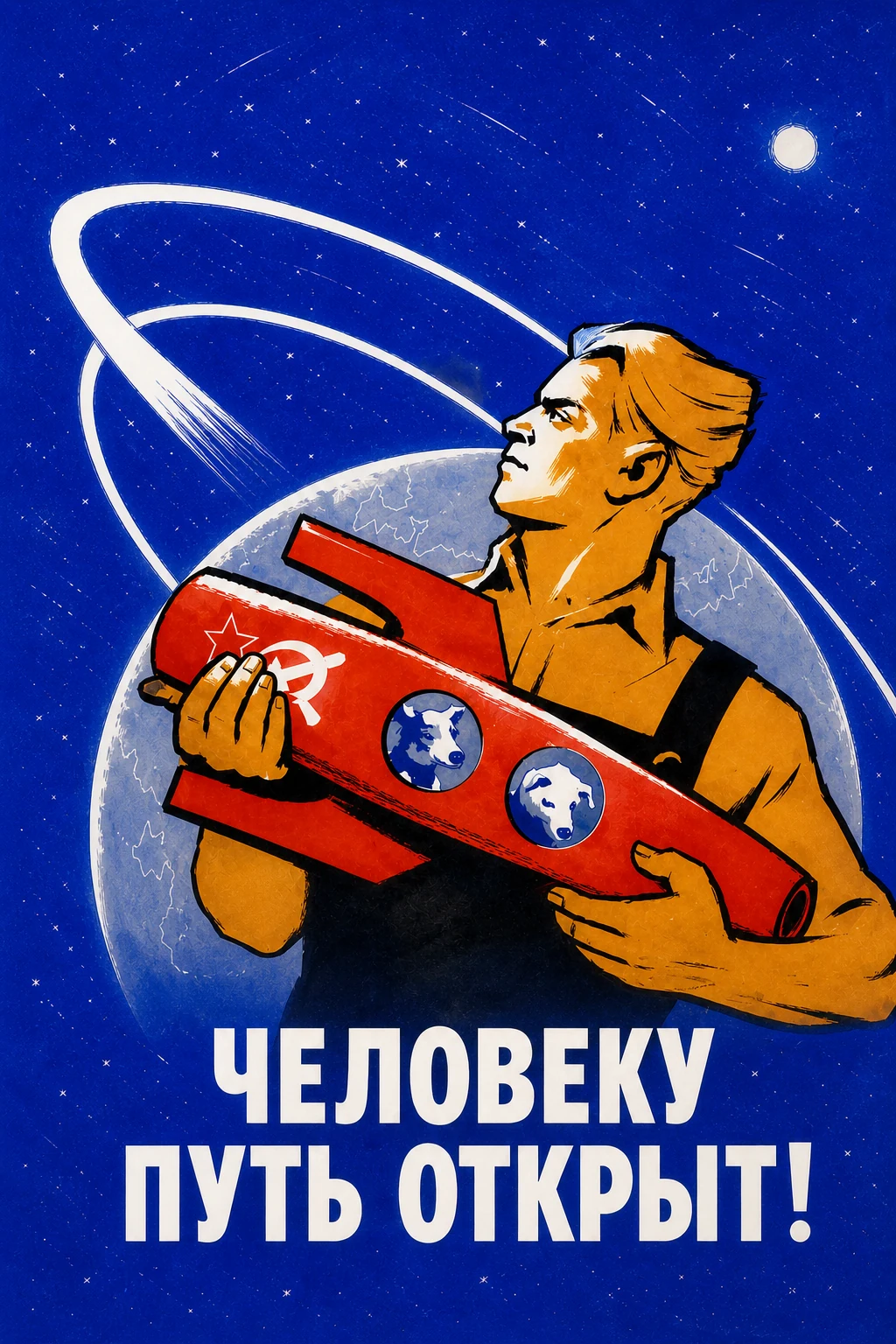
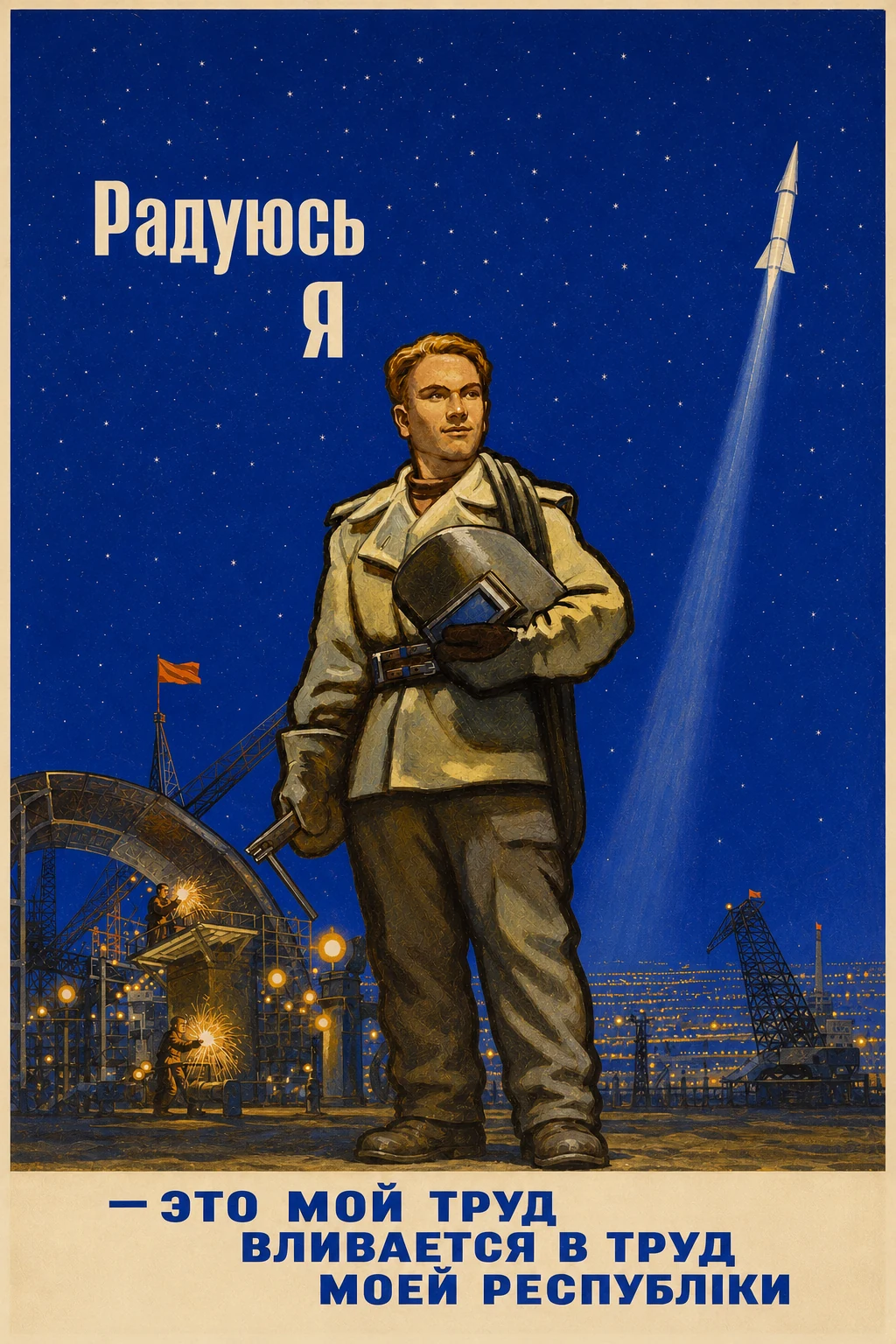
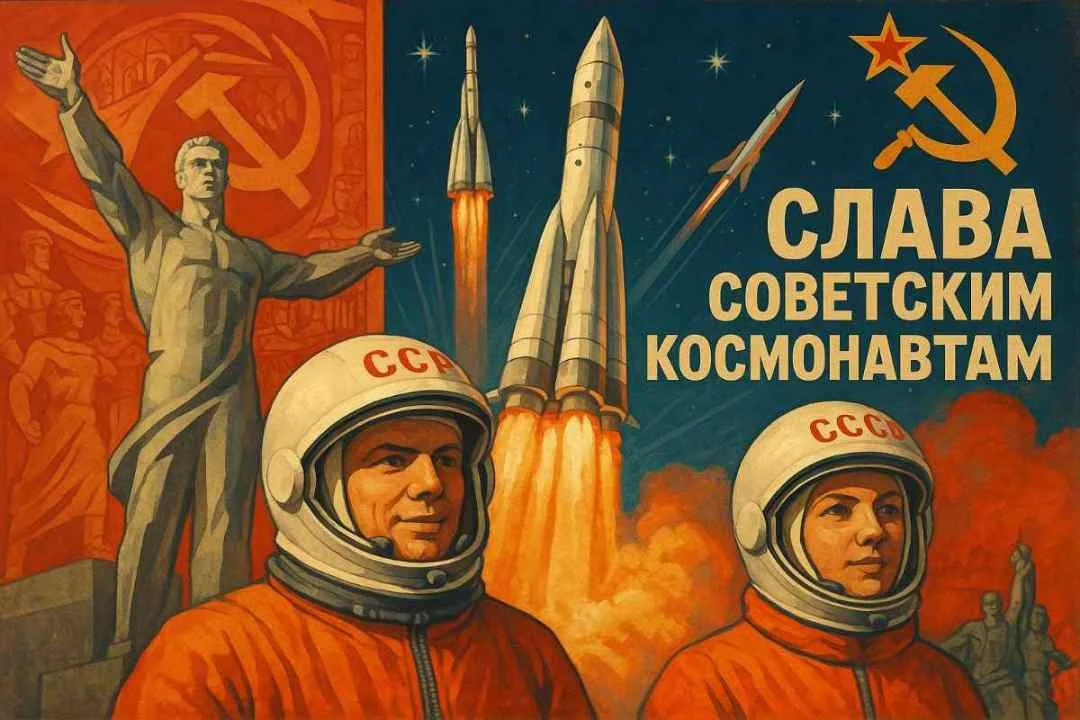
The first five years after Sputnik produced what historians of Soviet design now call the golden age of space posters. State publishing houses commissioned hundreds of them. They were printed in editions ranging from thousands to hundreds of thousands and distributed to schools, factories, and Houses of Culture across the USSR. Our Soviet space poster collection interprets this visual style as newly made art prints, with English titles beside the Cyrillic slogans. The prints are contemporary artwork, not vintage originals.
Most were uncredited. The ones that are attributed point to a small group of designers: Konstantin Ivanov ("The Road is Open for Humans," 1960), Boris Berezovsky ("Glory of the Space Heroes," 1963), Valentin Viktorov, N. Grishin, N. Kolchitsky, and S. Alimov. Cosmonaut Alexei Leonov, the first person to walk in space, was himself a trained artist and contributed designs.
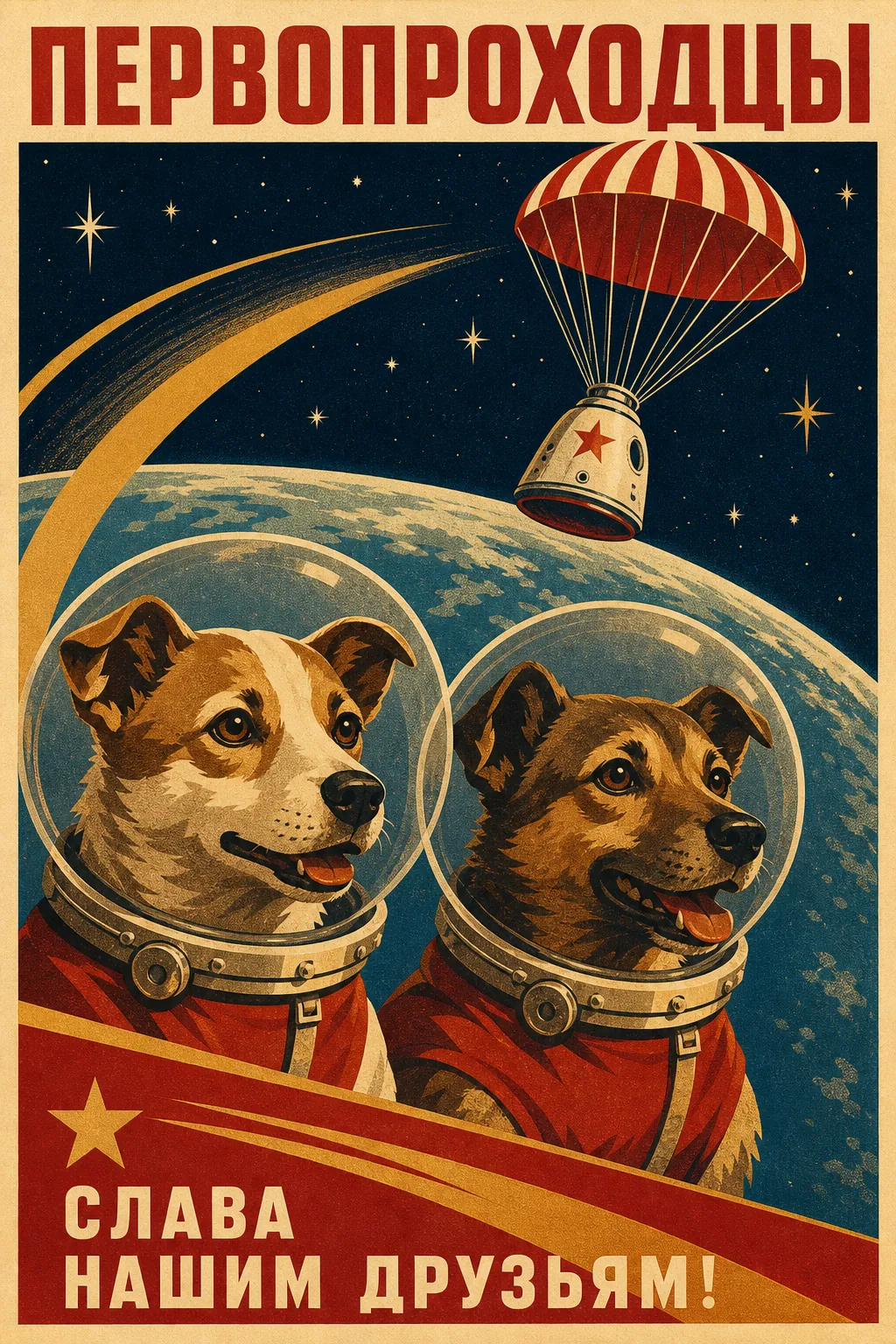
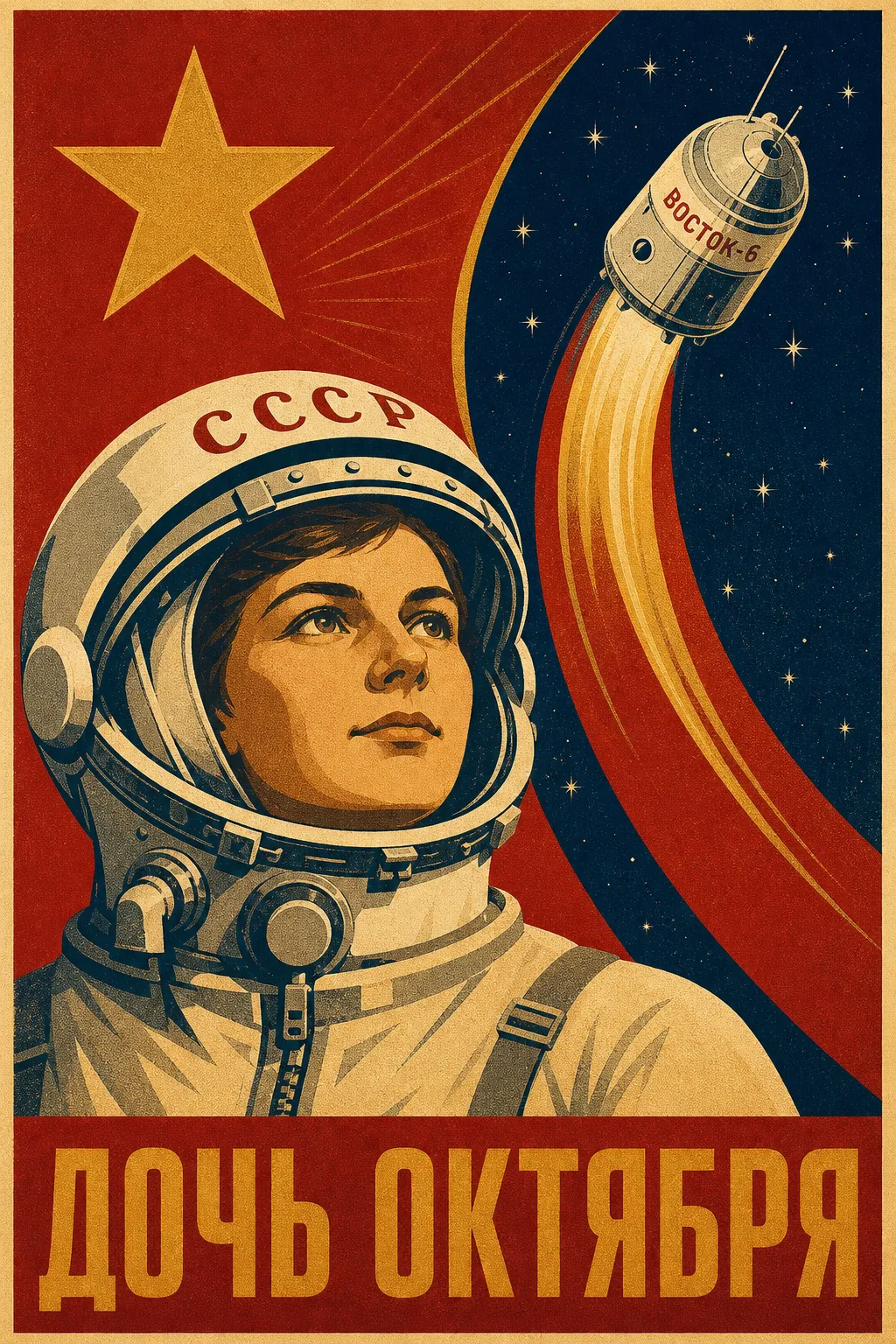
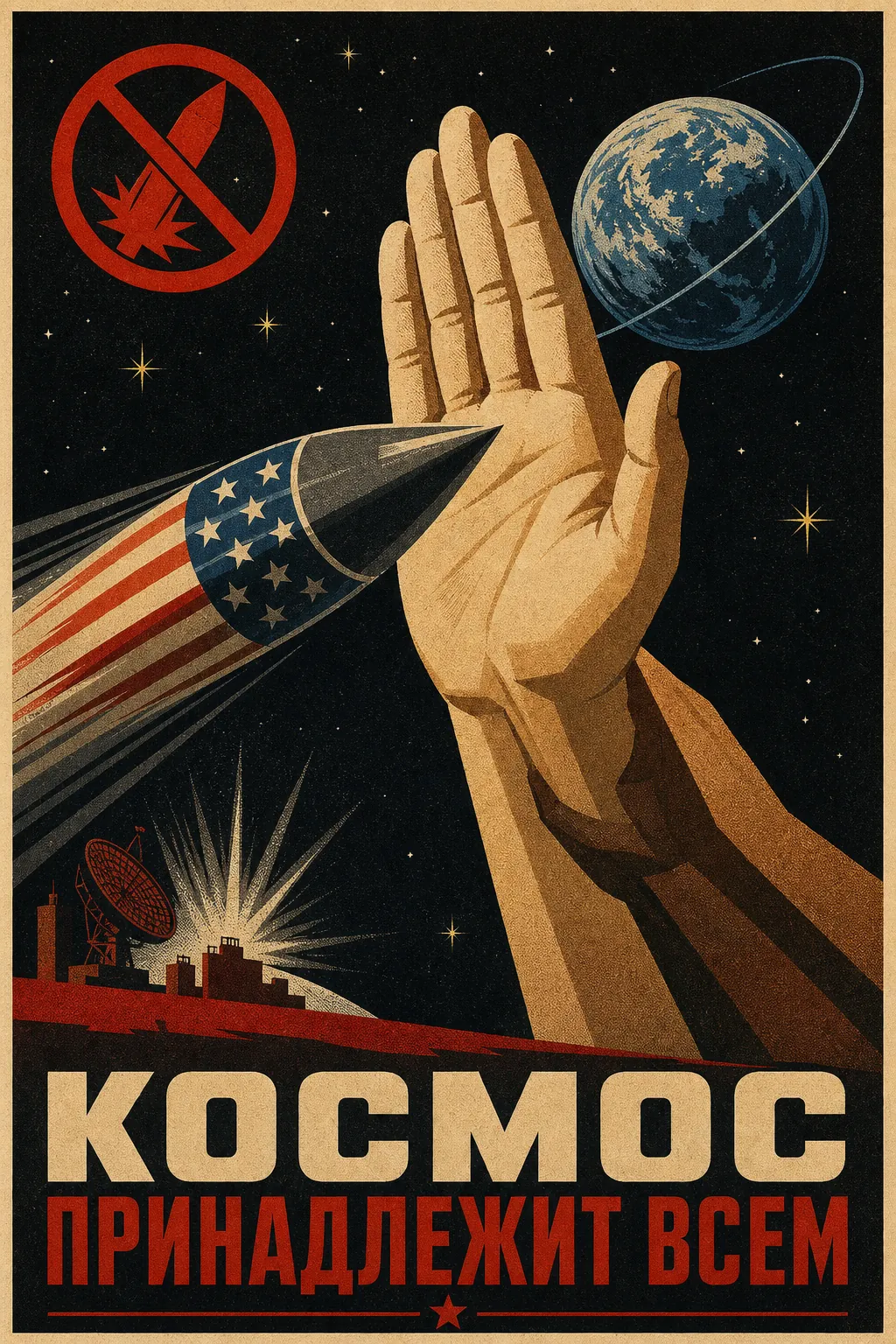
The 1980s saw a second wave of space-themed posters, this time arguing against the militarization of space in response to Reagan's Strategic Defense Initiative. Posters like "Stop the Militarization of Space!" (1984) repurposed the visual language of triumph from the 1960s as protest art.
Cinema before Kubrick
Soviet science fiction film predates 2001: A Space Odyssey by decades. Pavel Klushantsev's documentary The Road to the Stars (1957) premiered the same year as Sputnik. His feature Planet of Storms (1962) introduced underwater filming and weightlessness rigs that became standard in the genre. The rights were sold to 28 countries, including the United States.
Klushantsev's techniques were later studied by Kubrick during production of 2001, and George Lucas has called him the "godfather" of the Star Wars saga. Soviet cinema produced a steady output of crewed space films into the 1980s, including Richard Viktorov's Moscow-Cassiopeia (1974) and Adolescents in the Universe (1975).
Monumental architecture
The Monument to the Conquerors of Space dominates the northeastern Moscow skyline at the entrance to the VDNKh exhibition grounds. A 107-meter polished titanium obelisk shaped like a rising rocket plume, it was selected from 350 submitted designs and opened in October 1964. Inside its base is the Memorial Museum of Cosmonautics. Cosmonauts Alley, lined with bronze busts of individual cosmonauts, runs south from its foot.
It is not the only one. Hundreds of smaller monuments to cosmonauts, space dogs, and design bureau chiefs were built in the Soviet Union and its republics between 1957 and 1991. Many still stand in cities across post-Soviet space, particularly in Russia, Kazakhstan, and Ukraine.
Cosmonautics Day - April 12
Cosmonautics Day was created by Presidium decree on April 9, 1962, one year after Gagarin's flight. The official song of the holiday in the 1960s was "14 Minutes Until Start," written by Oscar Feltsman and Vladimir Voynovich and broadcast every year on the date. An adapted march version is still played at Russian Space Forces ceremonies.
In 1968 the Fédération Aéronautique Internationale adopted April 12 as the World Aviation and Astronautics Day. In 2011 the United Nations General Assembly declared it the International Day of Human Space Flight, an annual observance now marked at UN headquarters in New York.
The modern Moscow celebration follows a specific route. It begins at Gagarin's statue in the city of Korolyov, proceeds to Red Square and his grave in the Kremlin Wall Necropolis, continues to Cosmonauts Alley near the Monument to the Conquerors of Space, and ends at Novodevichy Cemetery, where many program engineers are buried.
Cold War Soft Power
From 1957 through the early 1970s, Soviet space firsts functioned as foreign-policy assets. They were used to court non-aligned nations in Africa, Asia, and Latin America, to undermine the U.S. claim of unrivaled technical superiority, and to recruit foreign students into Soviet technical universities. Schools, streets, and squares named after Gagarin exist on every inhabited continent.
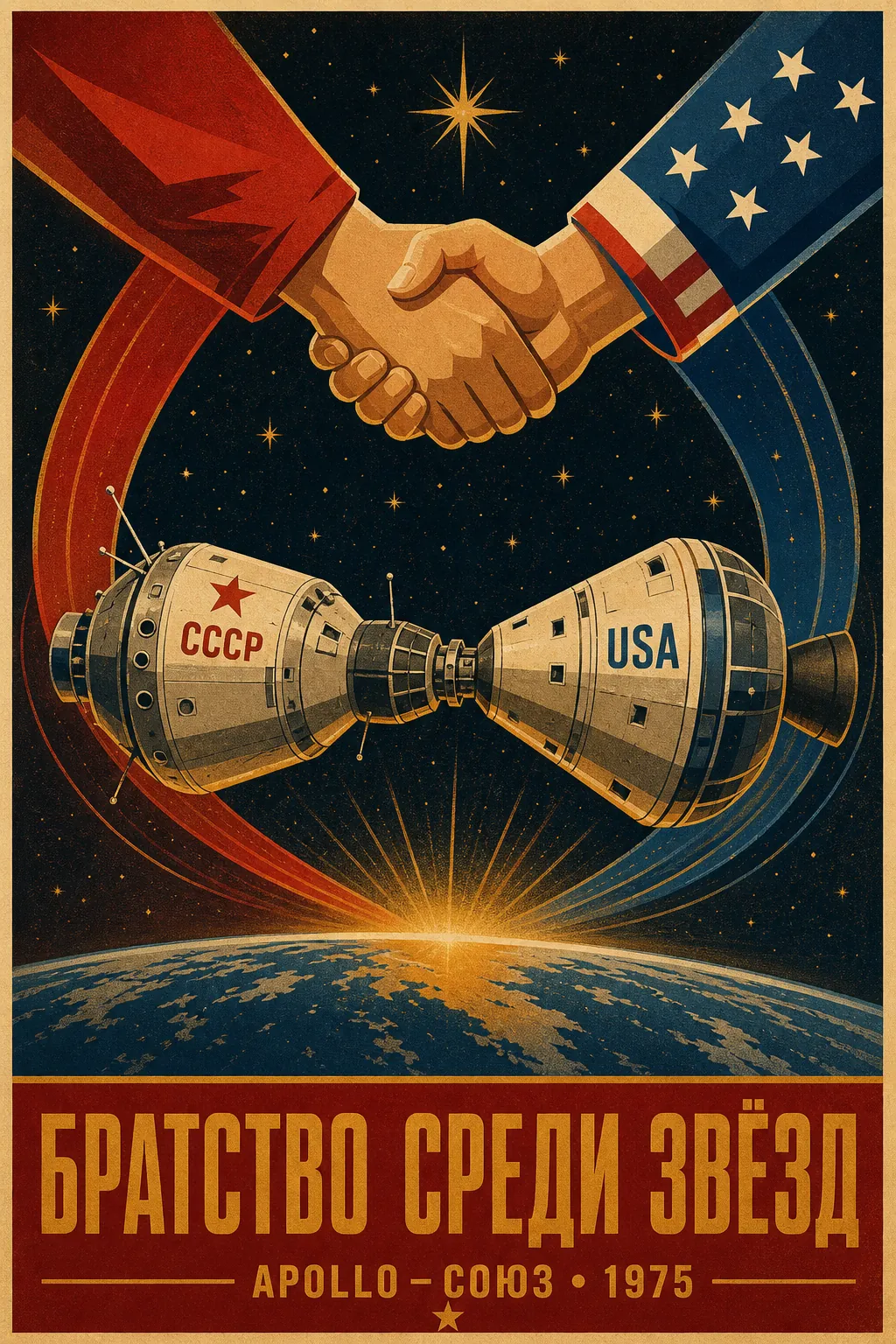
The 1975 Apollo-Soyuz mission, in which a Soyuz capsule docked with an Apollo capsule in orbit, was treated by the Soviet press as evidence that competition was giving way to cooperation. It was also, in the same coverage, framed as evidence that Soviet engineering had been the equal of NASA's all along.
Late-Soviet Decline and Legacy
By the 1980s the propaganda function had cooled. Mir was a working space station rather than a symbolic gesture, and economic strain at home made expensive spectacle harder to justify. Gorbachev's 1989 disclosure that the program absorbed about 1.5% of Soviet GDP and that more than half went to military programs ended the public claim that it had been mostly peaceful and civilian. The full budget breakdown is on the Historical Context page.
After the USSR dissolved in 1991, the cultural infrastructure stayed. Cosmonautics Day is still observed annually in Russia. The Monument to the Conquerors of Space was renovated in the 2010s. Cosmonaut training continues at Star City, which is now an open city rather than a closed one. The cosmonauts themselves remain national heroes in a way no post-Soviet political figure has matched.
Frequently Asked Questions
When was Cosmonautics Day established and why?
The Presidium of the Supreme Soviet established it by decree on April 9, 1962, one year after Yuri Gagarin's flight on April 12, 1961. The date marks the first crewed spaceflight and has since been adopted by the Fédération Aéronautique Internationale (1968) and the United Nations (2011) as an international observance.
How did Yuri Gagarin become a cultural icon?
Gagarin's working-class background, photogenic appearance, easy public manner, and the unprecedented nature of his flight made him a natural successor to the Stalin-era personality cult. His exclamation "Poyekhali!" entered the Russian language. His hometown was renamed after him in 1968 following his fatal jet crash. A 2004 survey of Russians ranked his flight second only to the WWII victory in modern Russian history.
How tall is the Monument to the Conquerors of Space?
107 meters (351 feet), shaped like a rising rocket on its exhaust plume, clad in polished titanium. The winning design was selected from 350 submissions and opened on October 4, 1964 - the 7th anniversary of Sputnik. The Memorial Museum of Cosmonautics is housed inside its base.
Did Soviet space cinema influence Hollywood?
Yes, demonstrably. Pavel Klushantsev's Planet of Storms (1962) invented over 300 cinematic special effects, including weightlessness rigs and underwater filming techniques. The film was distributed in 28 countries. Stanley Kubrick studied Klushantsev's work during production of 2001: A Space Odyssey, and George Lucas has explicitly called Klushantsev the "godfather" of his Star Wars saga (Source: GW2RU).
Why were Soviet space propaganda posters so prolific in 1958 - 1963?
The five years after Sputnik 1 produced the largest concentration of Soviet space firsts: Laika, Luna 1 to 3, Belka and Strelka, and Gagarin. Each one was treated as a state event requiring matching publishing output. Designers like Konstantin Ivanov and Boris Berezovsky were commissioned through Goznak and Plakat state publishers. Print runs ran into hundreds of thousands and were distributed to schools, factories, and Houses of Culture across the USSR.
Does the Soviet cultural infrastructure still exist today?
Most of it, yes. The Monument to the Conquerors of Space was renovated in the 2010s. Cosmonautics Day is observed every April 12 in Russia and recognized as the International Day of Human Space Flight by the UN. Star City still trains cosmonauts. Hundreds of streets, squares, and schools across the former USSR and beyond still carry Gagarin's name.
Additional Resources
- Physics World: how Gagarin and the cosmonauts shaped Soviet space culture - long-form review of the academic literature.
- Smithsonian Air & Space: Saint Yuri - on the post-mortem deification of Gagarin.
- Daily Art Magazine: Soviet Space Art - Posters of Propaganda and Progress - illustrated tour of the poster golden age.
- Open Culture: The Glorious Poster Art of the Soviet Space Program 1958 - 1963 - more posters with translations.
- Klassiki: how Soviet cinema went extra-terrestrial - history of Soviet space film, including Klushantsev's career.
- Wikipedia: Monument to the Conquerors of Space and Cosmonautics Day - reference entries with full source chains.