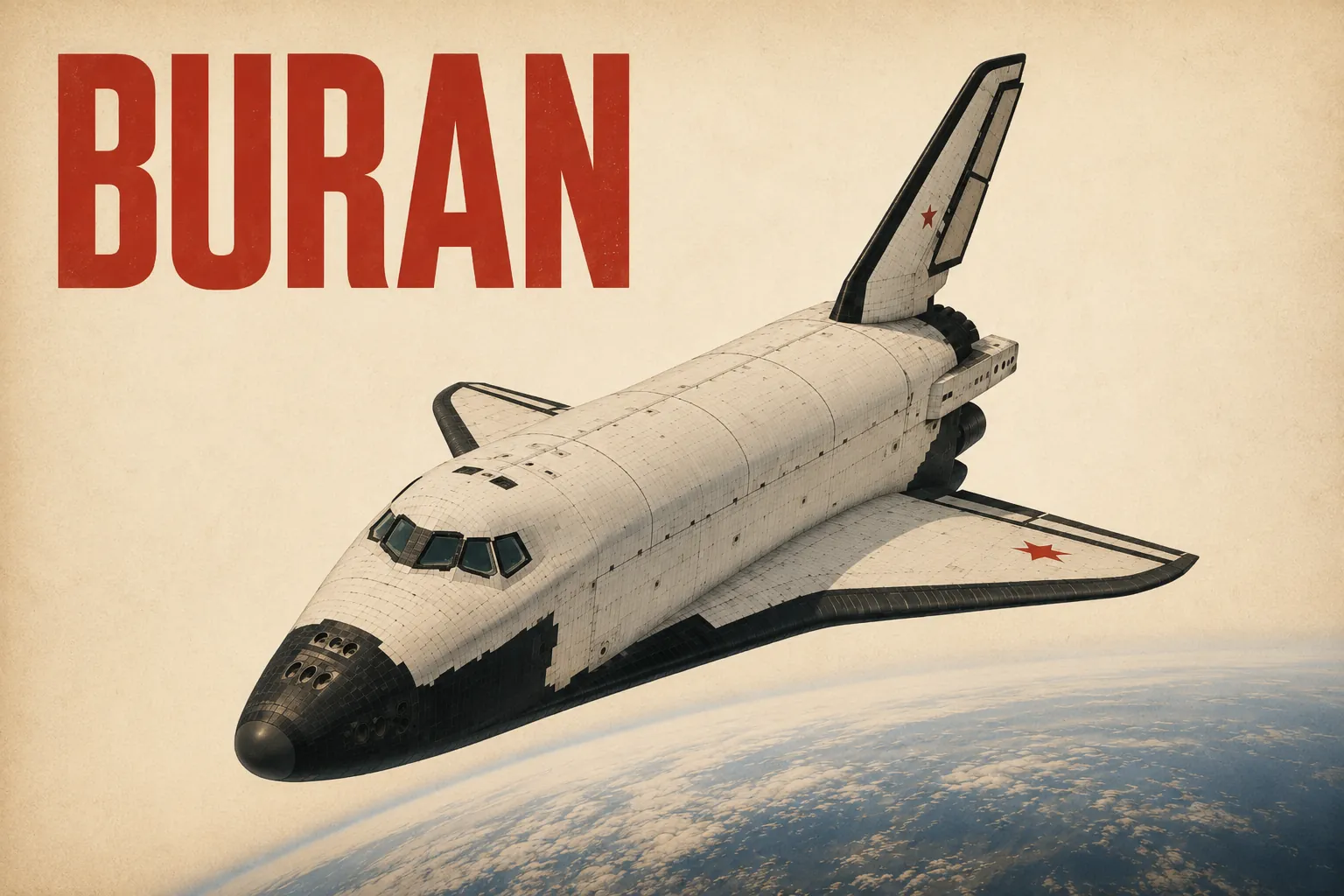
Illustration of Buran. It is not an archival image of the November 1988 landing.
The Buran shuttle made its only orbital flight on November 15, 1988. Launched by Energia from Baikonur, it orbited Earth without a crew and returned to a runway automatically.
The flight demonstrated an uncrewed orbital mission and landing, but it did not establish a record of repeated reuse or operational crew transport. Those are different tests, and Buran never accumulated that flight history.
What happened during Buran's first flight?
The European Space Agency's historical launch record identifies the date, site and Energia launcher. The mission carried no crew. After two Earth orbits, the spacecraft returned to Baikonur under automatic control.
That sequence made the flight a substantial test of the vehicle and its guidance systems, even without an operational payload-delivery schedule behind it.
A contemporary TASS release preserved by the Buran archive describes the flight from the Soviet public-information side. It is useful as a contemporary account, not as proof that every proposed future use became practical. Reading an announcement alongside the actual flight record separates what happened from what planners hoped would follow.
How was Buran different from the U.S. Space Shuttle?
Similar exterior shapes can hide different launch arrangements. Buran rode an Energia rocket; the U.S. Shuttle orbiter carried its own large main engines for ascent, supplied by an external tank.
NASA's 1986-1990 astronautics chronology notes that distinction in its November 1988 entry. The orbiter and the launcher should be identified separately when comparing the two systems.
The automatic landing is another specific result worth preserving. It does not justify assigning Buran an unlimited set of autonomous mission capabilities, and it does not make every other reusable spacecraft the same design.
For a fair comparison, ask about the demonstrated flight profile first, then the planned operating concept. The rocket guide places Energia alongside other Soviet launchers.
Was Buran a proven reusable transport?
The orbiter came back from space, which is a prerequisite for reuse. Repeated reuse requires more evidence: inspection, refurbishment, another launch and another successful return.
One flight cannot provide observed turnaround times across a fleet or a measured cost per routine mission. Numerical claims about those operations need to be labeled as estimates or plans, not presented as Buran's operating record.
The Gorbachev-era space history explains the political and financial setting of the late Soviet program. The legacy overview separates hardware that continued flying from projects that did not become sustained services.
Buran's November anniversary is strongest when it stays with the achievement that can be demonstrated: an uncrewed orbital flight ending in an automatic runway landing.
Buran: Demonstrated Versus Planned
A claim-checking table based on the 1988 orbital flight. It deliberately avoids speculative cost and performance rankings.
| Capability | Evidence from the orbital flight | Limit of the claim | Source |
|---|---|---|---|
| Launch to orbit | Energia launched Buran on 1988-11-15 | Orbiter and launch vehicle were separate elements | esa.int |
| Uncrewed operation | No crew aboard the orbital mission | Does not demonstrate a crewed operational flight | buran.fr |
| Automatic landing | Runway return after two orbits | Specific flight result, not every proposed mission | buran.fr |
| Repeated reuse | Only one orbital flight occurred | No repeated orbital turnaround record | esa.int |
Download the source-linked reference table (CSV). Permanent link to this table. Cite this article and the original sources listed in each row.
Frequently Asked Questions
Did anyone fly aboard Buran in space?
No. Buran's only orbital flight was uncrewed. Atmospheric test vehicles and their pilots should not be confused with that spaceflight.
When did Buran first fly in orbit?
November 15, 1988. That was also its only orbital flight.
Did Buran land automatically?
Yes. It returned to a runway at Baikonur under automatic control after completing two orbits of Earth.
Follow the Soviet space program timeline for the missions and decisions surrounding this date, or browse more space history articles.
By Soviet Space Program. Published . Historical date: .