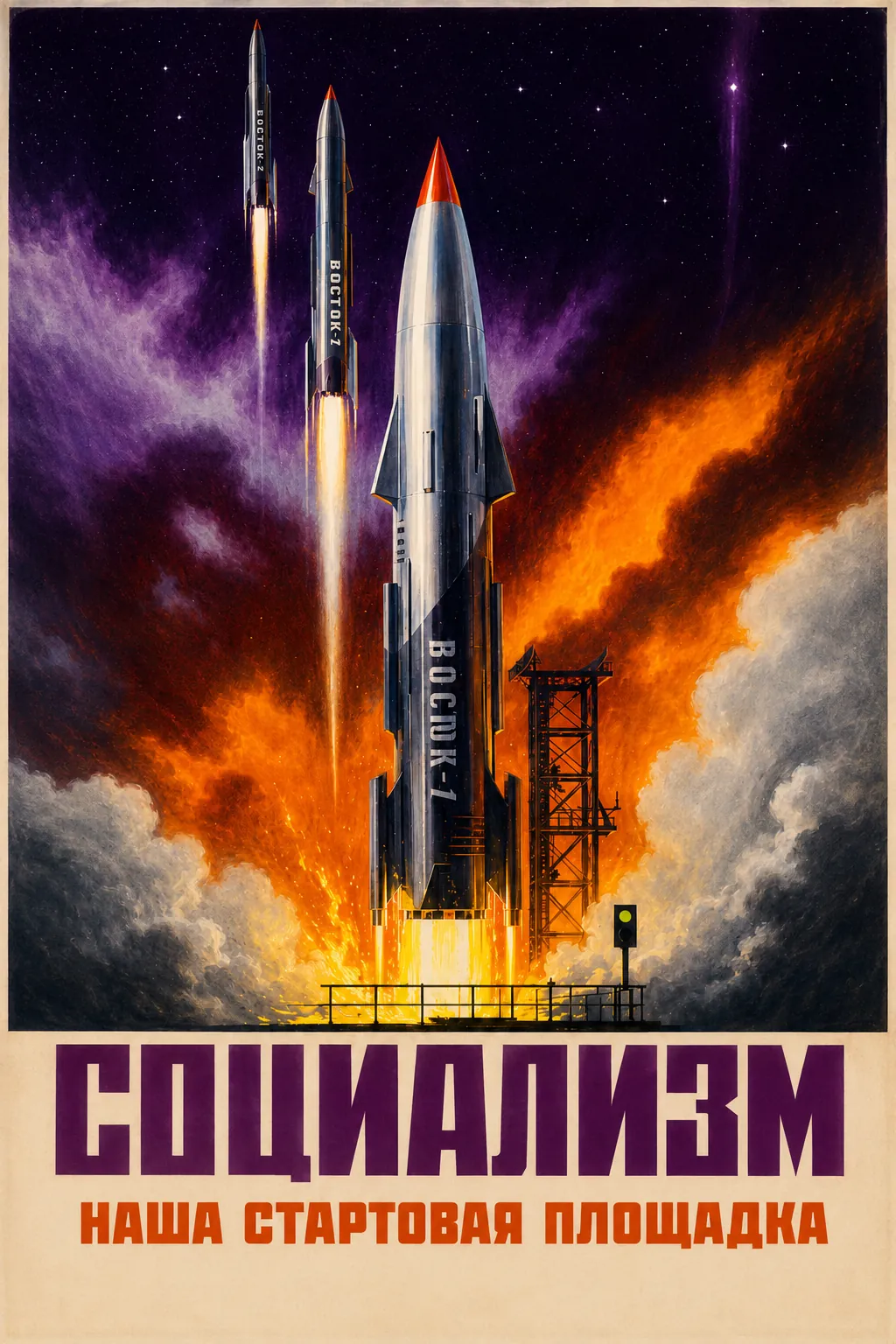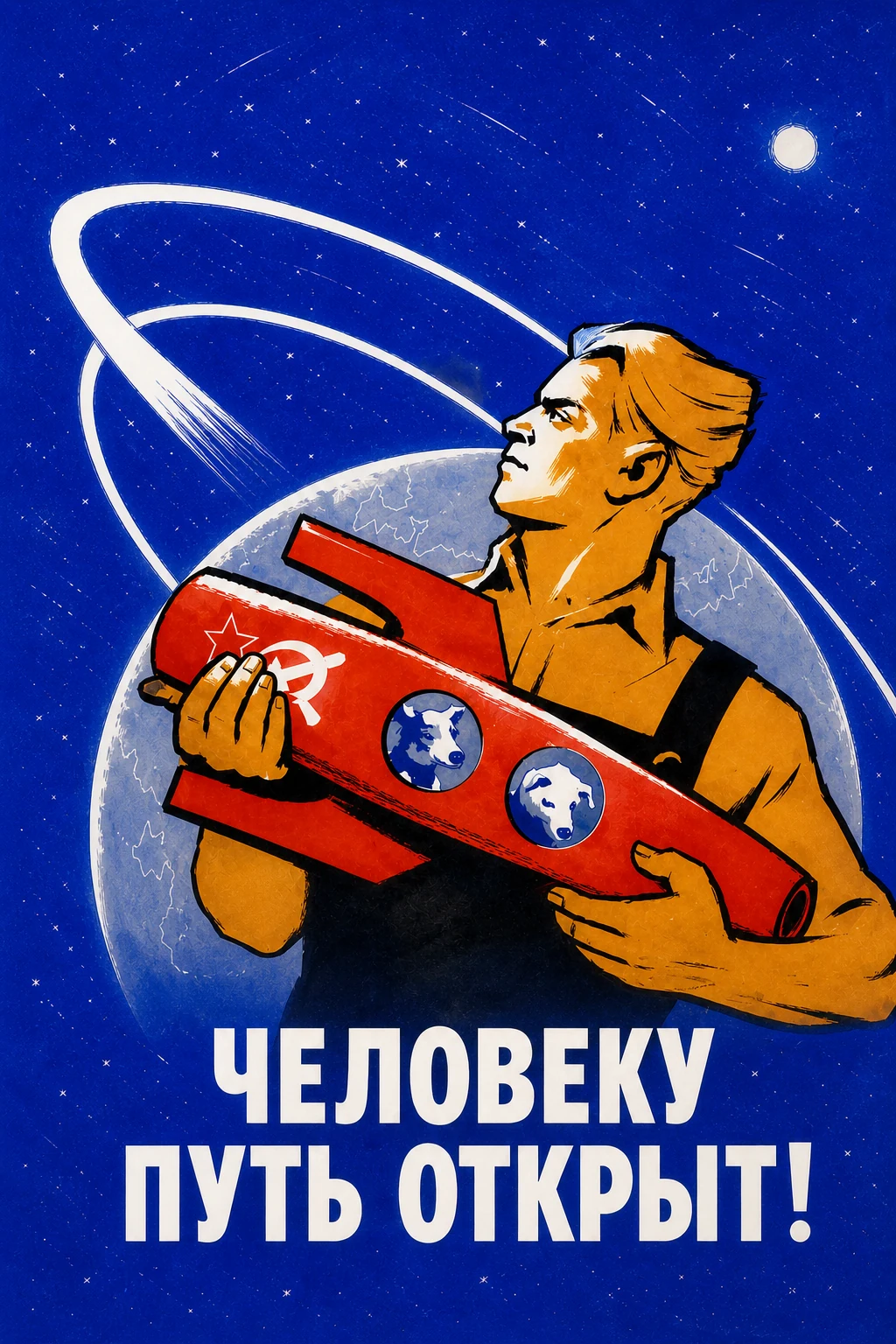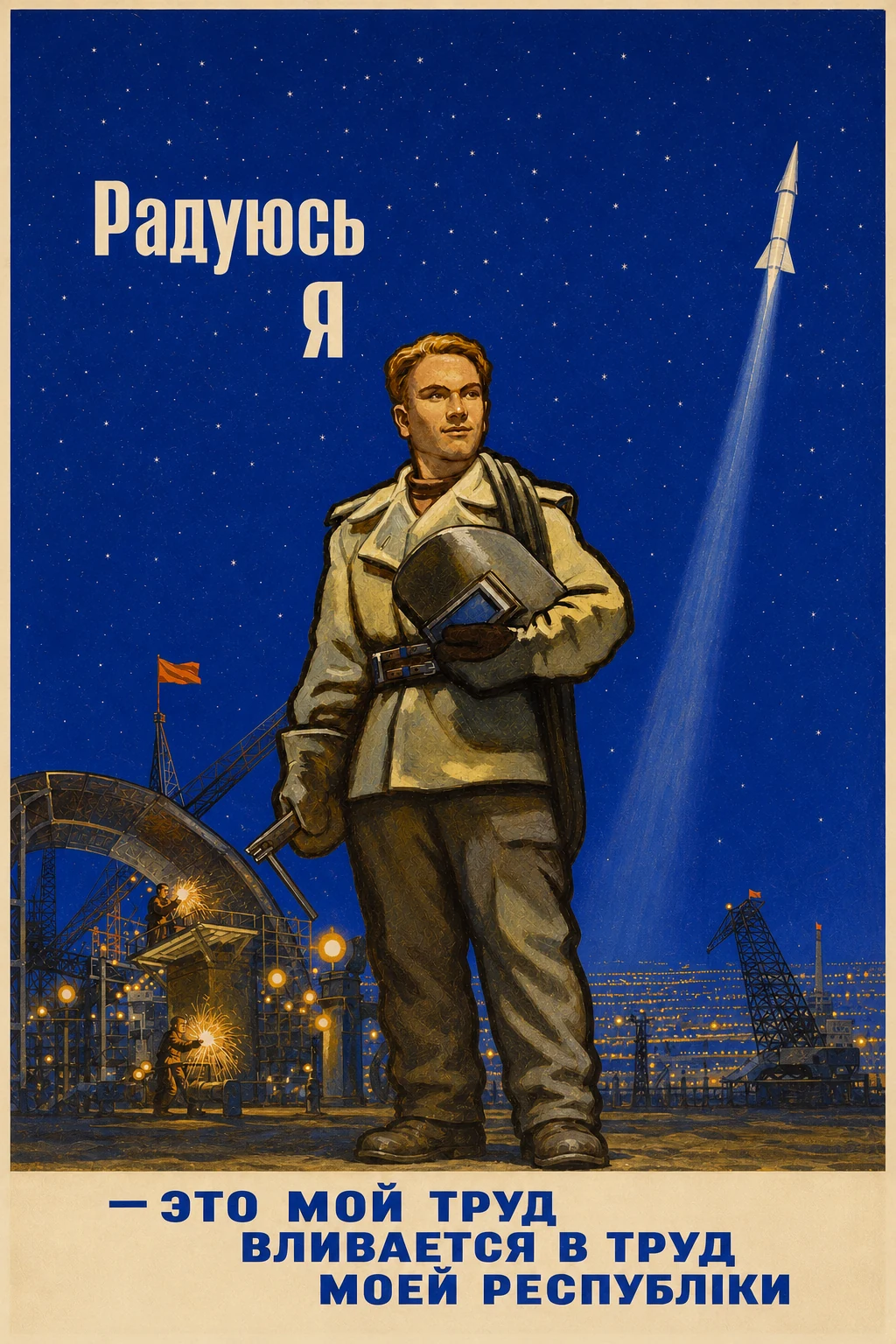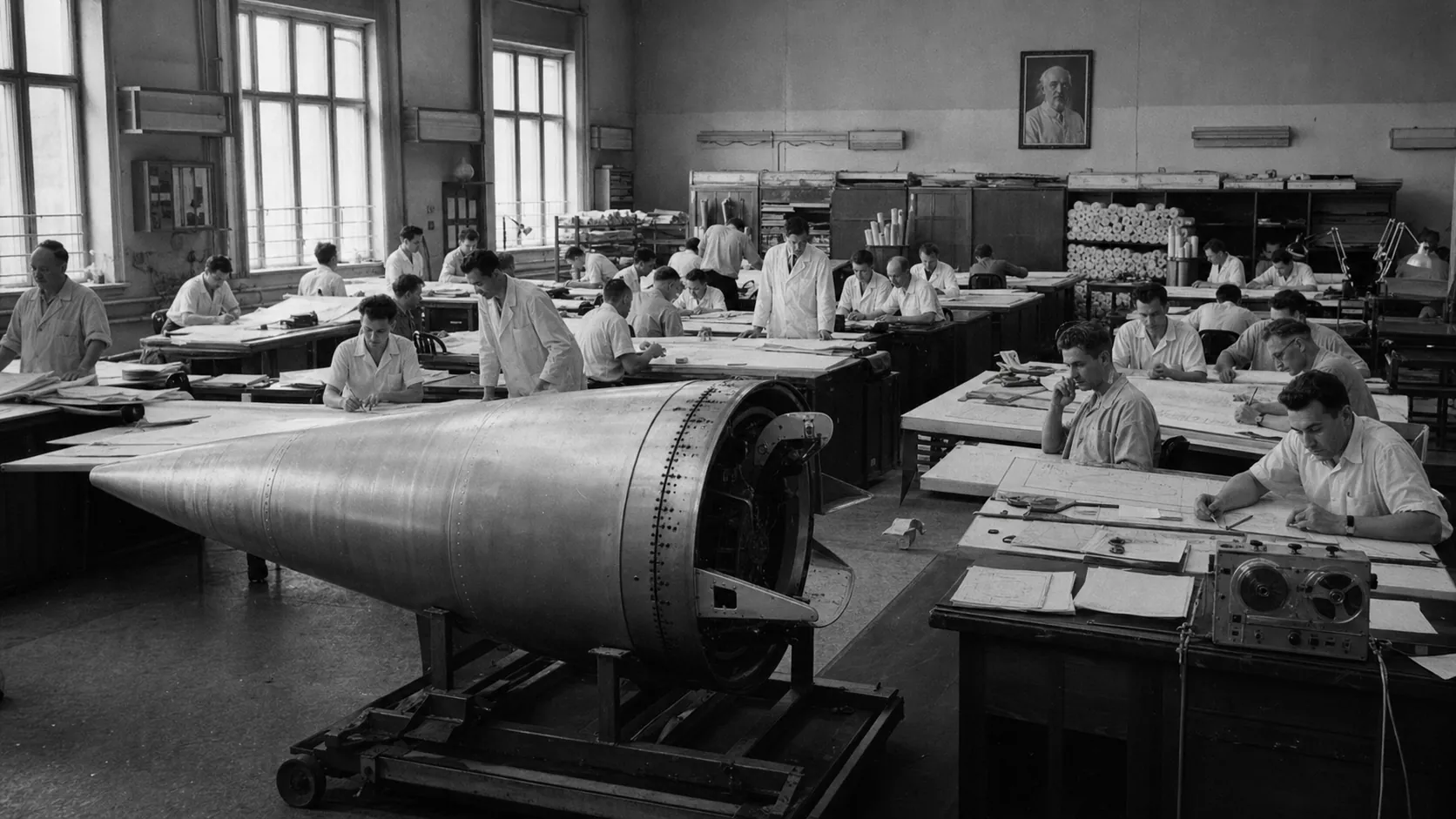
Illustration of a Soviet design bureau, not a photograph of the Voskhod 1 crew or capsule.
Voskhod 1 launched on October 12, 1964, with Vladimir Komarov, Konstantin Feoktistov and Boris Yegorov aboard. It was the first spaceflight to carry more than one person.
Fitting three people into a capsule derived from Vostok required sharp compromises, including flying without pressure suits. The milestone expanded the size and professional range of a space crew while exposing the limits of adapting an existing spacecraft.
Who was in the Voskhod 1 crew?
Komarov commanded the mission. Feoktistov brought spacecraft-engineering experience, and Yegorov served as the physician. That combination made the flight more than a passenger-count record: it put different kinds of professional work inside the same cabin. RussianSpaceWeb's mission history identifies the crew and the flight's place between Vostok and Soyuz.
The distinction between role and flight qualification matters. A physician aboard a spacecraft could observe the crew directly, while an engineer could assess systems from inside the vehicle.
Neither fact made the mission routine. Everyone still depended on the same capsule, life-support equipment and recovery sequence. More people in orbit meant more people sharing the consequences of a single failure.
What changed when Vostok became Voskhod?
The engineers were adapting a design associated with one-person flights. NASA's discussion of early Soviet spacecraft explains the space constraint and the decision to omit pressure suits.
A suit can provide a separate pressurized environment if a cabin loses pressure. Leaving it behind made room, but removed that layer of protection.
The landing arrangement also had to suit a crew returning inside the capsule. Vostok's single occupant had used an ejection-and-parachute sequence. Voskhod's recovery plan kept its occupants aboard.
These changes are easier to understand as a set of engineering decisions than as a simple progression from one seat to three. The reference table pairs each visible achievement with the question a reader should ask about it.
How should the flight be judged?
The crew returned on October 13 after about a day in space. NASA's contemporary 1964 chronology records the return and the attention paid to the three-person flight.
That success demonstrates what happened on this mission. It does not establish that flying without suits had become an acceptable default for every later spacecraft.
The human-spaceflight overview follows the later Soviet programs, while the Korolev biography explains the leadership behind the early flights. For this anniversary, keep Voskhod 1 distinct from Voskhod 2: Alexei Leonov's spacewalk belonged to the second mission in March 1965. The program timeline helps separate those two often-compressed milestones.
Voskhod 1 Design-Tradeoff Reference
A compact comparison of the mission's achievements and their engineering implications. This is a historical reference, not a spacecraft safety specification.
| Feature | Voskhod 1 record | Why it matters | Source |
|---|---|---|---|
| Crew | Komarov, Feoktistov and Yegorov | Commander, engineer and physician flew together | russianspaceweb.com |
| Occupancy | Three people | More occupants in a Vostok-derived cabin | russianspaceweb.com |
| Pressure suits | Not worn | No suit-level protection against cabin depressurization | nasa.gov |
| Return | 1964-10-13, crew inside capsule | Recovery differed from Vostok's ejection arrangement | nasa.gov |
Download the source-linked reference table (CSV). Permanent link to this table. Cite this article and the original sources listed in each row.
Frequently Asked Questions
Who flew on Voskhod 1?
Vladimir Komarov commanded the mission, with engineer Konstantin Feoktistov and physician Boris Yegorov. They launched on October 12, 1964.
Why didn't the Voskhod 1 crew wear pressure suits?
The three-person cabin arrangement left insufficient room for suited occupants. Flying without pressure suits was a design compromise, not proof that suits had no safety value.
Was Voskhod 1 the first spacewalk mission?
No. Alexei Leonov made the first spacewalk during Voskhod 2 in March 1965. Voskhod 1's record was the first multi-person spaceflight.
Follow the Soviet space program timeline for the missions and decisions surrounding this date, or browse more space history articles.
By Soviet Space Program. Published . Historical date: .