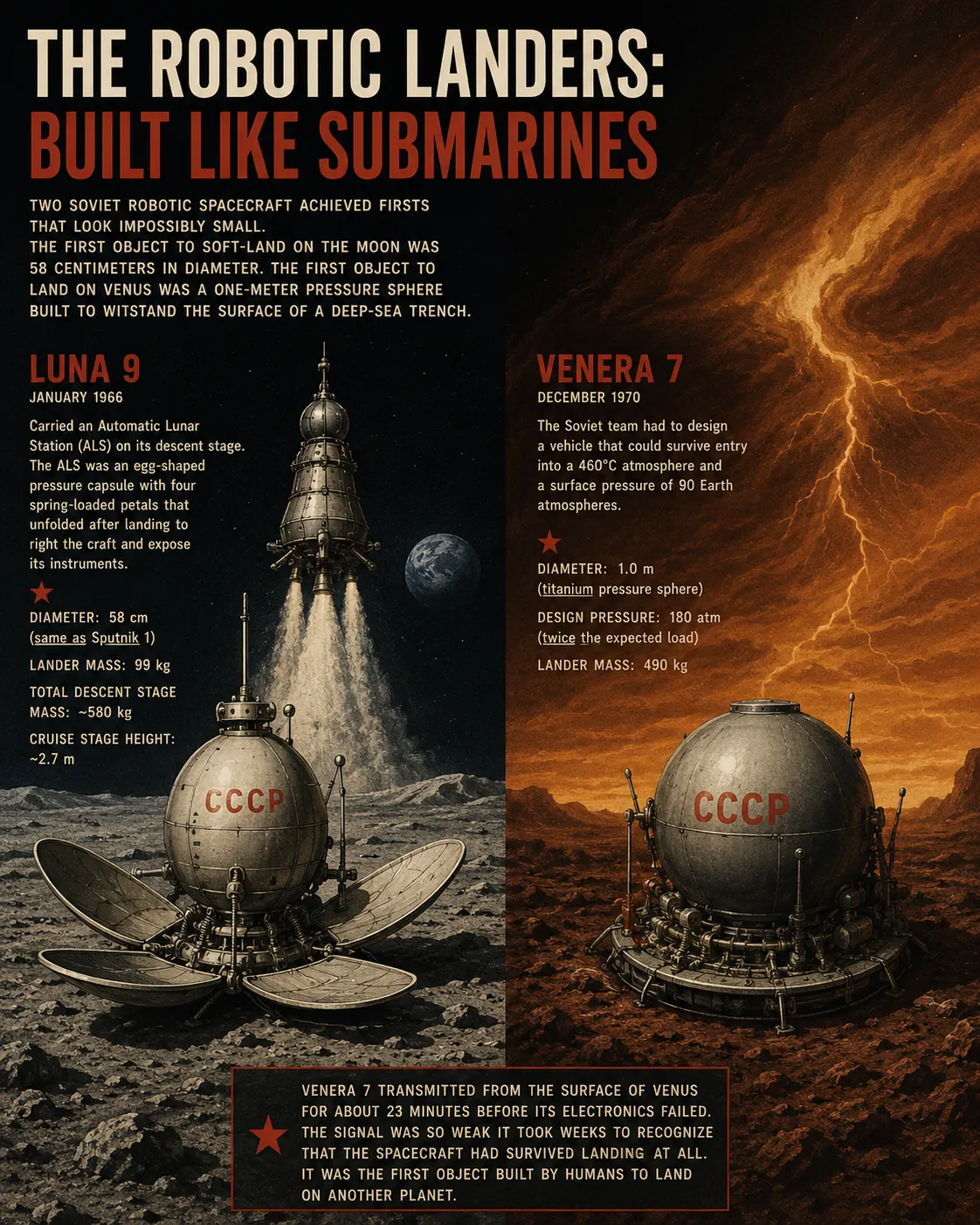
Illustration of robotic planetary exploration. The historical Venera 9 image is linked in NASA's image record below.
Venera 9 photos gave people their first view from the surface of Venus on October 22, 1975. The lander transmitted a black-and-white panorama during a short surface mission, revealing rocks beneath the planet's thick atmosphere.
It was a photographic first, not the first successful Venus landing. Earlier Soviet probes had already returned surface measurements without cameras.
What do the Venera 9 photos show?
NASA's Venera 9 image record preserves a view of the landing area and identifies its origin. The rocks in that image are evidence from one place reached by one lander.
They should not be treated as a survey of all Venusian terrain. A panorama provides local context, while measurements and orbital observations answer other questions about the planet.
The familiar curved presentation also deserves care. A lander's scanning camera and the way its data are assembled affect how the view looks on a page. The original record, a geometric correction and a colorized interpretation are different products.
A caption should say which one the reader is seeing. Adding color to a monochrome image does not turn it into a direct color measurement from Venera 9.
How long did the lander have?
The surface operation lasted about 53 minutes. NASA's 1975 chronology separately describes atmospheric descent and surface operation for Venera 9 and Venera 10. That separation prevents a common mistake: quoting a combined descent-and-surface duration as the time a spacecraft survived on the ground.
Venera 9 also included an orbiter. The carrier and the descent vehicle had different work to do, so a lander transmission ending does not describe every part of the mission.
For a reader comparing planetary spacecraft, the useful questions are which component produced the data, where it was and how long that component operated. The reference table makes those distinctions explicit.
Which Venus images belong to which mission?
The Planetary Society's collection of Venus surface pictures places the images beside their mission names. Use it to distinguish Venera 9 from later spacecraft, particularly when an online post combines several panoramas into one graphic.
A dramatic color image can be genuine Venus data and still be the wrong illustration for an October 1975 anniversary.
The broader Soviet robotic mission history separates the landing, imaging and later exploration milestones. The space technology guide provides engineering context, and the mission timeline places the Venus program alongside the Moon and Mars efforts. Venera 9 earns its place through a specific result: a picture from the ground of another planet.
Venera 9 Image-Provenance Checklist
A reference for captions, classroom slides and articles using Venus imagery. It separates directly recorded facts from later presentation choices.
| Question | Venera 9 answer | Do not confuse it with | Source |
|---|---|---|---|
| When was the surface image returned? | 1975-10-22 | The June launch date | science.nasa.gov |
| Was it a color panorama? | No, the original is monochrome | Later Venera color imagery or colorization | planetary.org |
| Surface operating duration | About 53 minutes | Time spent descending through the atmosphere | nasa.gov |
| Which first? | First images from another planet's surface | The earlier first successful Venus landing | science.nasa.gov |
Download the source-linked reference table (CSV). Permanent link to this table. Cite this article and the original sources listed in each row.
Frequently Asked Questions
Did Venera 9 take the first photo on Venus?
Yes. Its October 22, 1975 panorama was the first image returned from the surface of Venus and the first from another planet's surface.
Are Venera 9's original photos in color?
No. The original Venera 9 panorama is black and white. Later color images and modern colorized versions need their own mission or processing labels.
Was Venera 9 the first spacecraft to land successfully on Venus?
No. Venera 7 had returned data from the surface in 1970. Venera 9's distinction was surface photography.
Follow the Soviet space program timeline for the missions and decisions surrounding this date, or browse more space history articles.
By Soviet Space Program. Published . Historical date: .