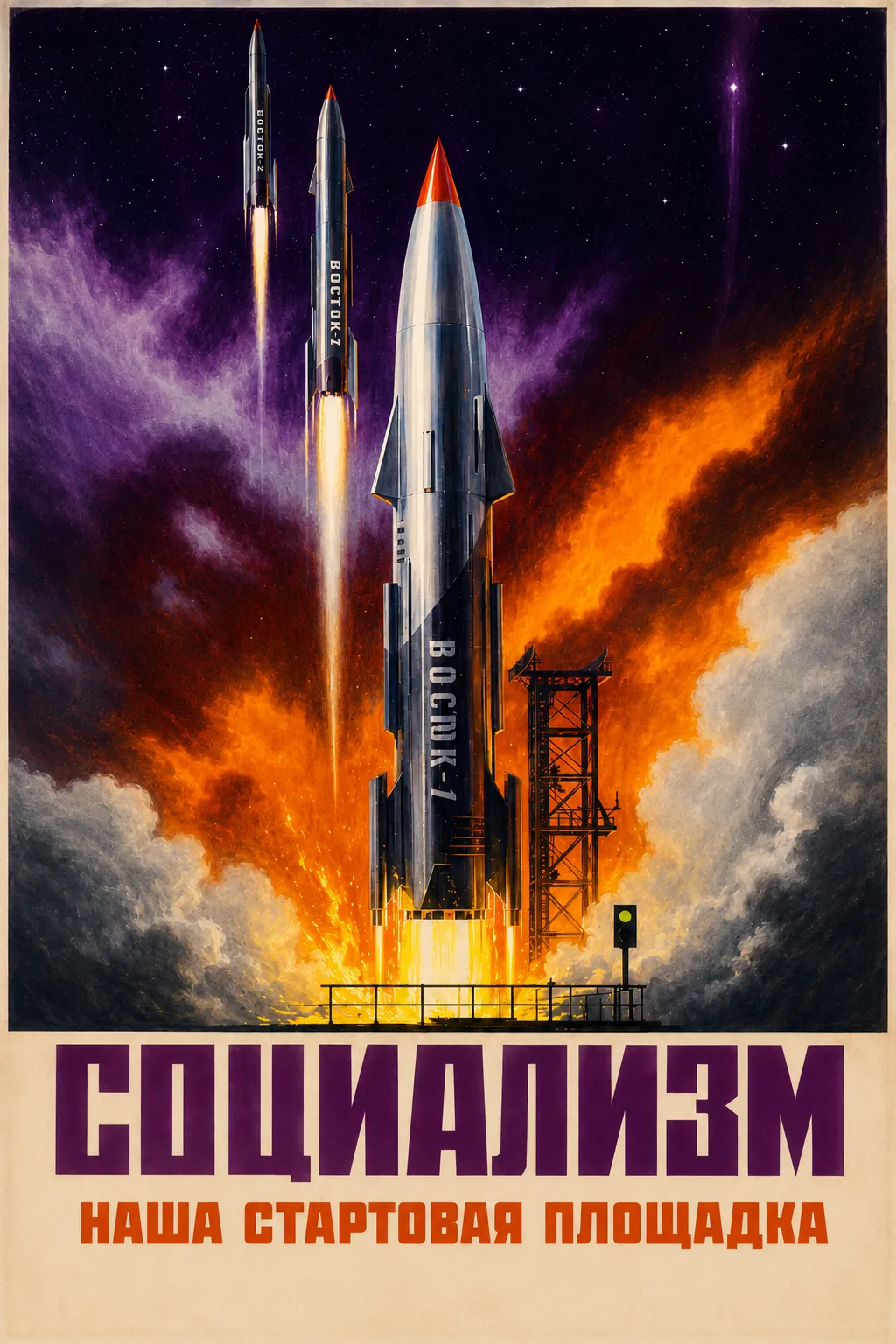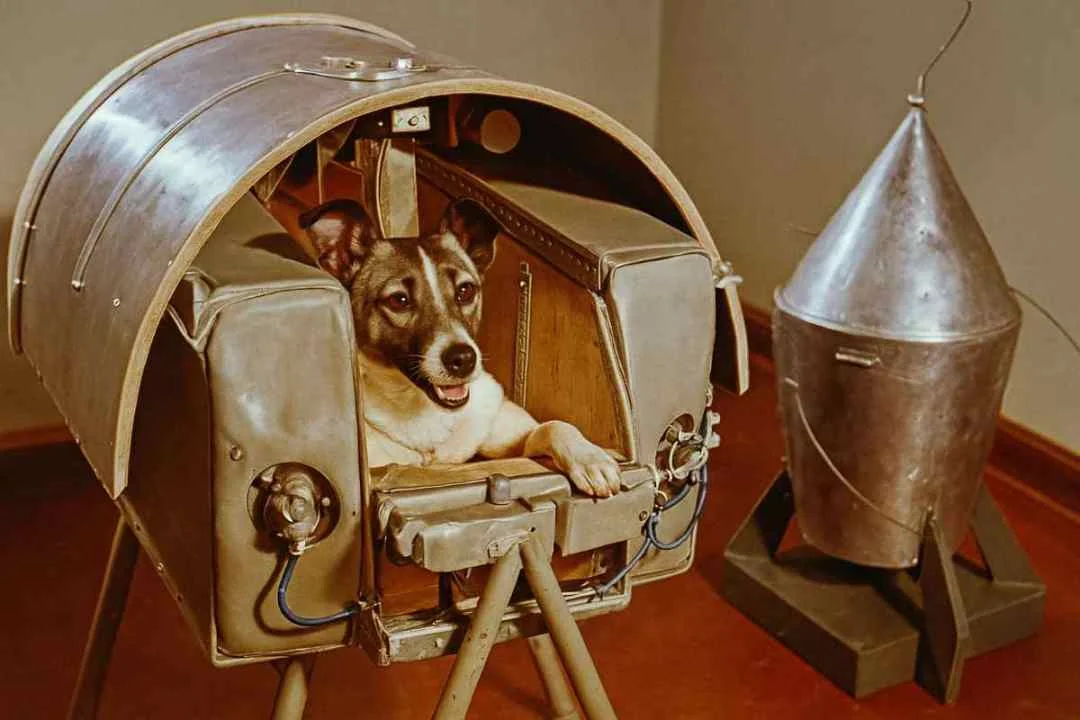
Illustration of Laika and Sputnik 2, not a photograph transmitted from orbit.
Sputnik 2 launched on November 3, 1957, carrying Laika, the first dog to orbit Earth. The spacecraft had no system to bring her home safely.
Later accounts established that she survived only a short time after launch, not the months the satellite remained in orbit. Her anniversary is both a spaceflight milestone and a record of an experiment that made an animal's death part of its design.
Why was Laika sent aboard Sputnik 2?
The mission followed Sputnik 1 by about a month and added a living passenger to the Soviet orbital program. Monitoring an animal offered evidence about the effects of launch and weightlessness.
That purpose should be stated alongside the condition of the experiment: the spacecraft was not equipped to return Laika alive. A biological measurement and an acceptable treatment of the subject are separate questions.
NASA's Sputnik anniversary history identifies the second satellite and describes the uncertainty surrounding how long Laika survived. The broader history of Sputnik's origins explains the political setting. The rapid sequence of launches helped make the Soviet program seem capable of producing a succession of firsts.
How long did Laika survive?
The reliable way to explain the record is to avoid pretending that the satellite's time in orbit measures its passenger's life. Later disclosures placed Laika's death within the early part of the flight, associated with overheating and stress.
NASA describes survival as possibly only a few hours. Exact-hour claims should retain their source and uncertainty rather than becoming a countdown repeated as settled fact.
The Sputnik 2 mission history at RussianSpaceWeb gives the spacecraft context. A satellite can remain above Earth after a biological experiment has ended and after its transmitter has stopped.
The comparison table below separates those events. It is intended to prevent the especially misleading claim that Laika lived in the spacecraft until it burned up in the atmosphere.
How should an anniversary account describe the mission?
Use the word orbit precisely. Animals had already flown on suborbital rockets, which rose into space and returned without circling Earth. Laika's first was orbital flight.
It should not erase earlier animal experiments, and it should not be confused with the later Soviet dog flights that achieved recovery. The space-dog history distinguishes those missions and their outcomes.
The event also belongs in the history of Soviet space propaganda. Laika became a public symbol, but a symbol is not a substitute for the animal's experience.
An account can recognize the technical milestone while stating plainly that a safe return was never part of this mission. The human-spaceflight overview follows the later work required before a person could be launched and recovered.
Laika and Sputnik 2: Three Different Clocks
A reference for separating launch, biological survival and spacecraft lifetime. Uncertainty in the survival record is retained.
| Record | What can be stated | What it does not establish | Source |
|---|---|---|---|
| Launch | Sputnik 2 launched on 1957-11-03 | A successful recovery capability | nasa.gov |
| Laika's survival | Later accounts indicate only the early hours of flight | Survival throughout the satellite's orbiting lifetime | nasa.gov |
| Recovery design | No safe return system for Laika | A planned rescue or return landing | russianspaceweb.com |
| Satellite lifetime | The spacecraft remained in orbit after Laika died | An ongoing live-animal experiment | russianspaceweb.com |
Download the source-linked reference table (CSV). Permanent link to this table. Cite this article and the original sources listed in each row.
Frequently Asked Questions
Did Laika return to Earth alive?
No. Sputnik 2 had no system to return her safely. She died during the flight, long before the spacecraft's eventual reentry.
Was Laika the first animal in space?
Her specific milestone was becoming the first dog to orbit Earth. Earlier animals had flown on suborbital rockets without completing an orbit.
Did Laika live for months in orbit?
No. The spacecraft's orbital lifetime is not Laika's survival time. Later accounts place her death in the early hours of the mission.
Follow the Soviet space program timeline for the missions and decisions surrounding this date, or browse more space history articles.
By Soviet Space Program. Published . Historical date: .