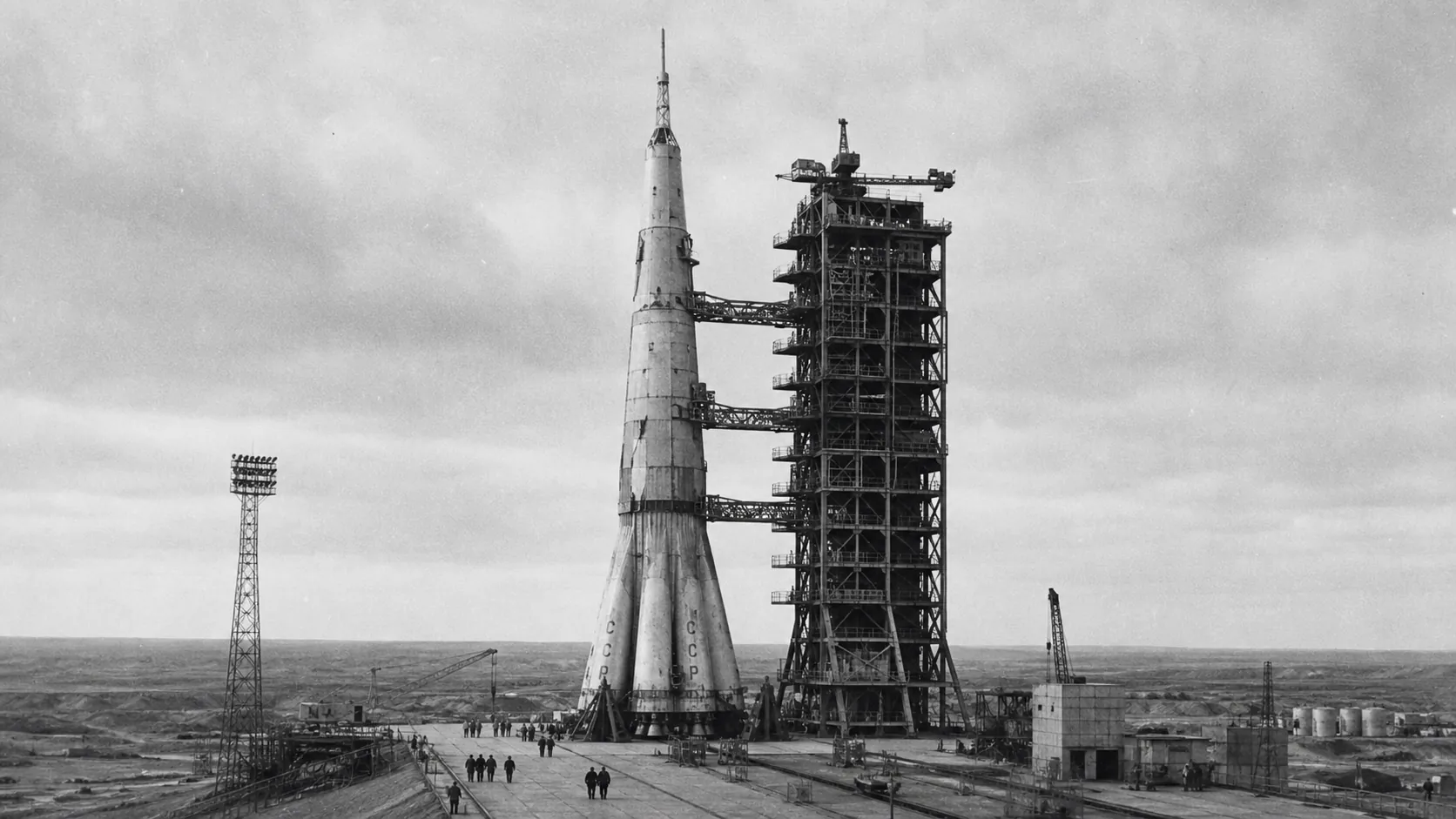
Illustration of an N1 at Baikonur. It does not document vehicle 7L's November 1972 launch.
The N1 rocket's fourth and final flight launched on November 23, 1972, and failed before first-stage separation. Vehicle 7L flew for about 107 seconds, longer than the earlier attempts, but never reached orbit.
Its anniversary is a useful point at which to separate recorded flight events from competing explanations of the failure. Getting farther into ascent was progress in a test program, not completion of a lunar-launch capability.
How far did the final N1 rocket flight get?
The flight progressed through most of the first-stage burn before the vehicle broke up. RussianSpaceWeb's account of vehicle 7L records the approximately 107-second duration and identifies the payload as an uncrewed LOK vehicle with a lunar-lander mockup. No cosmonauts were attempting a Moon landing aboard the test.
A long first-stage burn still leaves the rest of a launch unproven. The upper stages must separate and ignite correctly, guidance must place the payload on the required trajectory, and the spacecraft must carry out its own operations.
That is why the phrase nearly successful needs a defined object: nearly completing one stage's work is different from nearly completing an entire lunar expedition.
What can the failure sequence tell us?
Telemetry and recovered hardware gave investigators evidence about the loss. Interpretations of the initiating fault were disputed. Boris Chertok's Rockets and People, Volume IV is a participant's account of the program and its investigations.
It should be read with that position in mind, rather than as a view from outside the engineering disagreements.
For readers, the safest method is to keep three columns mentally separate: an observed event, the measurement behind it and the proposed cause. A pressure change is an observation.
A pump failure or a damaging transient is an explanation that must fit the sequence. Collapsing those categories can turn a debated reconstruction into a falsely certain one-sentence answer. The reference table below states only the broad sequence supported by the cited histories.
Why didn't a longer flight settle the N1's future?
The N1 program chronology records four failed launch attempts. Flight testing produces information, but a lunar program also needs enough time, money and political support to use that information in another vehicle. A result can be technically informative while still falling short of what the program needs to continue.
The Soviet rocket comparison explains where N1 sat among the country's launchers. The Glushko biography follows later leadership and Energia, while the space-program cost article explains why neat budget comparisons can mislead.
November 23 marks the last N1 launch, not a crewed lunar flight or proof that the remaining engineering work was trivial.
N1 Vehicle 7L: Evidence and Limits
A sequence for the final N1 flight. Approximate times stay approximate; the table does not choose a disputed root cause.
| Stage of account | Supported statement | Limit | Source |
|---|---|---|---|
| Liftoff | 1972-11-23, uncrewed vehicle 7L | Not a cosmonaut flight | russianspaceweb.com |
| Ascent | Progressed through most of the first-stage burn | No demonstrated orbital insertion | russianspaceweb.com |
| Loss | About 107 seconds after liftoff | Approximate duration is not a complete causal explanation | russianspaceweb.com |
| Investigation | Telemetry and hardware informed competing explanations | Distinguish evidence from participants' interpretations | nasa.gov |
| Program record | Four failed flight attempts | The final attempt was not an operational Moon mission | russianspaceweb.com |
Download the source-linked reference table (CSV). Permanent link to this table. Cite this article and the original sources listed in each row.
Frequently Asked Questions
When was the last N1 launch?
November 23, 1972. It was the fourth N1 flight attempt and used vehicle 7L.
Were cosmonauts aboard the final N1 rocket?
No. The mission was an uncrewed test flight. It did not carry a crew attempting a lunar landing.
Did any N1 rocket reach orbit?
No. All four launch attempts failed before reaching orbit. The last flight lasted about 107 seconds.
Follow the Soviet space program timeline for the missions and decisions surrounding this date, or browse more space history articles.
By Soviet Space Program. Published . Historical date: .