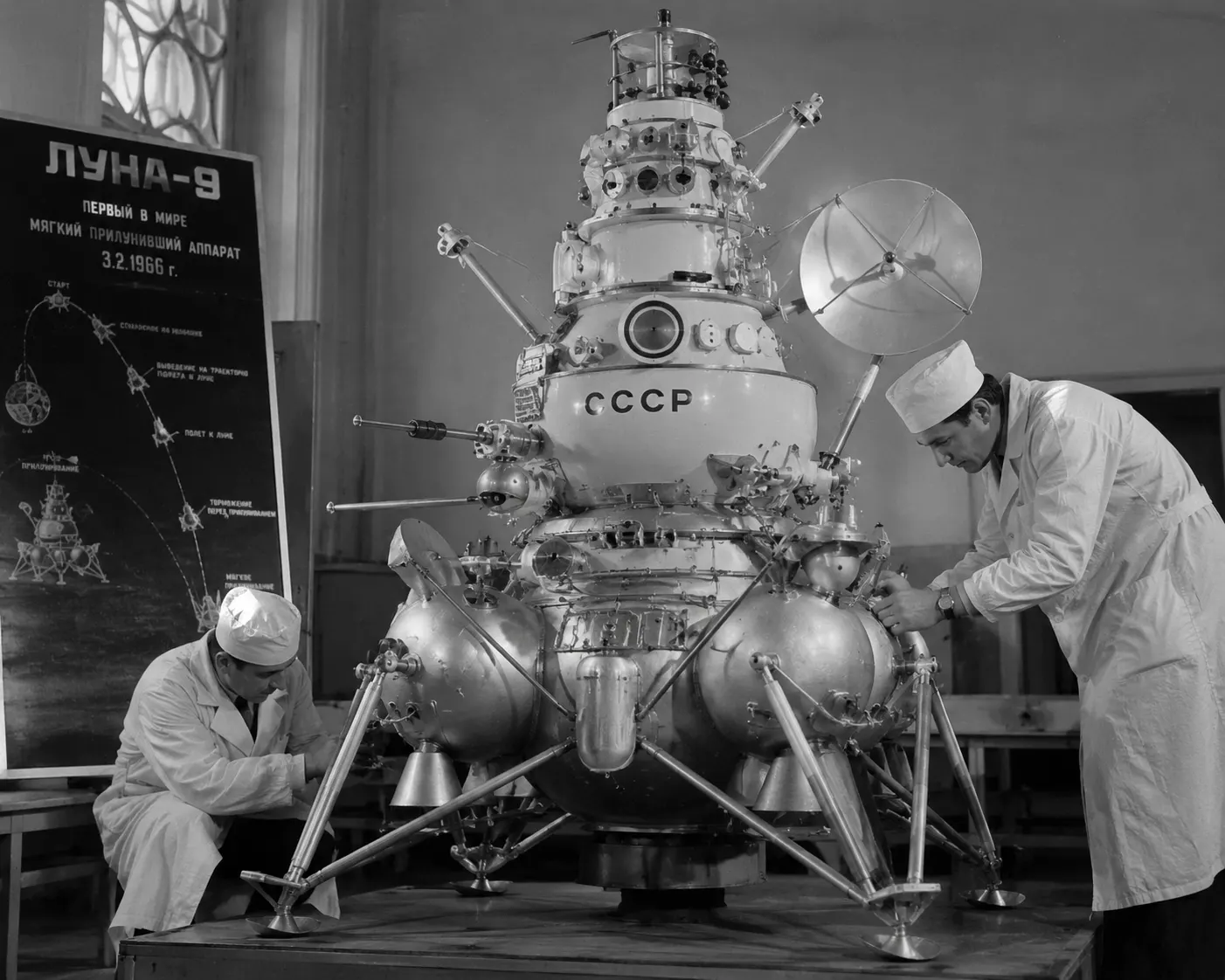
Illustration of Soviet lunar engineering. The actual Luna 17 landing site is shown in the NASA orbital image linked below.
Lunokhod 1 reached the Moon aboard Luna 17 on November 17, 1970, then drove onto the surface. It became the first robotic rover to explore another world.
The rover was guided from Earth, making its mission a joint operation between a wheeled machine on the Moon and a control team far away. Luna 17 names the delivery spacecraft; Lunokhod 1 names the rover it carried.
How did Lunokhod 1 move beyond its landing site?
A stationary lander can inspect the ground within reach of its instruments. A rover adds movement, allowing observations at several locations rather than only the touchdown point.
Lunokhod 1 used eight wheels and television views to support commands from Earth. The RAND report on the lunar surface vehicle documents the mission as it was being understood during the early rover era.
Remote control does not mean an Earth operator gets an instantaneous view through a windscreen. Images must reach the ground, people must interpret them and commands must travel back.
The vehicle's route is constrained by what operators can see and by how safely the machine can execute a command. That makes communication and judgment part of the rover system, alongside its wheels and motors.
What stayed behind when the rover drove away?
Luna 17's landing stage remained at the touchdown site. Lunokhod moved off to conduct its surface work. NASA's orbital view of the Soviet lunar landing sites shows how a later spacecraft could revisit the evidence from above.
A lander, a rover and their surface traces are distinct features, not interchangeable labels for the same object.
That distinction is useful when reading mission catalogs. A launch entry can identify Luna 17 while a scientific result is credited to Lunokhod 1.
Both can be correct because one names the delivery mission and the other names its mobile payload. The reference table below maps each part of the system to its role, including the ground team that never left Earth.
How could a silent rover still help science?
Lunokhod carried a laser retroreflector, a passive device that sends incoming light back toward its source. NASA's account of the rover's later recovery in laser-ranging observations describes renewed contact with that reflector after the rover's location was established. This was not a reboot of the rover's motors or cameras.
A passive reflector needs no functioning onboard transmitter to return a laser pulse. That makes its later use different from extending the original driving mission.
The distinction belongs in the legacy of Soviet space hardware and the technology history. For the mission's original setting, the robotic exploration overview places Lunokhod alongside sample-return landers and planetary probes.
Luna 17 and Lunokhod 1: System and Roles
A reusable guide to the names and functions in the first robotic lunar-rover mission.
| Element | Location | Role | Source |
|---|---|---|---|
| Luna 17 landing stage | Moon | Delivered the rover and remained at the landing site | science.nasa.gov |
| Lunokhod 1 rover | Moon | Moved across the surface for observations | rand.org |
| Ground operators | Earth | Interpreted imagery and commanded movement | rand.org |
| Laser retroreflector | On the rover | Returned incoming laser light without an active radio transmitter | apod.nasa.gov |
Download the source-linked reference table (CSV). Permanent link to this table. Cite this article and the original sources listed in each row.
Frequently Asked Questions
Are Luna 17 and Lunokhod 1 the same thing?
No. Luna 17 was the spacecraft that delivered the rover. Lunokhod 1 was the mobile vehicle that drove onto the lunar surface.
Did an astronaut drive Lunokhod 1 on the Moon?
No. Operators on Earth guided the robotic rover using information sent back from the Moon.
Was finding its reflector the same as restarting Lunokhod 1?
No. Laser ranging used a passive reflector. It did not restart the rover's cameras, radio or wheels.
Follow the Soviet space program timeline for the missions and decisions surrounding this date, or browse more space history articles.
By Soviet Space Program. Published . Historical date: .