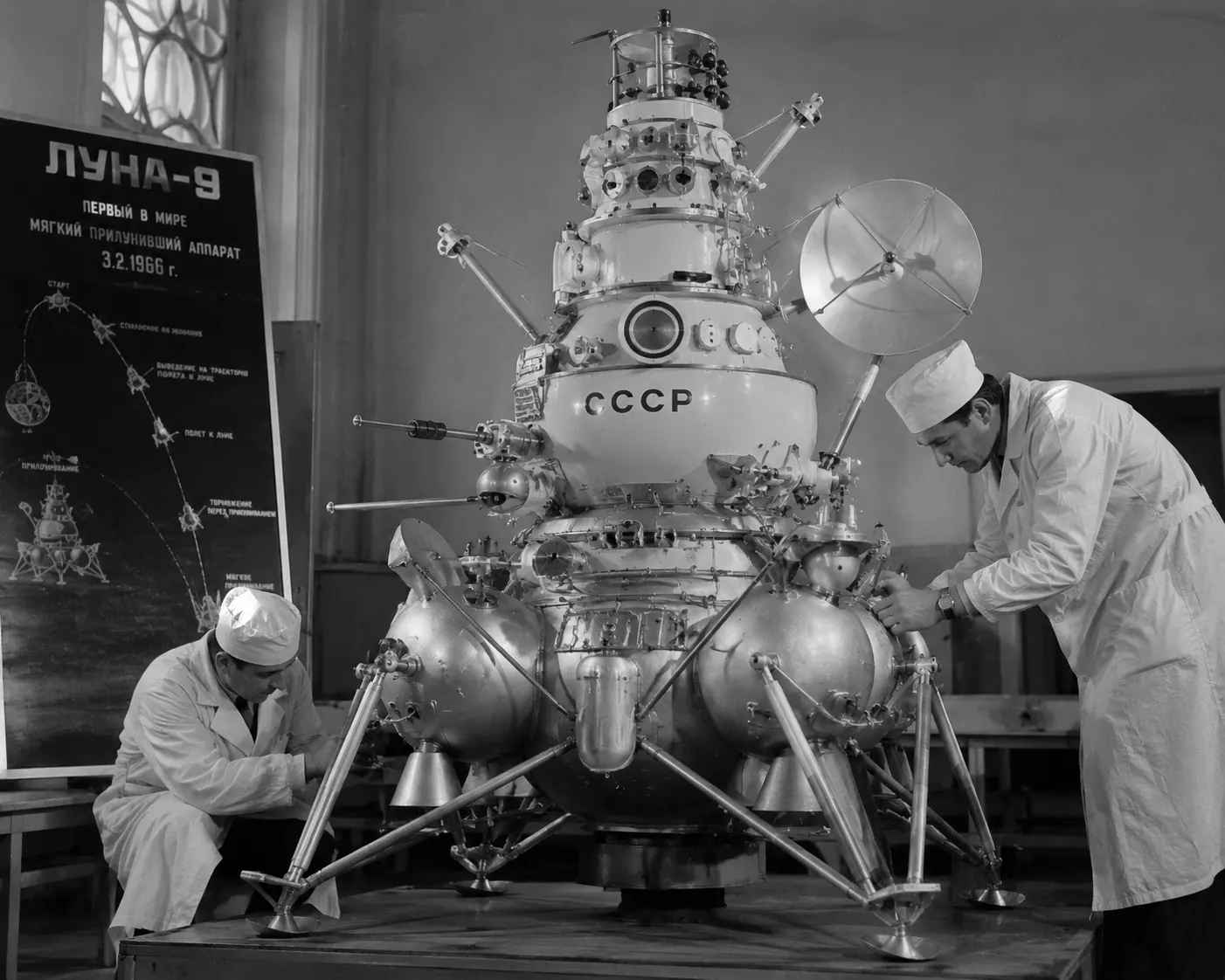
Illustration of lunar spacecraft engineering. For the actual 1959 image, follow the NASA image record cited below.
The first Luna 3 photos of the Moon's far side were taken on October 7, 1959. They were grainy, but they showed terrain that people could not see from Earth.
The Soviet spacecraft photographed the illuminated hemisphere, developed the film aboard the probe and converted the images into radio signals. The date marks the photography session, not Luna 3's launch three days earlier.
How did Luna 3 photos get back to Earth?
The process joined photography to radio engineering. A camera exposed film while the far side was visible from the spacecraft. The film then had to be processed without a laboratory worker, scanned and transmitted.
Earth received signals representing the image rather than a physical reel of film. NASA's account of the early lunar missions describes that sequence and its roughly 40-minute photographic session.
Each step imposed a separate demand. The spacecraft needed the right view for the exposure, working chemistry for the film and a radio link for the scan.
That is why a launch date, an image-capture date and a reception date should not be used interchangeably. The table below describes the stages without assigning an unsupported single timestamp to the entire transfer.
What could scientists see in the pictures?
NASA's record of the first far-side image identifies recognizable features in a noisy, low-resolution view. One broad difference stood out: the far side showed fewer of the large dark plains familiar on the Earth-facing side. The pictures changed the map. They did not have the resolution of today's lunar imagery.
The original frames and later restorations serve different purposes. A restoration can make a feature easier to see, but enlarging a blurred frame cannot recover surface detail the camera never recorded. A caption should identify which version the reader is looking at.
Why isn't it the dark side?
The Moon keeps approximately the same face toward Earth as it rotates and orbits. That makes the opposite hemisphere the far side from our viewpoint, not a hemisphere without daylight.
Luna 3 could photograph it because the terrain was sunlit during the encounter. The phrase dark side can confuse an observing problem with an illumination condition.
The Lunar and Planetary Institute's mission list places Luna 3 after the first Soviet lunar flyby and impact attempts. Read the robotic mission history for that progression, the technology guide for spacecraft communications, and the timeline for the dates of later lunar firsts.
From Lunar Light to a Picture on Earth
A source-linked process chart for the Luna 3 photography experiment. Only the launch and exposure date are assigned calendar dates here.
| Step | Date or sequence | Operation | Source |
|---|---|---|---|
| Launch | 1959-10-04 | Spacecraft begins its lunar flight | lpi.usra.edu |
| Exposure | 1959-10-07 | 29 photographs of the sunlit far side | science.nasa.gov |
| Processing | After exposure | Film developed aboard the probe | nasa.gov |
| Scanning | After processing | Photographic information converted for radio transmission | nasa.gov |
| Reception | After transmission | Signals reconstructed into images on Earth | nasa.gov |
Download the source-linked reference table (CSV). Permanent link to this table. Cite this article and the original sources listed in each row.
Frequently Asked Questions
When were the first photos of the Moon's far side taken?
Luna 3 took them on October 7, 1959. Its launch occurred on October 4, so the two anniversaries mark different events.
Was Luna 3 a digital camera spacecraft?
The images began on photographic film that was developed aboard the spacecraft. A scanning and radio system then transmitted image information to Earth.
Did Luna 3 photograph the entire far side?
No. NASA describes 29 photographs covering about 70 percent of the far side. That is a coverage estimate, not a claim that every point was recorded sharply.
Follow the Soviet space program timeline for the missions and decisions surrounding this date, or browse more space history articles.
By Soviet Space Program. Published . Historical date: .