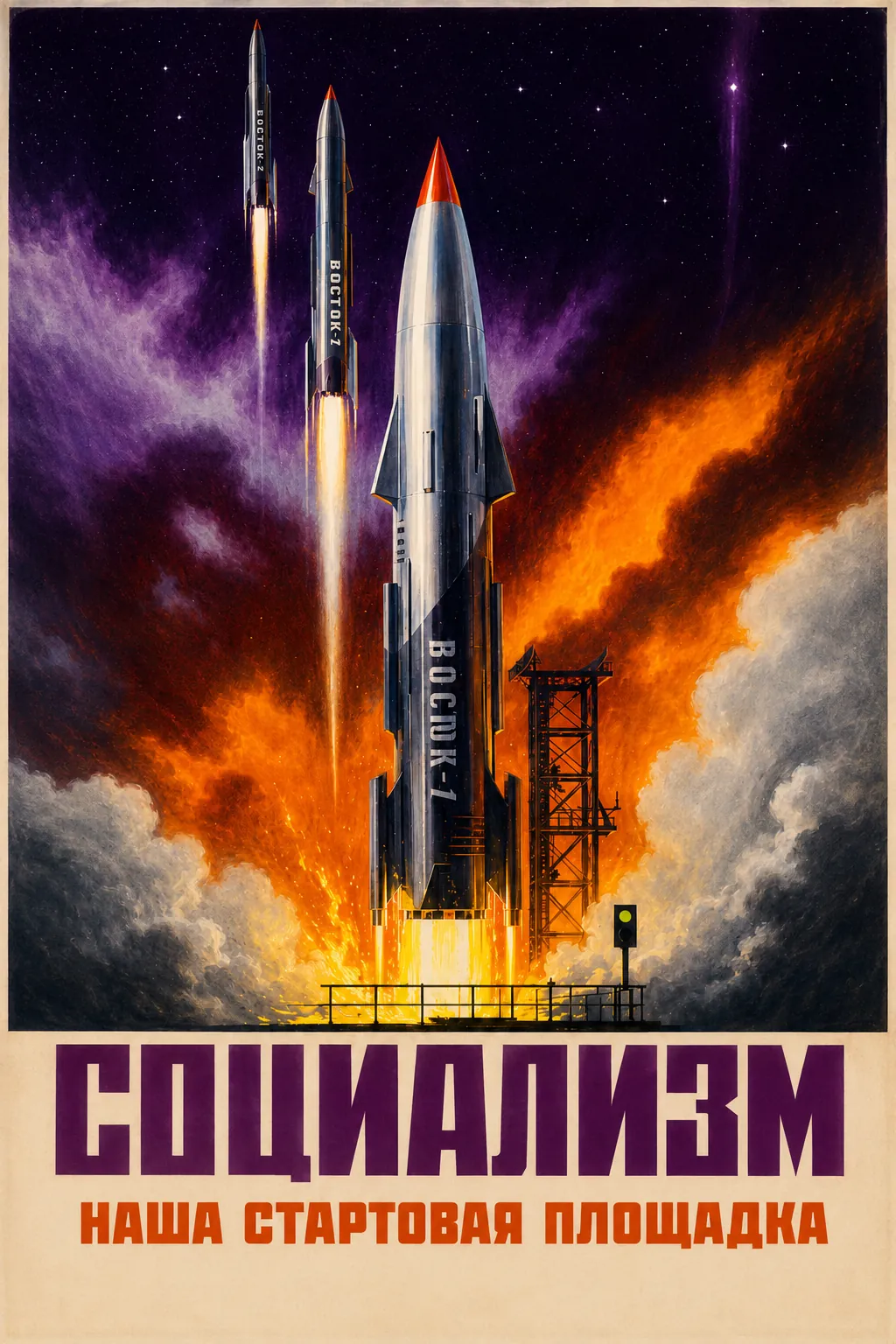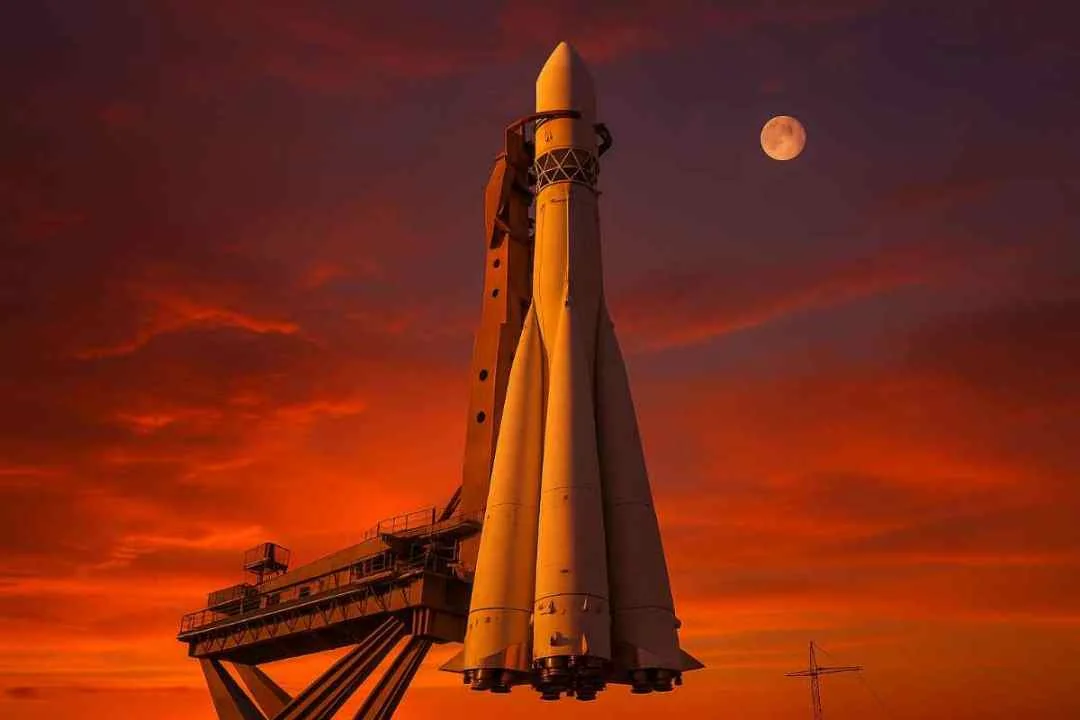
Above: an illustration of an R-7-family rocket. This is not a photograph of Cosmos 361 or its launch from Plesetsk.
Cosmos 361, also spelled Kosmos 361, launched on September 8, 1970, at 10:30 UTC. A Voskhod rocket carried it from Plesetsk into Earth orbit. Jonathan McDowell's launch catalog identifies the payload as a Zenit-4M reconnaissance satellite. Its anniversary opens a less publicized part of Soviet space history: the recurring work of photographing Earth for military intelligence.
Cosmos 361 Mission Facts
| Field | Record |
|---|---|
| Launch | September 8, 1970, 10:30 UTC |
| Launch site | Plesetsk, pad 41/1 |
| Rocket | Voskhod 11A57 |
| Spacecraft | Zenit-4M No. 6L |
| International designation | 1970-071A |
| Cataloged end of flight | September 21, 1970 |
What Did the Public Record Reveal?
NASA's contemporary satellite-data report, NASA-TM-X-67241, lists Cosmos 361 on printed page 56. Its brief description mentions scientific apparatus, orbital measurements and telemetry. It does not identify a reconnaissance camera or name the Zenit-4M design. The launch date and catalog number let us match that short public description to the later identification.
A neutral mission label shouldn't be read as a complete account of what a spacecraft did. This example is useful precisely because the two records answer different questions. The contemporary report preserves what was recorded publicly; a specialist catalog places the object in a spacecraft family.
How Did Soviet Photographic Reconnaissance Work?
Early Zenit missions brought exposed film back to Earth for processing. Engineer Boris Chertok describes that work in Rockets and People, Volume III, chapter 12. In his account of the early program, recovered film traveled under armed escort to a military intelligence laboratory. A good camera was only part of the job: the photographs still had to survive reentry, reach the analysts and be interpreted.
Chertok's account concerns the early Zenit program, not this specific 1970 flight. It explains the film-return approach without telling us what Cosmos 361 photographed. The sources linked here do not provide a target list or a set of its reconnaissance images.
The United States also developed film-return reconnaissance, covered in how America spied on the Soviet space program. Reading the two histories together gives a fuller picture than following only the missions that carried people.
The launch vehicle has its own place in that story. Voskhod belonged to the R-7 rocket family, whose descendants served many different payloads. The name on the rocket and the name of the spacecraft are separate entries in the launch record.
Frequently Asked Questions
Are Cosmos 361 and Kosmos 361 the same satellite?
Yes. They are alternative English spellings of the same Soviet designation. Both refer to the object cataloged as 1970-071A.
Did Cosmos 361 carry cosmonauts?
No. It was an uncrewed reconnaissance satellite. Voskhod in this launch record names the launch vehicle, not a crewed spacecraft on this mission.
Was September 8 the launch date or the announcement date?
September 8, 1970 was the launch date. The launch catalog records liftoff at 10:30 UTC, and NASA's contemporary report lists the same calendar date.
Follow the Soviet space program timeline for the missions and decisions surrounding this date, or browse more space history articles.
By Soviet Space Program. Published . Historical date: .